

126
7 Virtual testing approach for sandwich panel joints
p. 62). Lastly, the structural element level also enables to validate the material models
determined on constituent level. On sub-component level, the objective is to synthesize
the previous derived model parameters into the top-level virtual test. Furthermore, the
bond between adhesive and face sheet is often characterized on sub-component level
as well. This is due to the fact, that the strength of this bond is the result of the complete
configuration including reinforcement and core. Therefore, this mechanical effect often
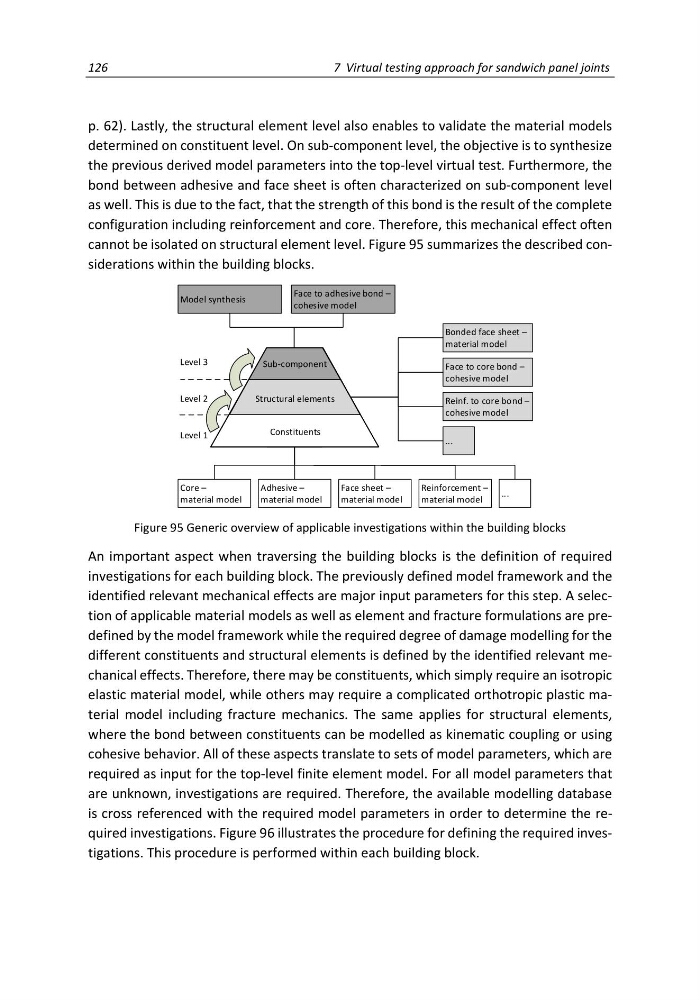
cannot be isolated on structural element level. Figure 95 summarizes the described considerations within the building blocks.
Structural elements
Constituents
Level 1
Level 2
Level 3
Core –
material model
Adhesive –
material model
Face sheet –
material model
Reinforcement –
material model
...
Bonded face sheet –
material model
Face to core bond –
cohesive model
Reinf. to core bond –
cohesive model
Model synthesis
Face to adhesive bond –
cohesive model
...
Constituents
Structural elements
Sub-component
Figure 95 Generic overview of applicable investigations within the building blocks
An important aspect when traversing the building blocks is the definition of required
investigations for each building block. The previously defined model framework and the
identified relevant mechanical effects are major input parameters for this step. A selection of applicable material models as well as element and fracture formulations are predefined by the model framework while the required degree of damage modelling for the
different constituents and structural elements is defined by the identified relevant mechanical effects. Therefore, there may be constituents, which simply require an isotropic
elastic material model, while others may require a complicated orthotropic plastic material model including fracture mechanics. The same applies for structural elements,
where the bond between constituents can be modelled as kinematic coupling or using
cohesive behavior. All of these aspects translate to sets of model parameters, which are
required as input for the top-level finite element model. For all model parameters that
are unknown, investigations are required. Therefore, the available modelling database
is cross referenced with the required model parameters in order to determine the required investigations. Figure 96 illustrates the procedure for defining the required investigations. This procedure is performed within each building block.
7 Virtual testing approach for sandwich panel joints
p. 62). Lastly, the structural element level also enables to validate the material models
determined on constituent level. On sub-component level, the objective is to synthesize
the previous derived model parameters into the top-level virtual test. Furthermore, the
bond between adhesive and face sheet is often characterized on sub-component level
as well. This is due to the fact, that the strength of this bond is the result of the complete
configuration including reinforcement and core. Therefore, this mechanical effect often
cannot be isolated on structural element level. Figure 95 summarizes the described considerations within the building blocks.
Structural elements
Constituents
Level 1
Level 2
Level 3
Core –
material model
Adhesive –
material model
Face sheet –
material model
Reinforcement –
material model
...
Bonded face sheet –
material model
Face to core bond –
cohesive model
Reinf. to core bond –
cohesive model
Model synthesis
Face to adhesive bond –
cohesive model
...
Constituents
Structural elements
Sub-component
Figure 95 Generic overview of applicable investigations within the building blocks
An important aspect when traversing the building blocks is the definition of required
investigations for each building block. The previously defined model framework and the
identified relevant mechanical effects are major input parameters for this step. A selection of applicable material models as well as element and fracture formulations are predefined by the model framework while the required degree of damage modelling for the
different constituents and structural elements is defined by the identified relevant mechanical effects. Therefore, there may be constituents, which simply require an isotropic
elastic material model, while others may require a complicated orthotropic plastic material model including fracture mechanics. The same applies for structural elements,
where the bond between constituents can be modelled as kinematic coupling or using
cohesive behavior. All of these aspects translate to sets of model parameters, which are
required as input for the top-level finite element model. For all model parameters that
are unknown, investigations are required. Therefore, the available modelling database
is cross referenced with the required model parameters in order to determine the required investigations. Figure 96 illustrates the procedure for defining the required investigations. This procedure is performed within each building block.