

5.3 Additional test methods
93
is typically determined using the double cantilever beam (DCB) test. However, in case of
sandwich structures several studies suggest that the DCB yields significant scatter, thus
limiting its quantitative value [Rat11]. In order to overcome this the single cantilever
beam (SCB) test has been proposed. This test appears most suited for a virtual testing
framework, since it provides reliable determination of G 1c . Furthermore, it can be easily
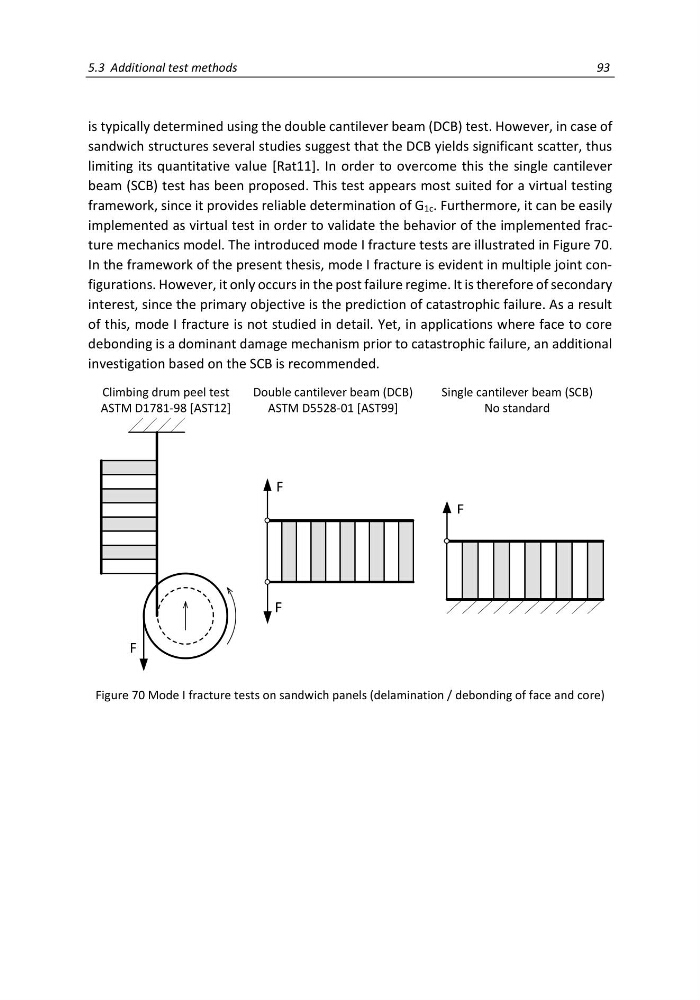
implemented as virtual test in order to validate the behavior of the implemented fracture mechanics model. The introduced mode I fracture tests are illustrated in Figure 70.
In the framework of the present thesis, mode I fracture is evident in multiple joint configurations. However, it only occurs in the post failure regime. It is therefore of secondary
interest, since the primary objective is the prediction of catastrophic failure. As a result
of this, mode I fracture is not studied in detail. Yet, in applications where face to core
debonding is a dominant damage mechanism prior to catastrophic failure, an additional
investigation based on the SCB is recommended.
Climbing drum peel test
ASTM D1781-98 [AST12]
Double cantilever beam (DCB)
ASTM D5528-01 [AST99]
Single cantilever beam (SCB)
No standard
Figure 70 Mode I fracture tests on sandwich panels (delamination / debonding of face and core)
93
is typically determined using the double cantilever beam (DCB) test. However, in case of
sandwich structures several studies suggest that the DCB yields significant scatter, thus
limiting its quantitative value [Rat11]. In order to overcome this the single cantilever
beam (SCB) test has been proposed. This test appears most suited for a virtual testing
framework, since it provides reliable determination of G 1c . Furthermore, it can be easily
implemented as virtual test in order to validate the behavior of the implemented fracture mechanics model. The introduced mode I fracture tests are illustrated in Figure 70.
In the framework of the present thesis, mode I fracture is evident in multiple joint configurations. However, it only occurs in the post failure regime. It is therefore of secondary
interest, since the primary objective is the prediction of catastrophic failure. As a result
of this, mode I fracture is not studied in detail. Yet, in applications where face to core
debonding is a dominant damage mechanism prior to catastrophic failure, an additional
investigation based on the SCB is recommended.
Climbing drum peel test
ASTM D1781-98 [AST12]
Double cantilever beam (DCB)
ASTM D5528-01 [AST99]
Single cantilever beam (SCB)
No standard
Figure 70 Mode I fracture tests on sandwich panels (delamination / debonding of face and core)