

92
5 Mechanical characterization on structural element level
and even global buckling. Therefore, it may provide a good validation basis for the compressive face sheet behavior within virtual testing frameworks. However, in the present
work the compressive face sheet behavior is of secondary interest, since the investigated
joints do not exhibit such damage mechanisms. Therefore, the characterization via bending tests is considered sufficient. The non-standardized tensile test of bonded sandwich
panels typically fails due to tensile rupture of the face sheet. Since face sheet failure in
bending tests is generally caused by compressive yield, this test may supplement flexural
tests or edgewise compression tests by providing the tensile strength of face sheets including degradation due to honeycomb bonding. However, in the framework of the present thesis, these properties are determined based on tensile tests on formerly bonded
face sheets. Therefore, this test is not further investigated.
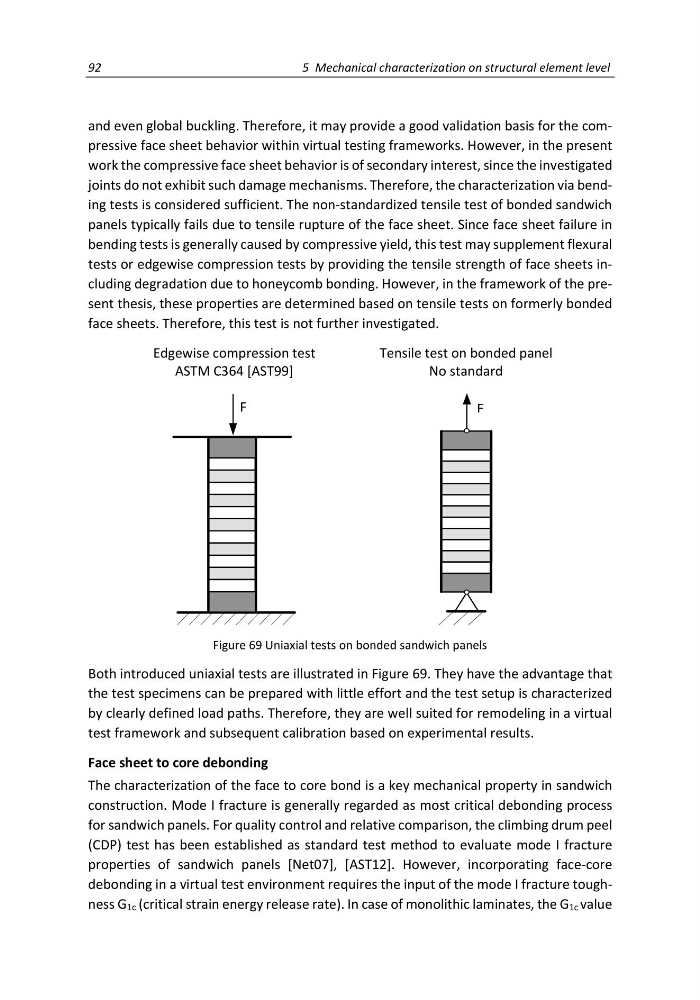
Figure 69 Uniaxial tests on bonded sandwich panels
Both introduced uniaxial tests are illustrated in Figure 69. They have the advantage that
the test specimens can be prepared with little effort and the test setup is characterized
by clearly defined load paths. Therefore, they are well suited for remodeling in a virtual
test framework and subsequent calibration based on experimental results.
Face sheet to core debonding
The characterization of the face to core bond is a key mechanical property in sandwich
construction. Mode I fracture is generally regarded as most critical debonding process
for sandwich panels. For quality control and relative comparison, the climbing drum peel
(CDP) test has been established as standard test method to evaluate mode I fracture
properties of sandwich panels [Net07], [AST12]. However, incorporating face-core
debonding in a virtual test environment requires the input of the mode I fracture toughness G 1c (critical strain energy release rate). In case of monolithic laminates, the G 1c value
Edgewise compression test
ASTM C364 [AST99]
Tensile test on bonded panel
No standard
5 Mechanical characterization on structural element level
and even global buckling. Therefore, it may provide a good validation basis for the compressive face sheet behavior within virtual testing frameworks. However, in the present
work the compressive face sheet behavior is of secondary interest, since the investigated
joints do not exhibit such damage mechanisms. Therefore, the characterization via bending tests is considered sufficient. The non-standardized tensile test of bonded sandwich
panels typically fails due to tensile rupture of the face sheet. Since face sheet failure in
bending tests is generally caused by compressive yield, this test may supplement flexural
tests or edgewise compression tests by providing the tensile strength of face sheets including degradation due to honeycomb bonding. However, in the framework of the present thesis, these properties are determined based on tensile tests on formerly bonded
face sheets. Therefore, this test is not further investigated.
Figure 69 Uniaxial tests on bonded sandwich panels
Both introduced uniaxial tests are illustrated in Figure 69. They have the advantage that
the test specimens can be prepared with little effort and the test setup is characterized
by clearly defined load paths. Therefore, they are well suited for remodeling in a virtual
test framework and subsequent calibration based on experimental results.
Face sheet to core debonding
The characterization of the face to core bond is a key mechanical property in sandwich
construction. Mode I fracture is generally regarded as most critical debonding process
for sandwich panels. For quality control and relative comparison, the climbing drum peel
(CDP) test has been established as standard test method to evaluate mode I fracture
properties of sandwich panels [Net07], [AST12]. However, incorporating face-core
debonding in a virtual test environment requires the input of the mode I fracture toughness G 1c (critical strain energy release rate). In case of monolithic laminates, the G 1c value
Edgewise compression test
ASTM C364 [AST99]
Tensile test on bonded panel
No standard