

90
5 Mechanical characterization on structural element level
axial face sheet properties are adopted from the bending study as well as the tensile face
sheet tests described in section 4.2. The same applies for numerical parameters such as
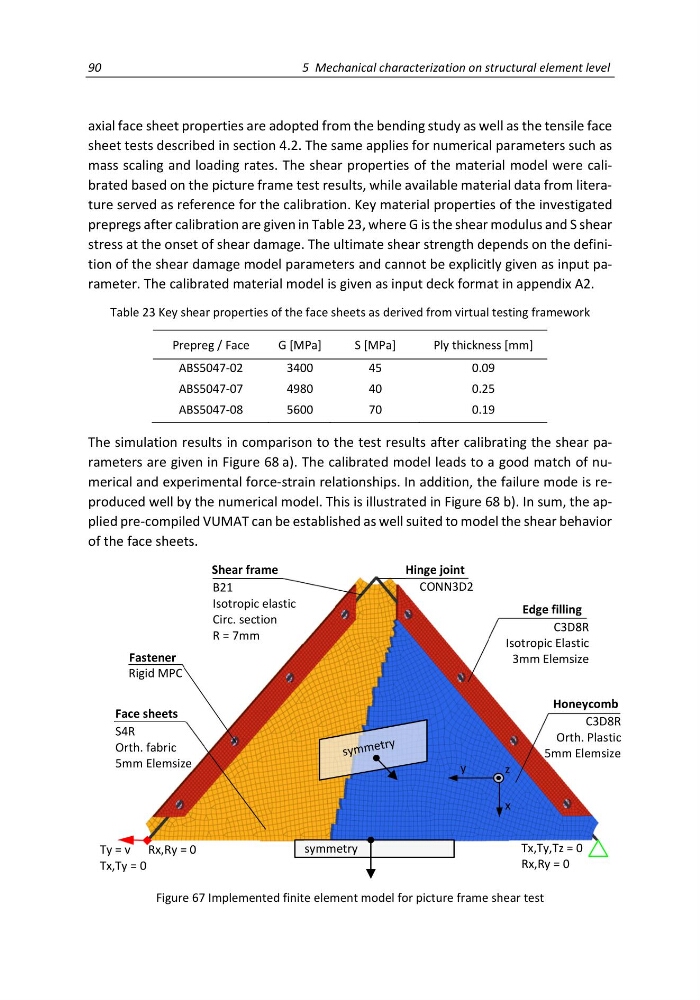
mass scaling and loading rates. The shear properties of the material model were calibrated based on the picture frame test results, while available material data from literature served as reference for the calibration. Key material properties of the investigated
prepregs after calibration are given in Table 23, where G is the shear modulus and S shear
stress at the onset of shear damage. The ultimate shear strength depends on the definition of the shear damage model parameters and cannot be explicitly given as input parameter. The calibrated material model is given as input deck format in appendix A2.
Table 23 Key shear properties of the face sheets as derived from virtual testing framework
Prepreg / Face
G [MPa]
S [MPa]
Ply thickness [mm]
ABS5047-02
3400
45
0.09
ABS5047-07
4980
40
0.25
ABS5047-08
5600
70
0.19
The simulation results in comparison to the test results after calibrating the shear parameters are given in Figure 68 a). The calibrated model leads to a good match of numerical and experimental force-strain relationships. In addition, the failure mode is reproduced well by the numerical model. This is illustrated in Figure 68 b). In sum, the applied pre-compiled VUMAT can be established as well suited to model the shear behavior
of the face sheets.
Figure 67 Implemented finite element model for picture frame shear test
symmetry
Tx,Ty,Tz = 0
Rx,Ry = 0
Ty = v Rx,Ry = 0
Tx,Ty = 0
Face sheets
S4R
Orth. fabric
5mm Elemsize
Honeycomb
C3D8R
Orth. Plastic
5mm Elemsize
Shear frame
B21
Isotropic elastic
Circ. section
R = 7mm
Edge filling
C3D8R
Isotropic Elastic
3mm Elemsize
y
x
z
Hinge joint
CONN3D2
Fastener
Rigid MPC
5 Mechanical characterization on structural element level
axial face sheet properties are adopted from the bending study as well as the tensile face
sheet tests described in section 4.2. The same applies for numerical parameters such as
mass scaling and loading rates. The shear properties of the material model were calibrated based on the picture frame test results, while available material data from literature served as reference for the calibration. Key material properties of the investigated
prepregs after calibration are given in Table 23, where G is the shear modulus and S shear
stress at the onset of shear damage. The ultimate shear strength depends on the definition of the shear damage model parameters and cannot be explicitly given as input parameter. The calibrated material model is given as input deck format in appendix A2.
Table 23 Key shear properties of the face sheets as derived from virtual testing framework
Prepreg / Face
G [MPa]
S [MPa]
Ply thickness [mm]
ABS5047-02
3400
45
0.09
ABS5047-07
4980
40
0.25
ABS5047-08
5600
70
0.19
The simulation results in comparison to the test results after calibrating the shear parameters are given in Figure 68 a). The calibrated model leads to a good match of numerical and experimental force-strain relationships. In addition, the failure mode is reproduced well by the numerical model. This is illustrated in Figure 68 b). In sum, the applied pre-compiled VUMAT can be established as well suited to model the shear behavior
of the face sheets.
Figure 67 Implemented finite element model for picture frame shear test
symmetry
Tx,Ty,Tz = 0
Rx,Ry = 0
Ty = v Rx,Ry = 0
Tx,Ty = 0
Face sheets
S4R
Orth. fabric
5mm Elemsize
Honeycomb
C3D8R
Orth. Plastic
5mm Elemsize
Shear frame
B21
Isotropic elastic
Circ. section
R = 7mm
Edge filling
C3D8R
Isotropic Elastic
3mm Elemsize
y
x
z
Hinge joint
CONN3D2
Fastener
Rigid MPC