

80
3 Continuum Mechanics and Nonlinear Elasticity
in the plane of the disk (with u 3 = ∂/∂X 3 = 0). With Eqs. (3.50), the spatial
derivatives of the displacement components u i = x i − X i are
∂u 1
∂X 1
= cos θ − 1
∂u 2
∂X 2
= cos θ − 1
∂u 1
∂X 2
= − sin θ
∂u 2
∂X 1
= sin θ.
Combining these relations and neglecting the nonlinear terms yield the linear strain
components
11 =
∂u 1
∂X 1
= cos θ − 1
22 =
∂u 2
∂X 2
= cos θ − 1
12 = 21 =
1
2
∂u 1
∂X 2
+
∂u 2
∂X 1
= 0.
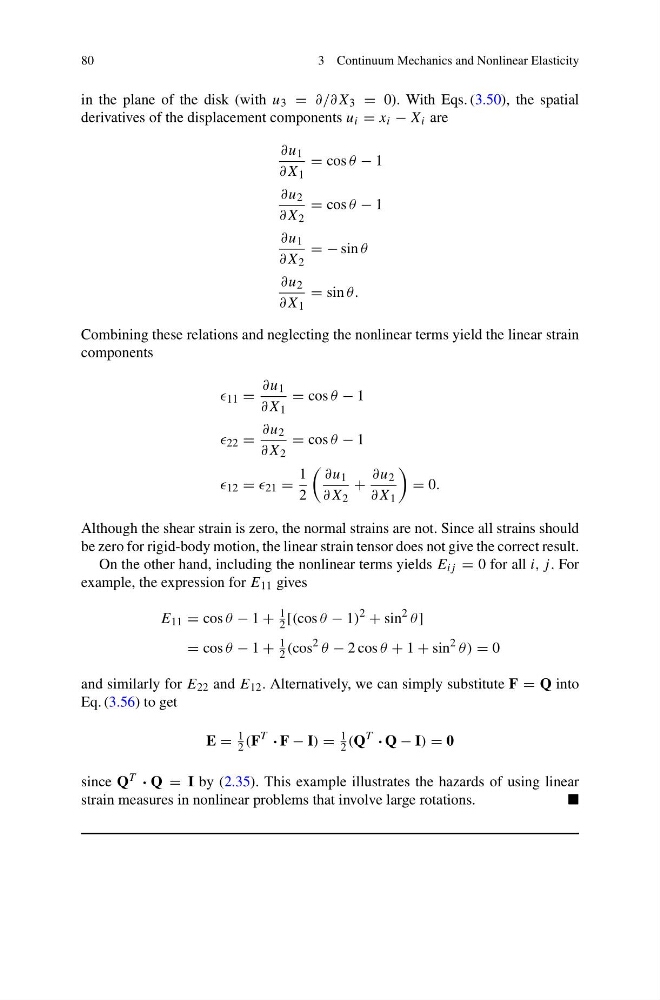
Although the shear strain is zero, the normal strains are not. Since all strains should
be zero for rigid-body motion, the linear strain tensor does not give the correct result.
On the other hand, including the nonlinear terms yields E ij = 0 for all i, j . For
example, the expression for E 11 gives
E 11 = cos θ − 1 +
1
2 [(cos θ − 1)
2
+ sin
2 θ ]
= cos θ − 1 +
1
2 (cos
2 θ − 2 cos θ + 1 + sin
2 θ) = 0
and similarly for E 22 and E 12 . Alternatively, we can simply substitute F = Q into
Eq. (3.56) to get
E =
1
2 (F
T
· F − I) =
1
2 (Q
T
· Q − I) = 0
since Q T · Q = I by (2.35). This example illustrates the hazards of using linear
strain measures in nonlinear problems that involve large rotations.
3 Continuum Mechanics and Nonlinear Elasticity
in the plane of the disk (with u 3 = ∂/∂X 3 = 0). With Eqs. (3.50), the spatial
derivatives of the displacement components u i = x i − X i are
∂u 1
∂X 1
= cos θ − 1
∂u 2
∂X 2
= cos θ − 1
∂u 1
∂X 2
= − sin θ
∂u 2
∂X 1
= sin θ.
Combining these relations and neglecting the nonlinear terms yield the linear strain
components
11 =
∂u 1
∂X 1
= cos θ − 1
22 =
∂u 2
∂X 2
= cos θ − 1
12 = 21 =
1
2
∂u 1
∂X 2
+
∂u 2
∂X 1
= 0.
Although the shear strain is zero, the normal strains are not. Since all strains should
be zero for rigid-body motion, the linear strain tensor does not give the correct result.
On the other hand, including the nonlinear terms yields E ij = 0 for all i, j . For
example, the expression for E 11 gives
E 11 = cos θ − 1 +
1
2 [(cos θ − 1)
2
+ sin
2 θ ]
= cos θ − 1 +
1
2 (cos
2 θ − 2 cos θ + 1 + sin
2 θ) = 0
and similarly for E 22 and E 12 . Alternatively, we can simply substitute F = Q into
Eq. (3.56) to get
E =
1
2 (F
T
· F − I) =
1
2 (Q
T
· Q − I) = 0
since Q T · Q = I by (2.35). This example illustrates the hazards of using linear
strain measures in nonlinear problems that involve large rotations.