

3.3 Analysis of Deformation
79
E ij =
1
2 (F ki F kj − δ ij ).
(3.59)
In Cartesian coordinates, the components of F in terms of displacements are
given by Eq. (3.49). Substitution into (3.59) yields
E ij =
1
2
δ ki +
∂u k
∂X i
δ kj +
∂u k
∂X j
− δ ij
=
1
2
δ ki
δ kj +
∂u k
∂X j
+
∂u k
∂X i
δ kj +
∂u k
∂X j
− δ ij
=
1
2
δ ij +
∂u i
∂X j
+
∂u j
∂X i
+
∂u k
∂X i
∂u k
∂X j
− δ ij
or
E ij =
1
2
∂u i
∂X j
+
∂u j
∂X i
+
∂u k
∂X i
∂u k
∂X j
.
(3.60)
If we set u 1 = u x , u 2 = u y , u 3 = ∂/∂X 3 = 0, X 1 = X, and X 2 = Y , this equation
yields the 2D strain components given by Eqs. (3.36), (3.37) 2 , and (3.41).
Lagrangian strains characterize the deformation of a rectangular element with
sides that are parallel to the coordinate planes before deformation. After deformation, the element geometry is, in general, no longer aligned with the coordinate axes.
Example 3.12 In Example 3.10, we showed that the deformation gradient tensor
for rigid-body rotation of a disk is equal to the rotation tensor Q. Using results from
that example, compute the linear and nonlinear (Lagrangian) strain tensors for that
problem.
Solution
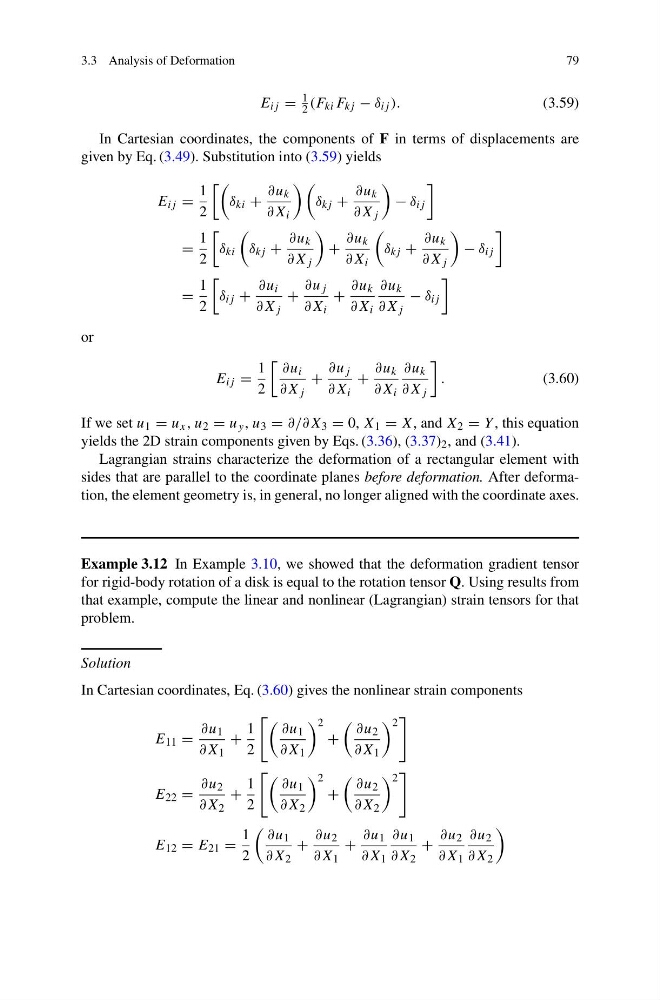
In Cartesian coordinates, Eq. (3.60) gives the nonlinear strain components
E 11 =
∂u 1
∂X 1
+
1
2
∂u 1
∂X 1
2
+
∂u 2
∂X 1
2
E 22 =
∂u 2
∂X 2
+
1
2
∂u 1
∂X 2
2
+
∂u 2
∂X 2
2
E 12 = E 21 =
1
2
∂u 1
∂X 2
+
∂u 2
∂X 1
+
∂u 1
∂X 1
∂u 1
∂X 2
+
∂u 2
∂X 1
∂u 2
∂X 2
79
E ij =
1
2 (F ki F kj − δ ij ).
(3.59)
In Cartesian coordinates, the components of F in terms of displacements are
given by Eq. (3.49). Substitution into (3.59) yields
E ij =
1
2
δ ki +
∂u k
∂X i
δ kj +
∂u k
∂X j
− δ ij
=
1
2
δ ki
δ kj +
∂u k
∂X j
+
∂u k
∂X i
δ kj +
∂u k
∂X j
− δ ij
=
1
2
δ ij +
∂u i
∂X j
+
∂u j
∂X i
+
∂u k
∂X i
∂u k
∂X j
− δ ij
or
E ij =
1
2
∂u i
∂X j
+
∂u j
∂X i
+
∂u k
∂X i
∂u k
∂X j
.
(3.60)
If we set u 1 = u x , u 2 = u y , u 3 = ∂/∂X 3 = 0, X 1 = X, and X 2 = Y , this equation
yields the 2D strain components given by Eqs. (3.36), (3.37) 2 , and (3.41).
Lagrangian strains characterize the deformation of a rectangular element with
sides that are parallel to the coordinate planes before deformation. After deformation, the element geometry is, in general, no longer aligned with the coordinate axes.
Example 3.12 In Example 3.10, we showed that the deformation gradient tensor
for rigid-body rotation of a disk is equal to the rotation tensor Q. Using results from
that example, compute the linear and nonlinear (Lagrangian) strain tensors for that
problem.
Solution
In Cartesian coordinates, Eq. (3.60) gives the nonlinear strain components
E 11 =
∂u 1
∂X 1
+
1
2
∂u 1
∂X 1
2
+
∂u 2
∂X 1
2
E 22 =
∂u 2
∂X 2
+
1
2
∂u 1
∂X 2
2
+
∂u 2
∂X 2
2
E 12 = E 21 =
1
2
∂u 1
∂X 2
+
∂u 2
∂X 1
+
∂u 1
∂X 1
∂u 1
∂X 2
+
∂u 2
∂X 1
∂u 2
∂X 2