

3.3 Analysis of Deformation
77
F 1
dR
dr 1
B
b 1
dr 2
b 2
F 2
F
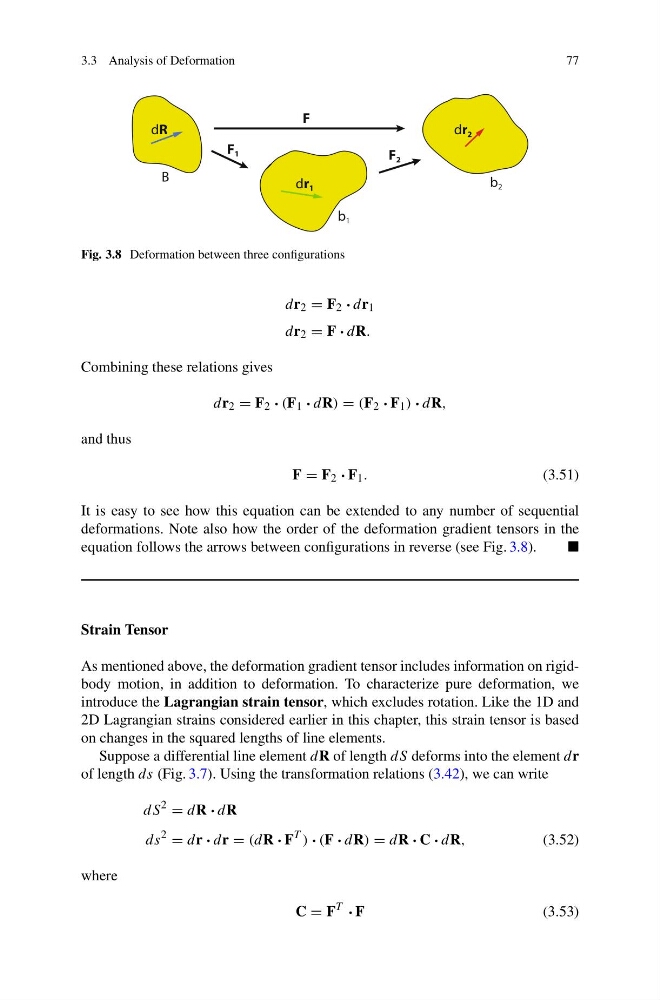
Fig. 3.8 Deformation between three configurations
dr 2 = F 2 · dr 1
dr 2 = F · dR.
Combining these relations gives
dr 2 = F 2 · (F 1 · dR) = (F 2 · F 1 ) · dR,
and thus
F = F 2 · F 1 .
(3.51)
It is easy to see how this equation can be extended to any number of sequential
deformations. Note also how the order of the deformation gradient tensors in the
equation follows the arrows between configurations in reverse (see Fig. 3.8).
Strain Tensor
As mentioned above, the deformation gradient tensor includes information on rigidbody motion, in addition to deformation. To characterize pure deformation, we
introduce the Lagrangian strain tensor, which excludes rotation. Like the 1D and
2D Lagrangian strains considered earlier in this chapter, this strain tensor is based
on changes in the squared lengths of line elements.
Suppose a differential line element dR of length dS deforms into the element dr
of length ds (Fig. 3.7). Using the transformation relations (3.42), we can write
dS
2
= dR · dR
ds
2
= dr · dr = (dR · F
T ) · (F · dR) = dR · C · dR,
(3.52)
where
C = F
T
· F
(3.53)
77
F 1
dR
dr 1
B
b 1
dr 2
b 2
F 2
F
Fig. 3.8 Deformation between three configurations
dr 2 = F 2 · dr 1
dr 2 = F · dR.
Combining these relations gives
dr 2 = F 2 · (F 1 · dR) = (F 2 · F 1 ) · dR,
and thus
F = F 2 · F 1 .
(3.51)
It is easy to see how this equation can be extended to any number of sequential
deformations. Note also how the order of the deformation gradient tensors in the
equation follows the arrows between configurations in reverse (see Fig. 3.8).
Strain Tensor
As mentioned above, the deformation gradient tensor includes information on rigidbody motion, in addition to deformation. To characterize pure deformation, we
introduce the Lagrangian strain tensor, which excludes rotation. Like the 1D and
2D Lagrangian strains considered earlier in this chapter, this strain tensor is based
on changes in the squared lengths of line elements.
Suppose a differential line element dR of length dS deforms into the element dr
of length ds (Fig. 3.7). Using the transformation relations (3.42), we can write
dS
2
= dR · dR
ds
2
= dr · dr = (dR · F
T ) · (F · dR) = dR · C · dR,
(3.52)
where
C = F
T
· F
(3.53)