

72
3 Continuum Mechanics and Nonlinear Elasticity
e
x =
1
λ x
1 +
∂u x
∂X
e x +
∂u y
∂X
e y
e
y =
1
λ y
∂u x
∂Y
e x +
1 +
∂u y
∂Y
e y
,
(3.39)
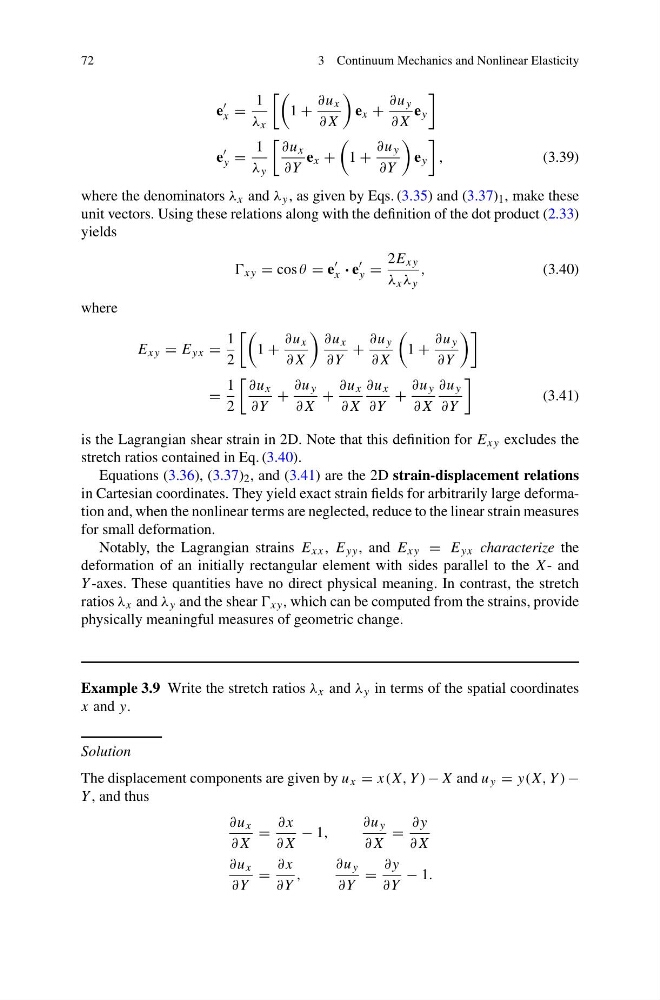
where the denominators λ x and λ y , as given by Eqs. (3.35) and (3.37) 1 , make these
unit vectors. Using these relations along with the definition of the dot product (2.33)
yields
xy = cos θ = e
x · e
y =
2E xy
λ x λ y
,
(3.40)
where
E xy = E yx =
1
2
1 +
∂u x
∂X
∂u x
∂Y
+
∂u y
∂X
1 +
∂u y
∂Y
=
1
2
∂u x
∂Y
+
∂u y
∂X
+
∂u x
∂X
∂u x
∂Y
+
∂u y
∂X
∂u y
∂Y
(3.41)
is the Lagrangian shear strain in 2D. Note that this definition for E xy excludes the
stretch ratios contained in Eq. (3.40).
Equations (3.36), (3.37) 2 , and (3.41) are the 2D strain-displacement relations
in Cartesian coordinates. They yield exact strain fields for arbitrarily large deformation and, when the nonlinear terms are neglected, reduce to the linear strain measures
for small deformation.
Notably, the Lagrangian strains E xx , E yy , and E xy = E yx characterize the
deformation of an initially rectangular element with sides parallel to the X- and
Y -axes. These quantities have no direct physical meaning. In contrast, the stretch
ratios λ x and λ y and the shear xy , which can be computed from the strains, provide
physically meaningful measures of geometric change.
Example 3.9 Write the stretch ratios λ x and λ y in terms of the spatial coordinates
x and y.
Solution
The displacement components are given by u x = x(X, Y ) − X and u y = y(X, Y ) −
Y , and thus
∂u x
∂X
=
∂x
∂X
− 1,
∂u y
∂X
=
∂y
∂X
∂u x
∂Y
=
∂x
∂Y
,
∂u y
∂Y
=
∂y
∂Y
− 1.
3 Continuum Mechanics and Nonlinear Elasticity
e
x =
1
λ x
1 +
∂u x
∂X
e x +
∂u y
∂X
e y
e
y =
1
λ y
∂u x
∂Y
e x +
1 +
∂u y
∂Y
e y
,
(3.39)
where the denominators λ x and λ y , as given by Eqs. (3.35) and (3.37) 1 , make these
unit vectors. Using these relations along with the definition of the dot product (2.33)
yields
xy = cos θ = e
x · e
y =
2E xy
λ x λ y
,
(3.40)
where
E xy = E yx =
1
2
1 +
∂u x
∂X
∂u x
∂Y
+
∂u y
∂X
1 +
∂u y
∂Y
=
1
2
∂u x
∂Y
+
∂u y
∂X
+
∂u x
∂X
∂u x
∂Y
+
∂u y
∂X
∂u y
∂Y
(3.41)
is the Lagrangian shear strain in 2D. Note that this definition for E xy excludes the
stretch ratios contained in Eq. (3.40).
Equations (3.36), (3.37) 2 , and (3.41) are the 2D strain-displacement relations
in Cartesian coordinates. They yield exact strain fields for arbitrarily large deformation and, when the nonlinear terms are neglected, reduce to the linear strain measures
for small deformation.
Notably, the Lagrangian strains E xx , E yy , and E xy = E yx characterize the
deformation of an initially rectangular element with sides parallel to the X- and
Y -axes. These quantities have no direct physical meaning. In contrast, the stretch
ratios λ x and λ y and the shear xy , which can be computed from the strains, provide
physically meaningful measures of geometric change.
Example 3.9 Write the stretch ratios λ x and λ y in terms of the spatial coordinates
x and y.
Solution
The displacement components are given by u x = x(X, Y ) − X and u y = y(X, Y ) −
Y , and thus
∂u x
∂X
=
∂x
∂X
− 1,
∂u y
∂X
=
∂y
∂X
∂u x
∂Y
=
∂x
∂Y
,
∂u y
∂Y
=
∂y
∂Y
− 1.