

2.6 Vector and Tensor Calculus
45
Table 2.7 Gradient formulas
∇(φψ) = (∇φ)ψ + φ(∇ψ)
∇(φa) = (∇φ)a + φ(∇a)
∇(a · b) = (∇a) · b + (∇b) · a
∇(ab) = (∇a)b + (a∇) T b
∇(T · a) = (∇T) · a + (∇a) · T T
∇r = I
∇(r · r) = 2r
Table 2.8 Divergence
formulas
∇ · a = tr ∇a
∇ · (φa) = (∇φ) · a + φ(∇ · a)
∇ · (ab) = (∇ · a)b + a · (∇b)
∇ · (T · a) = (∇ · T) · a + T : ∇a
∇ · (a × b) = (∇ × a) · b − a · (∇ × b)
∇ · (∇ × a) = 0
∇ · r = 3
Table 2.9 Curl formulas
∇ × (φa) = (∇φ) × a + φ(∇ × a)
∇ × (ab) = (∇ × a)b − a × (∇b)
∇ × (a × b) = a(∇ · b) + b · (∇a) − a · (∇b) − b(∇ · a)
∇ × (∇ × a) = ∇(∇ · a) − ∇ 2 a
∇ × (∇φ) = 0
∇ × r = 0
With this background, the gradient (“del”) operator ∇ is defined by
dφ = dr · ∇φ,
(2.65)
where dφ is the infinitesimal change of the scalar φ in the direction of dr. For
φ = φ(r), this expression is consistent with Eq. (2.56) if we set a = r and ∂/∂a =
∂/∂r = ∇. Then, Eqs. (2.58) 1 and (2.63) yield
∇ ≡
∂
∂r
= e i
∂
∂s i
.
(2.66)
In general, we can treat the gradient operator as a vector. Once we know the form of
∇ for a particular coordinate system, we can compute the Laplacian operator ∇ 2 =
∇ · ∇, as well as the gradient, divergence, and curl from their standard definitions:
Gradient:
∇φ
Divergence: ∇ · a
Curl:
∇ × a.
(2.67)
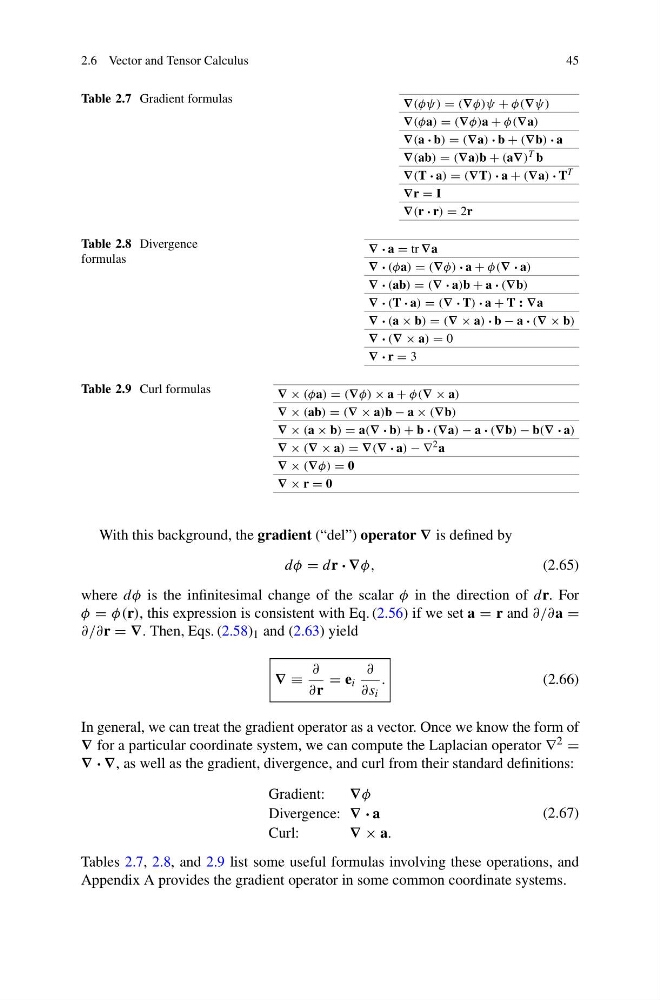
Tables 2.7, 2.8, and 2.9 list some useful formulas involving these operations, and
Appendix A provides the gradient operator in some common coordinate systems.
45
Table 2.7 Gradient formulas
∇(φψ) = (∇φ)ψ + φ(∇ψ)
∇(φa) = (∇φ)a + φ(∇a)
∇(a · b) = (∇a) · b + (∇b) · a
∇(ab) = (∇a)b + (a∇) T b
∇(T · a) = (∇T) · a + (∇a) · T T
∇r = I
∇(r · r) = 2r
Table 2.8 Divergence
formulas
∇ · a = tr ∇a
∇ · (φa) = (∇φ) · a + φ(∇ · a)
∇ · (ab) = (∇ · a)b + a · (∇b)
∇ · (T · a) = (∇ · T) · a + T : ∇a
∇ · (a × b) = (∇ × a) · b − a · (∇ × b)
∇ · (∇ × a) = 0
∇ · r = 3
Table 2.9 Curl formulas
∇ × (φa) = (∇φ) × a + φ(∇ × a)
∇ × (ab) = (∇ × a)b − a × (∇b)
∇ × (a × b) = a(∇ · b) + b · (∇a) − a · (∇b) − b(∇ · a)
∇ × (∇ × a) = ∇(∇ · a) − ∇ 2 a
∇ × (∇φ) = 0
∇ × r = 0
With this background, the gradient (“del”) operator ∇ is defined by
dφ = dr · ∇φ,
(2.65)
where dφ is the infinitesimal change of the scalar φ in the direction of dr. For
φ = φ(r), this expression is consistent with Eq. (2.56) if we set a = r and ∂/∂a =
∂/∂r = ∇. Then, Eqs. (2.58) 1 and (2.63) yield
∇ ≡
∂
∂r
= e i
∂
∂s i
.
(2.66)
In general, we can treat the gradient operator as a vector. Once we know the form of
∇ for a particular coordinate system, we can compute the Laplacian operator ∇ 2 =
∇ · ∇, as well as the gradient, divergence, and curl from their standard definitions:
Gradient:
∇φ
Divergence: ∇ · a
Curl:
∇ × a.
(2.67)
Tables 2.7, 2.8, and 2.9 list some useful formulas involving these operations, and
Appendix A provides the gradient operator in some common coordinate systems.