

44
2 Vector and Tensor Analysis
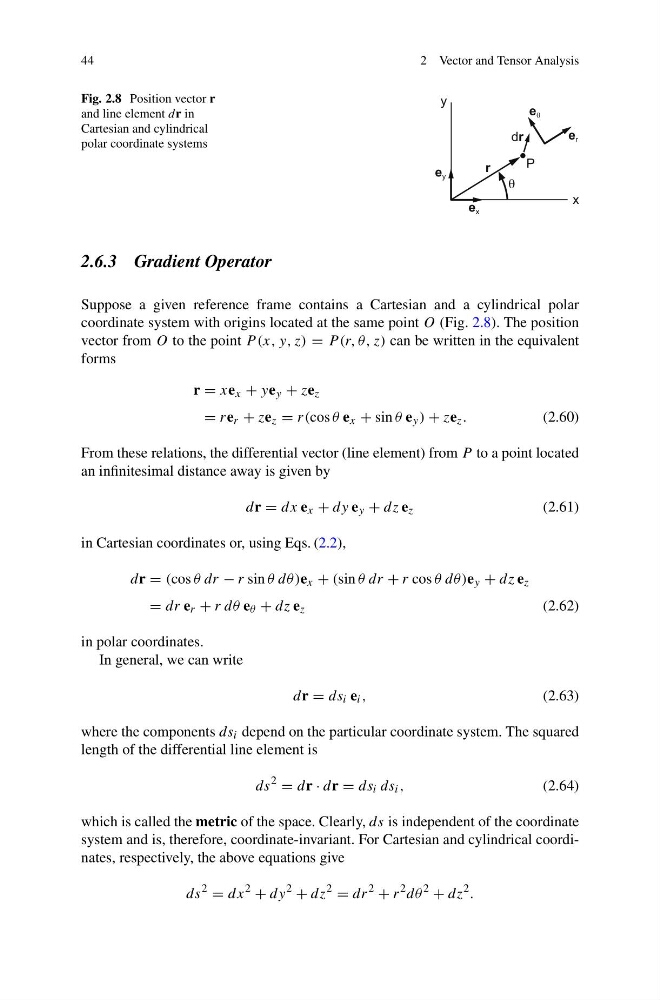
Fig. 2.8 Position vector r
and line element dr in
Cartesian and cylindrical
polar coordinate systems
T
dr
r
P
y
x
e x
e y
e r
e T
2.6.3 Gradient Operator
Suppose a given reference frame contains a Cartesian and a cylindrical polar
coordinate system with origins located at the same point O (Fig. 2.8). The position
vector from O to the point P (x, y, z) = P (r, θ, z) can be written in the equivalent
forms
r = xe x + ye y + ze z
= re r + ze z = r(cos θ e x + sin θ e y ) + ze z .
(2.60)
From these relations, the differential vector (line element) from P to a point located
an infinitesimal distance away is given by
dr = dx e x + dy e y + dz e z
(2.61)
in Cartesian coordinates or, using Eqs. (2.2),
dr = (cos θ dr − r sin θ dθ)e x + (sin θ dr + r cos θ dθ)e y + dz e z
= dr e r + r dθ e θ + dz e z
(2.62)
in polar coordinates.
In general, we can write
dr = ds i e i ,
(2.63)
where the components ds i depend on the particular coordinate system. The squared
length of the differential line element is
ds
2
= dr · dr = ds i ds i ,
(2.64)
which is called the metric of the space. Clearly, ds is independent of the coordinate
system and is, therefore, coordinate-invariant. For Cartesian and cylindrical coordinates, respectively, the above equations give
ds
2
= dx
2
+ dy
2
+ dz
2
= dr
2
+ r
2 dθ
2
+ dz
2 .
2 Vector and Tensor Analysis
Fig. 2.8 Position vector r
and line element dr in
Cartesian and cylindrical
polar coordinate systems
T
dr
r
P
y
x
e x
e y
e r
e T
2.6.3 Gradient Operator
Suppose a given reference frame contains a Cartesian and a cylindrical polar
coordinate system with origins located at the same point O (Fig. 2.8). The position
vector from O to the point P (x, y, z) = P (r, θ, z) can be written in the equivalent
forms
r = xe x + ye y + ze z
= re r + ze z = r(cos θ e x + sin θ e y ) + ze z .
(2.60)
From these relations, the differential vector (line element) from P to a point located
an infinitesimal distance away is given by
dr = dx e x + dy e y + dz e z
(2.61)
in Cartesian coordinates or, using Eqs. (2.2),
dr = (cos θ dr − r sin θ dθ)e x + (sin θ dr + r cos θ dθ)e y + dz e z
= dr e r + r dθ e θ + dz e z
(2.62)
in polar coordinates.
In general, we can write
dr = ds i e i ,
(2.63)
where the components ds i depend on the particular coordinate system. The squared
length of the differential line element is
ds
2
= dr · dr = ds i ds i ,
(2.64)
which is called the metric of the space. Clearly, ds is independent of the coordinate
system and is, therefore, coordinate-invariant. For Cartesian and cylindrical coordinates, respectively, the above equations give
ds
2
= dx
2
+ dy
2
+ dz
2
= dr
2
+ r
2 dθ
2
+ dz
2 .