

506
8 Morphogenesis
(a) For k = 0 and N = 0, derive the general solution
v(x) = c 1 + c 2 x + c 3 e
βx
+ c 4 e
−βx
β = (N/D)
1/2 .
Determine v(x) and sketch the shape of the deformed plate.
(b) For N = 0 and k = 0, derive the general solution
v(x) = e
λx (c 1 cos λx + c 2 sin λx) + e
−λx (c 3 cos λx + c 4 sin λx)
λ = (k/4D)
1/4 .
Determine v(x) and sketch the shape of the deformed plate.
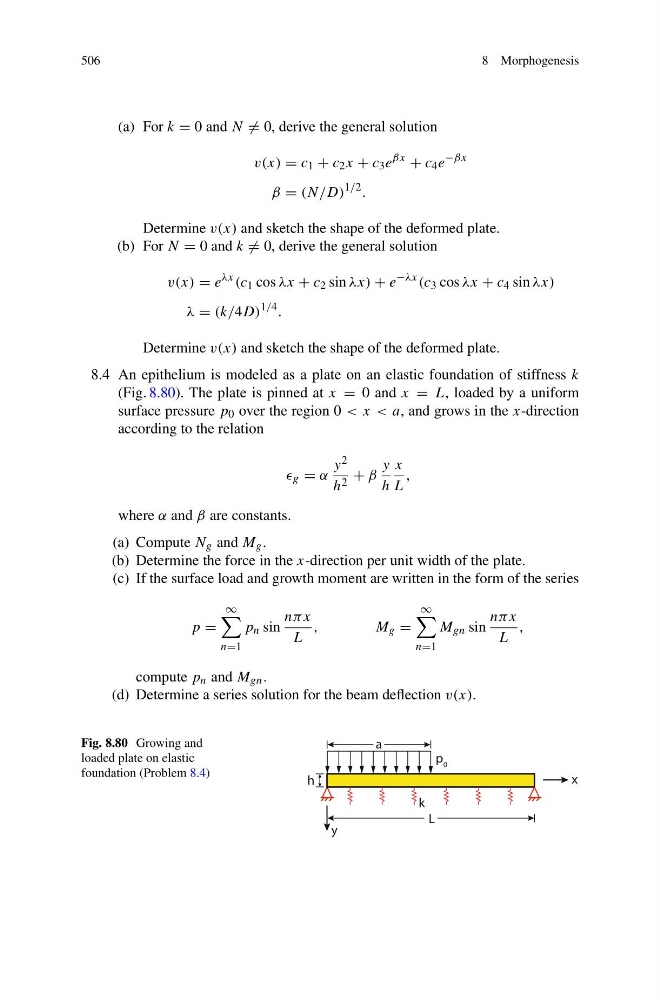
8.4 An epithelium is modeled as a plate on an elastic foundation of stiffness k
(Fig. 8.80). The plate is pinned at x = 0 and x = L, loaded by a uniform
surface pressure p 0 over the region 0 < x < a, and grows in the x-direction
according to the relation
g = α
y 2
h 2 + β
y
h
x
L
,
where α and β are constants.
(a) Compute N g and M g .
(b) Determine the force in the x-direction per unit width of the plate.
(c) If the surface load and growth moment are written in the form of the series
p =
∞
n=1
p n sin
nπ x
L
,
M g =
∞
n=1
M gn sin
nπ x
L
,
compute p n and M gn .
(d) Determine a series solution for the beam deflection v(x).
Fig. 8.80 Growing and
loaded plate on elastic
foundation (Problem 8.4)
x
y
k
a
L
h
p 0
8 Morphogenesis
(a) For k = 0 and N = 0, derive the general solution
v(x) = c 1 + c 2 x + c 3 e
βx
+ c 4 e
−βx
β = (N/D)
1/2 .
Determine v(x) and sketch the shape of the deformed plate.
(b) For N = 0 and k = 0, derive the general solution
v(x) = e
λx (c 1 cos λx + c 2 sin λx) + e
−λx (c 3 cos λx + c 4 sin λx)
λ = (k/4D)
1/4 .
Determine v(x) and sketch the shape of the deformed plate.
8.4 An epithelium is modeled as a plate on an elastic foundation of stiffness k
(Fig. 8.80). The plate is pinned at x = 0 and x = L, loaded by a uniform
surface pressure p 0 over the region 0 < x < a, and grows in the x-direction
according to the relation
g = α
y 2
h 2 + β
y
h
x
L
,
where α and β are constants.
(a) Compute N g and M g .
(b) Determine the force in the x-direction per unit width of the plate.
(c) If the surface load and growth moment are written in the form of the series
p =
∞
n=1
p n sin
nπ x
L
,
M g =
∞
n=1
M gn sin
nπ x
L
,
compute p n and M gn .
(d) Determine a series solution for the beam deflection v(x).
Fig. 8.80 Growing and
loaded plate on elastic
foundation (Problem 8.4)
x
y
k
a
L
h
p 0