

8.10 Mesenchymal Morphogenesis
505
Problems
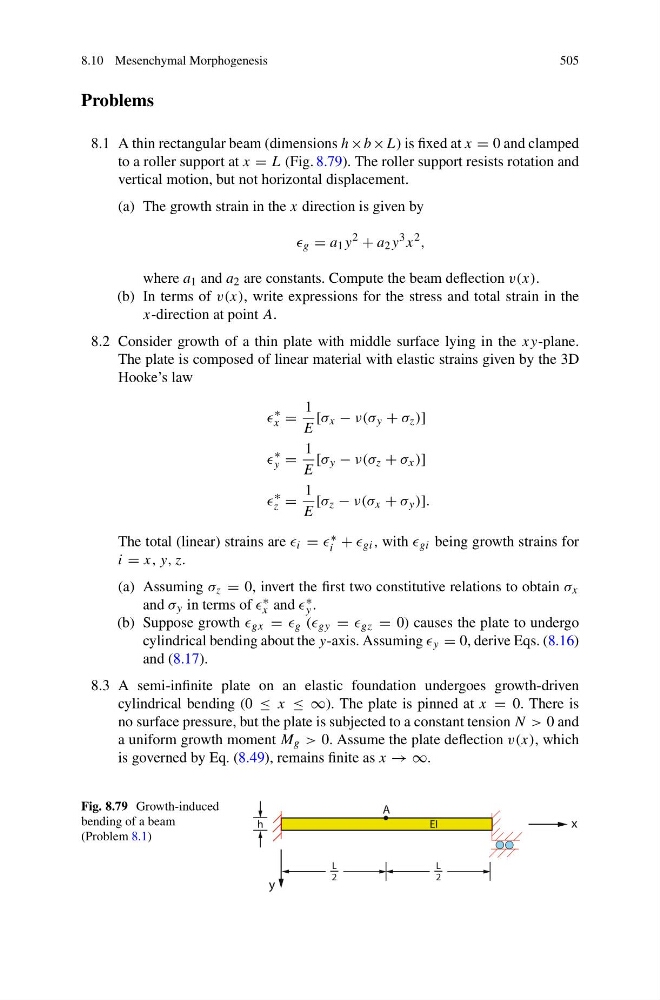
8.1 A thin rectangular beam (dimensions h×b ×L) is fixed at x = 0 and clamped
to a roller support at x = L (Fig. 8.79). The roller support resists rotation and
vertical motion, but not horizontal displacement.
(a) The growth strain in the x direction is given by
g = a 1 y
2
+ a 2 y
3 x
2 ,
where a 1 and a 2 are constants. Compute the beam deflection v(x).
(b) In terms of v(x), write expressions for the stress and total strain in the
x-direction at point A.
8.2 Consider growth of a thin plate with middle surface lying in the xy-plane.
The plate is composed of linear material with elastic strains given by the 3D
Hooke’s law
∗
x =
1
E
[σ x − ν(σ y + σ z )]
∗
y =
1
E
[σ y − ν(σ z + σ x )]
∗
z =
1
E
[σ z − ν(σ x + σ y )].
The total (linear) strains are i = ∗
i + gi , with gi being growth strains for
i = x, y, z.
(a) Assuming σ z = 0, invert the first two constitutive relations to obtain σ x
and σ y in terms of ∗
x and ∗
y .
(b) Suppose growth gx = g ( gy = gz = 0) causes the plate to undergo
cylindrical bending about the y-axis. Assuming y = 0, derive Eqs. (8.16)
and (8.17).
8.3 A semi-infinite plate on an elastic foundation undergoes growth-driven
cylindrical bending (0 ≤ x ≤ ∞). The plate is pinned at x = 0. There is
no surface pressure, but the plate is subjected to a constant tension N > 0 and
a uniform growth moment M g > 0. Assume the plate deflection v(x), which
is governed by Eq. (8.49), remains finite as x → ∞.
Fig. 8.79 Growth-induced
bending of a beam
(Problem 8.1)
y
x
L
2
L
2
EI
h
A
505
Problems
8.1 A thin rectangular beam (dimensions h×b ×L) is fixed at x = 0 and clamped
to a roller support at x = L (Fig. 8.79). The roller support resists rotation and
vertical motion, but not horizontal displacement.
(a) The growth strain in the x direction is given by
g = a 1 y
2
+ a 2 y
3 x
2 ,
where a 1 and a 2 are constants. Compute the beam deflection v(x).
(b) In terms of v(x), write expressions for the stress and total strain in the
x-direction at point A.
8.2 Consider growth of a thin plate with middle surface lying in the xy-plane.
The plate is composed of linear material with elastic strains given by the 3D
Hooke’s law
∗
x =
1
E
[σ x − ν(σ y + σ z )]
∗
y =
1
E
[σ y − ν(σ z + σ x )]
∗
z =
1
E
[σ z − ν(σ x + σ y )].
The total (linear) strains are i = ∗
i + gi , with gi being growth strains for
i = x, y, z.
(a) Assuming σ z = 0, invert the first two constitutive relations to obtain σ x
and σ y in terms of ∗
x and ∗
y .
(b) Suppose growth gx = g ( gy = gz = 0) causes the plate to undergo
cylindrical bending about the y-axis. Assuming y = 0, derive Eqs. (8.16)
and (8.17).
8.3 A semi-infinite plate on an elastic foundation undergoes growth-driven
cylindrical bending (0 ≤ x ≤ ∞). The plate is pinned at x = 0. There is
no surface pressure, but the plate is subjected to a constant tension N > 0 and
a uniform growth moment M g > 0. Assume the plate deflection v(x), which
is governed by Eq. (8.49), remains finite as x → ∞.
Fig. 8.79 Growth-induced
bending of a beam
(Problem 8.1)
y
x
L
2
L
2
EI
h
A