

456
8 Morphogenesis
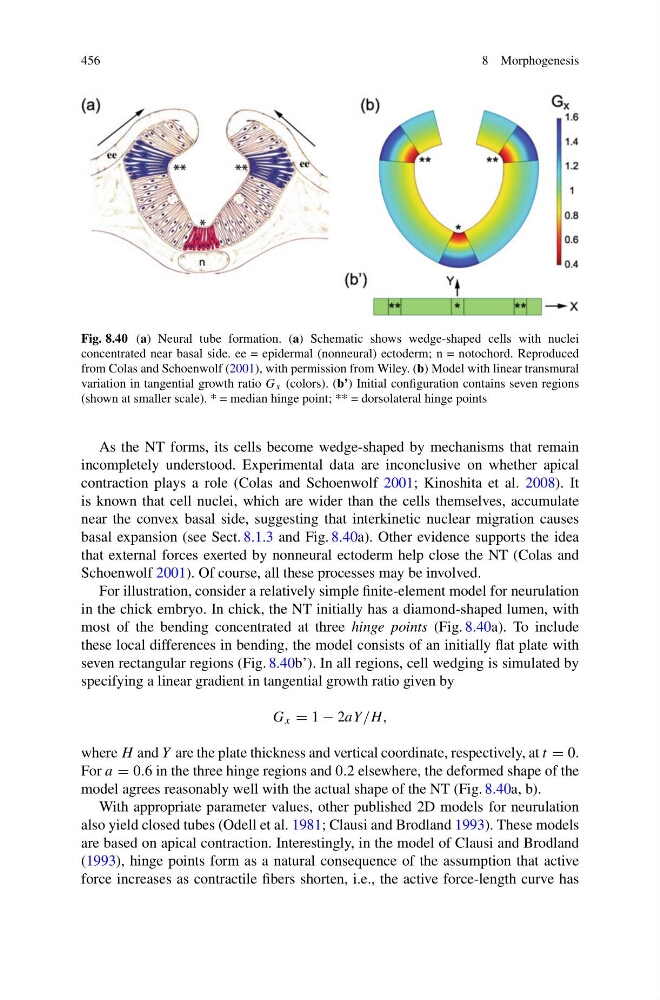
Fig. 8.40 (a) Neural tube formation. (a) Schematic shows wedge-shaped cells with nuclei
concentrated near basal side. ee = epidermal (nonneural) ectoderm; n = notochord. Reproduced
from Colas and Schoenwolf (2001), with permission from Wiley. (b) Model with linear transmural
variation in tangential growth ratio G x (colors). (b’) Initial configuration contains seven regions
(shown at smaller scale). * = median hinge point; ** = dorsolateral hinge points
As the NT forms, its cells become wedge-shaped by mechanisms that remain
incompletely understood. Experimental data are inconclusive on whether apical
contraction plays a role (Colas and Schoenwolf 2001; Kinoshita et al. 2008). It
is known that cell nuclei, which are wider than the cells themselves, accumulate
near the convex basal side, suggesting that interkinetic nuclear migration causes
basal expansion (see Sect. 8.1.3 and Fig. 8.40a). Other evidence supports the idea
that external forces exerted by nonneural ectoderm help close the NT (Colas and
Schoenwolf 2001). Of course, all these processes may be involved.
For illustration, consider a relatively simple finite-element model for neurulation
in the chick embryo. In chick, the NT initially has a diamond-shaped lumen, with
most of the bending concentrated at three hinge points (Fig. 8.40a). To include
these local differences in bending, the model consists of an initially flat plate with
seven rectangular regions (Fig. 8.40b’). In all regions, cell wedging is simulated by
specifying a linear gradient in tangential growth ratio given by
G x = 1 − 2aY/H,
where H and Y are the plate thickness and vertical coordinate, respectively, at t = 0.
For a = 0.6 in the three hinge regions and 0.2 elsewhere, the deformed shape of the
model agrees reasonably well with the actual shape of the NT (Fig. 8.40a, b).
With appropriate parameter values, other published 2D models for neurulation
also yield closed tubes (Odell et al. 1981; Clausi and Brodland 1993). These models
are based on apical contraction. Interestingly, in the model of Clausi and Brodland
(1993), hinge points form as a natural consequence of the assumption that active
force increases as contractile fibers shorten, i.e., the active force-length curve has
8 Morphogenesis
Fig. 8.40 (a) Neural tube formation. (a) Schematic shows wedge-shaped cells with nuclei
concentrated near basal side. ee = epidermal (nonneural) ectoderm; n = notochord. Reproduced
from Colas and Schoenwolf (2001), with permission from Wiley. (b) Model with linear transmural
variation in tangential growth ratio G x (colors). (b’) Initial configuration contains seven regions
(shown at smaller scale). * = median hinge point; ** = dorsolateral hinge points
As the NT forms, its cells become wedge-shaped by mechanisms that remain
incompletely understood. Experimental data are inconclusive on whether apical
contraction plays a role (Colas and Schoenwolf 2001; Kinoshita et al. 2008). It
is known that cell nuclei, which are wider than the cells themselves, accumulate
near the convex basal side, suggesting that interkinetic nuclear migration causes
basal expansion (see Sect. 8.1.3 and Fig. 8.40a). Other evidence supports the idea
that external forces exerted by nonneural ectoderm help close the NT (Colas and
Schoenwolf 2001). Of course, all these processes may be involved.
For illustration, consider a relatively simple finite-element model for neurulation
in the chick embryo. In chick, the NT initially has a diamond-shaped lumen, with
most of the bending concentrated at three hinge points (Fig. 8.40a). To include
these local differences in bending, the model consists of an initially flat plate with
seven rectangular regions (Fig. 8.40b’). In all regions, cell wedging is simulated by
specifying a linear gradient in tangential growth ratio given by
G x = 1 − 2aY/H,
where H and Y are the plate thickness and vertical coordinate, respectively, at t = 0.
For a = 0.6 in the three hinge regions and 0.2 elsewhere, the deformed shape of the
model agrees reasonably well with the actual shape of the NT (Fig. 8.40a, b).
With appropriate parameter values, other published 2D models for neurulation
also yield closed tubes (Odell et al. 1981; Clausi and Brodland 1993). These models
are based on apical contraction. Interestingly, in the model of Clausi and Brodland
(1993), hinge points form as a natural consequence of the assumption that active
force increases as contractile fibers shorten, i.e., the active force-length curve has