

386
7 Remodeling
Results
Results are shown for the following parameter values:
c m = 10 kPa
c c = 1 kPa
α c = 20
φ
m
0 = 0.25
φ
c
0 = 0.75
λ
c
0 = 1.1
a = 1
A = 5, 10.
(7.100)
Note that the remodeling (turnover) rate increases with A.
If an unconstrained bar composed entirely of muscle cells (φ m = 1) undergoes
uniform growth, then λ x (t) = G m
x (t) at all times. In the present problem, extension
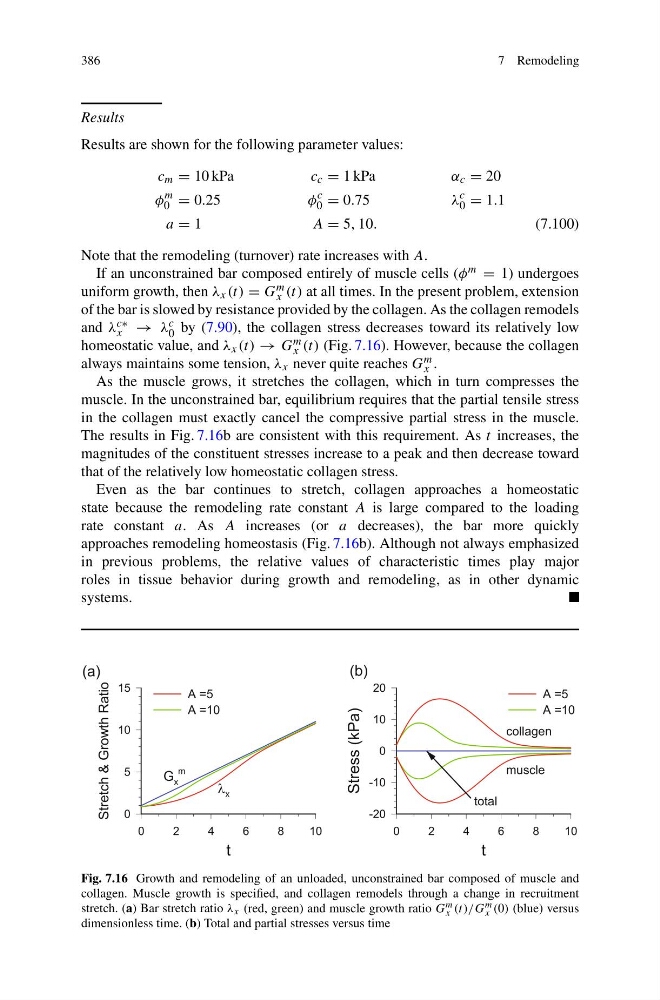
of the bar is slowed by resistance provided by the collagen. As the collagen remodels
and λ c∗
x → λ c
0 by (7.90), the collagen stress decreases toward its relatively low
homeostatic value, and λ x (t) → G m
x (t) (Fig. 7.16). However, because the collagen
always maintains some tension, λ x never quite reaches G m
x .
As the muscle grows, it stretches the collagen, which in turn compresses the
muscle. In the unconstrained bar, equilibrium requires that the partial tensile stress
in the collagen must exactly cancel the compressive partial stress in the muscle.
The results in Fig. 7.16b are consistent with this requirement. As t increases, the
magnitudes of the constituent stresses increase to a peak and then decrease toward
that of the relatively low homeostatic collagen stress.
Even as the bar continues to stretch, collagen approaches a homeostatic
state because the remodeling rate constant A is large compared to the loading
rate constant a. As A increases (or a decreases), the bar more quickly
approaches remodeling homeostasis (Fig. 7.16b). Although not always emphasized
in previous problems, the relative values of characteristic times play major
roles in tissue behavior during growth and remodeling, as in other dynamic
systems.
Fig. 7.16 Growth and remodeling of an unloaded, unconstrained bar composed of muscle and
collagen. Muscle growth is specified, and collagen remodels through a change in recruitment
stretch. (a) Bar stretch ratio λ x (red, green) and muscle growth ratio G m
x (t)/G m
x (0) (blue) versus
dimensionless time. (b) Total and partial stresses versus time
7 Remodeling
Results
Results are shown for the following parameter values:
c m = 10 kPa
c c = 1 kPa
α c = 20
φ
m
0 = 0.25
φ
c
0 = 0.75
λ
c
0 = 1.1
a = 1
A = 5, 10.
(7.100)
Note that the remodeling (turnover) rate increases with A.
If an unconstrained bar composed entirely of muscle cells (φ m = 1) undergoes
uniform growth, then λ x (t) = G m
x (t) at all times. In the present problem, extension
of the bar is slowed by resistance provided by the collagen. As the collagen remodels
and λ c∗
x → λ c
0 by (7.90), the collagen stress decreases toward its relatively low
homeostatic value, and λ x (t) → G m
x (t) (Fig. 7.16). However, because the collagen
always maintains some tension, λ x never quite reaches G m
x .
As the muscle grows, it stretches the collagen, which in turn compresses the
muscle. In the unconstrained bar, equilibrium requires that the partial tensile stress
in the collagen must exactly cancel the compressive partial stress in the muscle.
The results in Fig. 7.16b are consistent with this requirement. As t increases, the
magnitudes of the constituent stresses increase to a peak and then decrease toward
that of the relatively low homeostatic collagen stress.
Even as the bar continues to stretch, collagen approaches a homeostatic
state because the remodeling rate constant A is large compared to the loading
rate constant a. As A increases (or a decreases), the bar more quickly
approaches remodeling homeostasis (Fig. 7.16b). Although not always emphasized
in previous problems, the relative values of characteristic times play major
roles in tissue behavior during growth and remodeling, as in other dynamic
systems.
Fig. 7.16 Growth and remodeling of an unloaded, unconstrained bar composed of muscle and
collagen. Muscle growth is specified, and collagen remodels through a change in recruitment
stretch. (a) Bar stretch ratio λ x (red, green) and muscle growth ratio G m
x (t)/G m
x (0) (blue) versus
dimensionless time. (b) Total and partial stresses versus time