

7.7 An Alternative Remodeling Theory
385
Solution
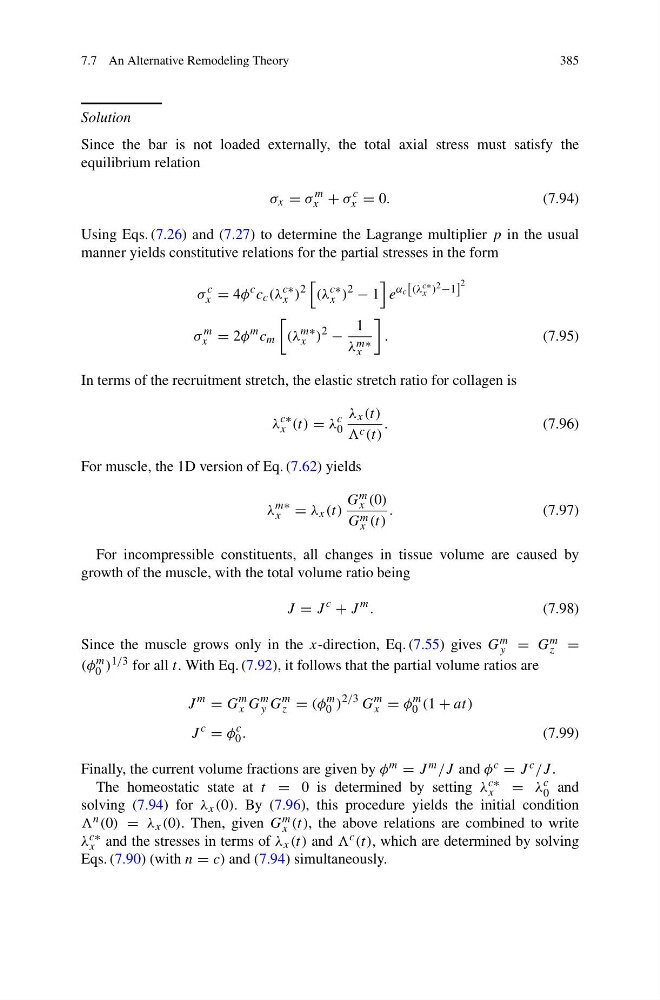
Since the bar is not loaded externally, the total axial stress must satisfy the
equilibrium relation
σ x = σ
m
x + σ
c
x = 0.
(7.94)
Using Eqs. (7.26) and (7.27) to determine the Lagrange multiplier p in the usual
manner yields constitutive relations for the partial stresses in the form
σ
c
x = 4φ
c c c (λ
c∗
x )
2
(λ
c∗
x )
2
− 1
e
α c
(λ c∗
x ) 2 −1
2
σ
m
x = 2φ
m c m
(λ
m∗
x )
2
−
1
λ m∗
x
.
(7.95)
In terms of the recruitment stretch, the elastic stretch ratio for collagen is
λ
c∗
x (t) = λ
c
0
λ x (t)
c (t)
.
(7.96)
For muscle, the 1D version of Eq. (7.62) yields
λ
m∗
x = λ x (t)
G m
x (0)
G m
x (t)
.
(7.97)
For incompressible constituents, all changes in tissue volume are caused by
growth of the muscle, with the total volume ratio being
J = J
c
+ J
m .
(7.98)
Since the muscle grows only in the x-direction, Eq. (7.55) gives G m
y = G m
z =
(φ m
0 ) 1/3 for all t. With Eq. (7.92), it follows that the partial volume ratios are
J
m
= G
m
x G
m
y G
m
z = (φ
m
0 )
2/3 G
m
x = φ
m
0 (1 + at)
J
c
= φ
c
0 .
(7.99)
Finally, the current volume fractions are given by φ m = J m /J and φ c = J c /J .
The homeostatic state at t = 0 is determined by setting λ c∗
x
= λ c
0 and
solving (7.94) for λ x (0). By (7.96), this procedure yields the initial condition
n (0) = λ x (0). Then, given G m
x (t), the above relations are combined to write
λ c∗
x and the stresses in terms of λ x (t) and c (t), which are determined by solving
Eqs. (7.90) (with n = c) and (7.94) simultaneously.
385
Solution
Since the bar is not loaded externally, the total axial stress must satisfy the
equilibrium relation
σ x = σ
m
x + σ
c
x = 0.
(7.94)
Using Eqs. (7.26) and (7.27) to determine the Lagrange multiplier p in the usual
manner yields constitutive relations for the partial stresses in the form
σ
c
x = 4φ
c c c (λ
c∗
x )
2
(λ
c∗
x )
2
− 1
e
α c
(λ c∗
x ) 2 −1
2
σ
m
x = 2φ
m c m
(λ
m∗
x )
2
−
1
λ m∗
x
.
(7.95)
In terms of the recruitment stretch, the elastic stretch ratio for collagen is
λ
c∗
x (t) = λ
c
0
λ x (t)
c (t)
.
(7.96)
For muscle, the 1D version of Eq. (7.62) yields
λ
m∗
x = λ x (t)
G m
x (0)
G m
x (t)
.
(7.97)
For incompressible constituents, all changes in tissue volume are caused by
growth of the muscle, with the total volume ratio being
J = J
c
+ J
m .
(7.98)
Since the muscle grows only in the x-direction, Eq. (7.55) gives G m
y = G m
z =
(φ m
0 ) 1/3 for all t. With Eq. (7.92), it follows that the partial volume ratios are
J
m
= G
m
x G
m
y G
m
z = (φ
m
0 )
2/3 G
m
x = φ
m
0 (1 + at)
J
c
= φ
c
0 .
(7.99)
Finally, the current volume fractions are given by φ m = J m /J and φ c = J c /J .
The homeostatic state at t = 0 is determined by setting λ c∗
x
= λ c
0 and
solving (7.94) for λ x (0). By (7.96), this procedure yields the initial condition
n (0) = λ x (0). Then, given G m
x (t), the above relations are combined to write
λ c∗
x and the stresses in terms of λ x (t) and c (t), which are determined by solving
Eqs. (7.90) (with n = c) and (7.94) simultaneously.