

336
6 Growth
P
z
A 1
A 2
passive
active
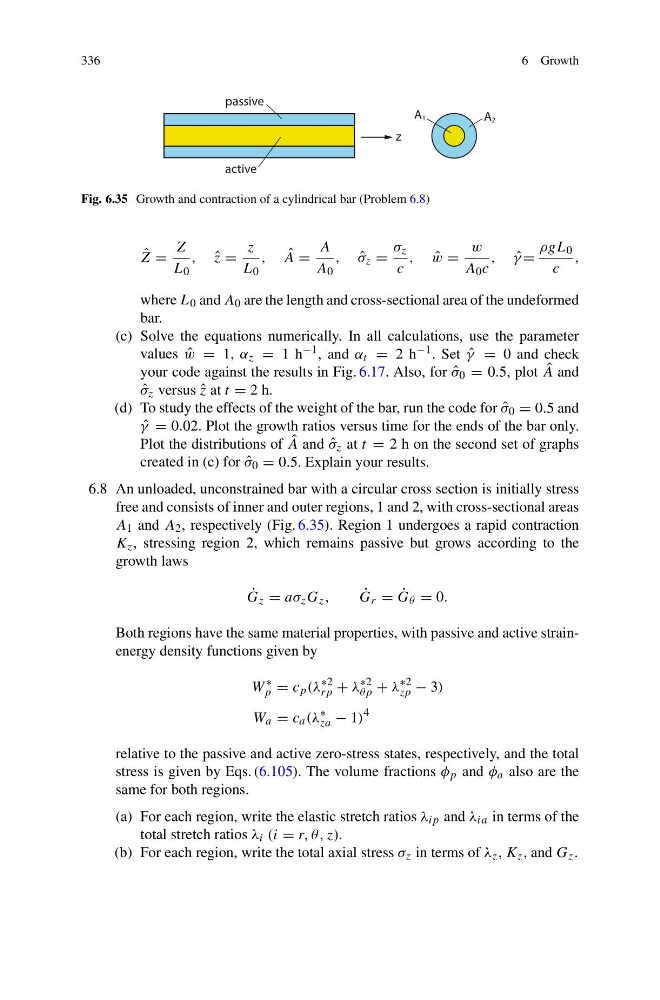
Fig. 6.35 Growth and contraction of a cylindrical bar (Problem 6.8)
ˆ
Z =
Z
L 0
, ˆ
z =
z
L 0
, ˆ
A =
A
A 0
, ˆ
σ z =
σ z
c
, ˆ
w =
w
A 0 c
, ˆ
γ =
ρgL 0
c
,
where L 0 and A 0 are the length and cross-sectional area of the undeformed
bar.
(c) Solve the equations numerically. In all calculations, use the parameter
values ˆ
w = 1, α z = 1 h −1 , and α t = 2 h −1 . Set ˆ
γ = 0 and check
your code against the results in Fig. 6.17. Also, for ˆ
σ 0 = 0.5, plot ˆ
A and
ˆ
σ z versus ˆ
z at t = 2 h.
(d) To study the effects of the weight of the bar, run the code for ˆ
σ 0 = 0.5 and
ˆ
γ = 0.02. Plot the growth ratios versus time for the ends of the bar only.
Plot the distributions of ˆ
A and ˆ
σ z at t = 2 h on the second set of graphs
created in (c) for ˆ
σ 0 = 0.5. Explain your results.
6.8 An unloaded, unconstrained bar with a circular cross section is initially stress
free and consists of inner and outer regions, 1 and 2, with cross-sectional areas
A 1 and A 2 , respectively (Fig. 6.35). Region 1 undergoes a rapid contraction
K z , stressing region 2, which remains passive but grows according to the
growth laws
˙
G z = aσ z G z ,
˙
G r = ˙
G θ = 0.
Both regions have the same material properties, with passive and active strainenergy density functions given by
W
∗
p = c p (λ
∗2
rp + λ
∗2
θp + λ
∗2
zp − 3)
W a = c a (λ
∗
za − 1)
4
relative to the passive and active zero-stress states, respectively, and the total
stress is given by Eqs. (6.105). The volume fractions φ p and φ a also are the
same for both regions.
(a) For each region, write the elastic stretch ratios λ ip and λ ia in terms of the
total stretch ratios λ i (i = r, θ, z).
(b) For each region, write the total axial stress σ z in terms of λ z , K z , and G z .
6 Growth
P
z
A 1
A 2
passive
active
Fig. 6.35 Growth and contraction of a cylindrical bar (Problem 6.8)
ˆ
Z =
Z
L 0
, ˆ
z =
z
L 0
, ˆ
A =
A
A 0
, ˆ
σ z =
σ z
c
, ˆ
w =
w
A 0 c
, ˆ
γ =
ρgL 0
c
,
where L 0 and A 0 are the length and cross-sectional area of the undeformed
bar.
(c) Solve the equations numerically. In all calculations, use the parameter
values ˆ
w = 1, α z = 1 h −1 , and α t = 2 h −1 . Set ˆ
γ = 0 and check
your code against the results in Fig. 6.17. Also, for ˆ
σ 0 = 0.5, plot ˆ
A and
ˆ
σ z versus ˆ
z at t = 2 h.
(d) To study the effects of the weight of the bar, run the code for ˆ
σ 0 = 0.5 and
ˆ
γ = 0.02. Plot the growth ratios versus time for the ends of the bar only.
Plot the distributions of ˆ
A and ˆ
σ z at t = 2 h on the second set of graphs
created in (c) for ˆ
σ 0 = 0.5. Explain your results.
6.8 An unloaded, unconstrained bar with a circular cross section is initially stress
free and consists of inner and outer regions, 1 and 2, with cross-sectional areas
A 1 and A 2 , respectively (Fig. 6.35). Region 1 undergoes a rapid contraction
K z , stressing region 2, which remains passive but grows according to the
growth laws
˙
G z = aσ z G z ,
˙
G r = ˙
G θ = 0.
Both regions have the same material properties, with passive and active strainenergy density functions given by
W
∗
p = c p (λ
∗2
rp + λ
∗2
θp + λ
∗2
zp − 3)
W a = c a (λ
∗
za − 1)
4
relative to the passive and active zero-stress states, respectively, and the total
stress is given by Eqs. (6.105). The volume fractions φ p and φ a also are the
same for both regions.
(a) For each region, write the elastic stretch ratios λ ip and λ ia in terms of the
total stretch ratios λ i (i = r, θ, z).
(b) For each region, write the total axial stress σ z in terms of λ z , K z , and G z .