

6.11 Case Study: Functional Adaptation in Arteries
335
where p is the mean blood pressure, Q is the mean flow rate, a is the vessel
radius, h is the wall thickness, and μ is the blood viscosity. Suppose the artery
is in a homeostatic state at t = 0, with p = p 0 , Q = Q 0 , a = a 0 , and h = h 0 .
If the pressure and flow change to p = αp 0 and Q = βQ 0 , the artery grows
to restore homeostasis. Determine the new radius and wall thickness after the
artery has adapted to the new loading conditions.
6.6 A weightless rectangular bar of soft tissue with axis oriented in the x direction
is fixed at its upper end. At t = 0, a weight w is attached to the lower end,
stretching the bar and decreasing its cross-sectional area to A 0 . In response to
the load, the tissue grows according to the relations
˙
G x /G x = ˙
G y /G y = a(σ x − σ 0 ),
˙
G z = 0,
where a and σ 0 are positive constants. For simplicity, assume all subsequent
changes in cross-sectional area from A 0 to A are caused by growth, i.e.,
neglect elastic changes in area.
(a) Determine a closed-form solution for the axial growth ratio G x (t).
(b) Sketch G x vs t for w = 2σ 0 A 0 and w = 0.5σ 0 A 0 .
6.7 The previous problem and Example 6.8 (page 302) examine growth of a
weightless vertical bar with a weight w attached to its lower end. Consider now
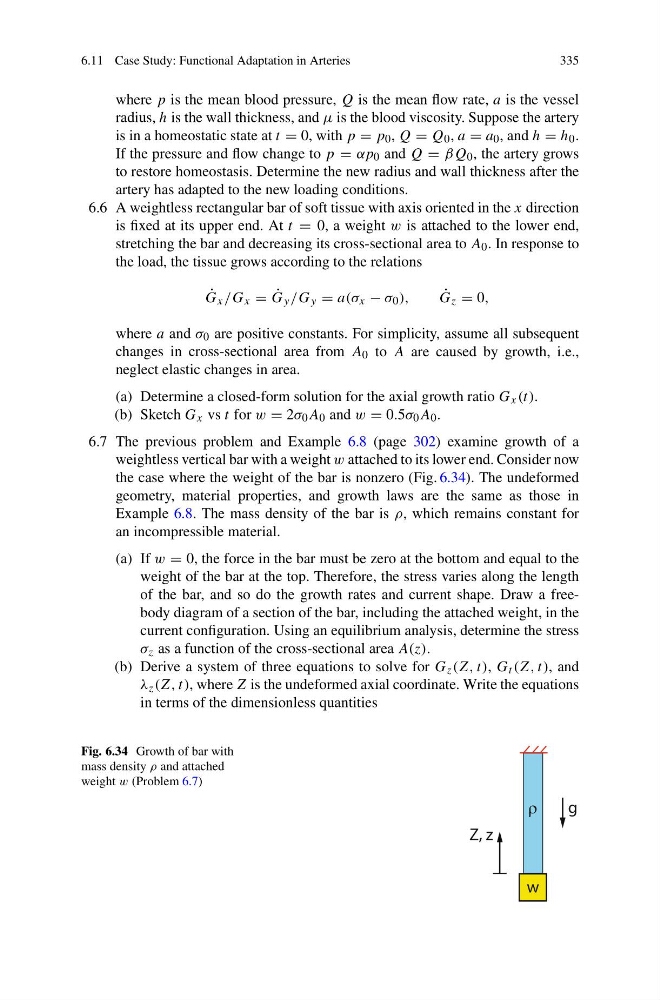
the case where the weight of the bar is nonzero (Fig. 6.34). The undeformed
geometry, material properties, and growth laws are the same as those in
Example 6.8. The mass density of the bar is ρ, which remains constant for
an incompressible material.
(a) If w = 0, the force in the bar must be zero at the bottom and equal to the
weight of the bar at the top. Therefore, the stress varies along the length
of the bar, and so do the growth rates and current shape. Draw a freebody diagram of a section of the bar, including the attached weight, in the
current configuration. Using an equilibrium analysis, determine the stress
σ z as a function of the cross-sectional area A(z).
(b) Derive a system of three equations to solve for G z (Z, t), G t (Z, t), and
λ z (Z, t), where Z is the undeformed axial coordinate. Write the equations
in terms of the dimensionless quantities
Fig. 6.34 Growth of bar with
mass density ρ and attached
weight w (Problem 6.7)
w
U
g
Z, z
335
where p is the mean blood pressure, Q is the mean flow rate, a is the vessel
radius, h is the wall thickness, and μ is the blood viscosity. Suppose the artery
is in a homeostatic state at t = 0, with p = p 0 , Q = Q 0 , a = a 0 , and h = h 0 .
If the pressure and flow change to p = αp 0 and Q = βQ 0 , the artery grows
to restore homeostasis. Determine the new radius and wall thickness after the
artery has adapted to the new loading conditions.
6.6 A weightless rectangular bar of soft tissue with axis oriented in the x direction
is fixed at its upper end. At t = 0, a weight w is attached to the lower end,
stretching the bar and decreasing its cross-sectional area to A 0 . In response to
the load, the tissue grows according to the relations
˙
G x /G x = ˙
G y /G y = a(σ x − σ 0 ),
˙
G z = 0,
where a and σ 0 are positive constants. For simplicity, assume all subsequent
changes in cross-sectional area from A 0 to A are caused by growth, i.e.,
neglect elastic changes in area.
(a) Determine a closed-form solution for the axial growth ratio G x (t).
(b) Sketch G x vs t for w = 2σ 0 A 0 and w = 0.5σ 0 A 0 .
6.7 The previous problem and Example 6.8 (page 302) examine growth of a
weightless vertical bar with a weight w attached to its lower end. Consider now
the case where the weight of the bar is nonzero (Fig. 6.34). The undeformed
geometry, material properties, and growth laws are the same as those in
Example 6.8. The mass density of the bar is ρ, which remains constant for
an incompressible material.
(a) If w = 0, the force in the bar must be zero at the bottom and equal to the
weight of the bar at the top. Therefore, the stress varies along the length
of the bar, and so do the growth rates and current shape. Draw a freebody diagram of a section of the bar, including the attached weight, in the
current configuration. Using an equilibrium analysis, determine the stress
σ z as a function of the cross-sectional area A(z).
(b) Derive a system of three equations to solve for G z (Z, t), G t (Z, t), and
λ z (Z, t), where Z is the undeformed axial coordinate. Write the equations
in terms of the dimensionless quantities
Fig. 6.34 Growth of bar with
mass density ρ and attached
weight w (Problem 6.7)
w
U
g
Z, z