

6.10 Theory for Combined Growth and Contraction
311
¯
σ = φ p ¯
σ p (F
∗
p ) + φ a σ a (F
∗
a ).
(6.105)
In general, the matrix can be incompressible (p = 0) or compressible (p = 0).
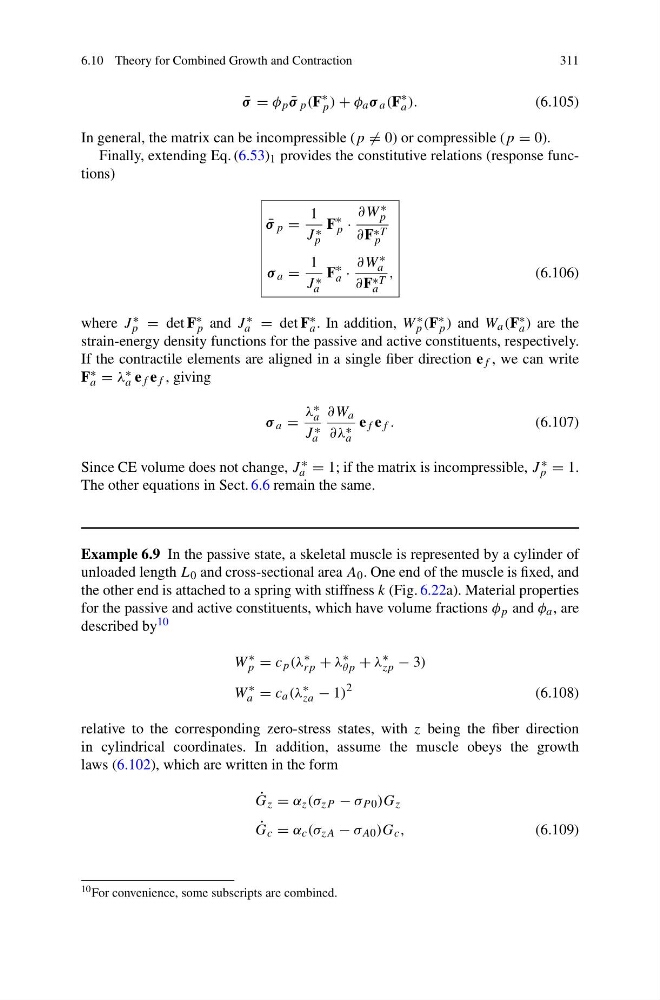
Finally, extending Eq. (6.53) 1 provides the constitutive relations (response functions)
¯
σ p =
1
J ∗
p
F
∗
p ·
∂W ∗
p
∂F ∗T
p
σ a =
1
J ∗
a
F
∗
a ·
∂W ∗
a
∂F ∗T
a
,
(6.106)
where J ∗
p = det F ∗
p and J ∗
a = det F ∗
a . In addition, W ∗
p (F ∗
p ) and W a (F ∗
a ) are the
strain-energy density functions for the passive and active constituents, respectively.
If the contractile elements are aligned in a single fiber direction e f , we can write
F ∗
a = λ ∗
a e f e f , giving
σ a =
λ ∗
a
J ∗
a
∂W a
∂λ ∗
a
e f e f .
(6.107)
Since CE volume does not change, J ∗
a = 1; if the matrix is incompressible, J ∗
p = 1.
The other equations in Sect. 6.6 remain the same.
Example 6.9 In the passive state, a skeletal muscle is represented by a cylinder of
unloaded length L 0 and cross-sectional area A 0 . One end of the muscle is fixed, and
the other end is attached to a spring with stiffness k (Fig. 6.22a). Material properties
for the passive and active constituents, which have volume fractions φ p and φ a , are
described by 10
W
∗
p = c p (λ
∗
rp + λ
∗
θp + λ
∗
zp − 3)
W
∗
a = c a (λ
∗
za − 1)
2
(6.108)
relative to the corresponding zero-stress states, with z being the fiber direction
in cylindrical coordinates. In addition, assume the muscle obeys the growth
laws (6.102), which are written in the form
˙
G z = α z (σ zP − σ P 0 )G z
˙
G c = α c (σ zA − σ A0 )G c ,
(6.109)
10 For convenience, some subscripts are combined.
311
¯
σ = φ p ¯
σ p (F
∗
p ) + φ a σ a (F
∗
a ).
(6.105)
In general, the matrix can be incompressible (p = 0) or compressible (p = 0).
Finally, extending Eq. (6.53) 1 provides the constitutive relations (response functions)
¯
σ p =
1
J ∗
p
F
∗
p ·
∂W ∗
p
∂F ∗T
p
σ a =
1
J ∗
a
F
∗
a ·
∂W ∗
a
∂F ∗T
a
,
(6.106)
where J ∗
p = det F ∗
p and J ∗
a = det F ∗
a . In addition, W ∗
p (F ∗
p ) and W a (F ∗
a ) are the
strain-energy density functions for the passive and active constituents, respectively.
If the contractile elements are aligned in a single fiber direction e f , we can write
F ∗
a = λ ∗
a e f e f , giving
σ a =
λ ∗
a
J ∗
a
∂W a
∂λ ∗
a
e f e f .
(6.107)
Since CE volume does not change, J ∗
a = 1; if the matrix is incompressible, J ∗
p = 1.
The other equations in Sect. 6.6 remain the same.
Example 6.9 In the passive state, a skeletal muscle is represented by a cylinder of
unloaded length L 0 and cross-sectional area A 0 . One end of the muscle is fixed, and
the other end is attached to a spring with stiffness k (Fig. 6.22a). Material properties
for the passive and active constituents, which have volume fractions φ p and φ a , are
described by 10
W
∗
p = c p (λ
∗
rp + λ
∗
θp + λ
∗
zp − 3)
W
∗
a = c a (λ
∗
za − 1)
2
(6.108)
relative to the corresponding zero-stress states, with z being the fiber direction
in cylindrical coordinates. In addition, assume the muscle obeys the growth
laws (6.102), which are written in the form
˙
G z = α z (σ zP − σ P 0 )G z
˙
G c = α c (σ zA − σ A0 )G c ,
(6.109)
10 For convenience, some subscripts are combined.