

302
6 Growth
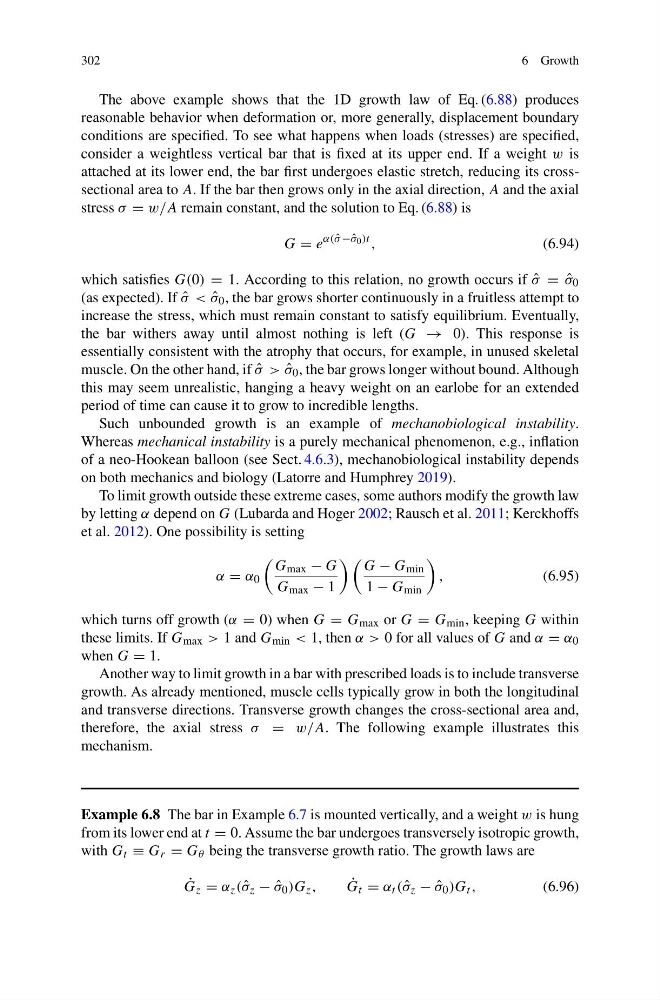
The above example shows that the 1D growth law of Eq. (6.88) produces
reasonable behavior when deformation or, more generally, displacement boundary
conditions are specified. To see what happens when loads (stresses) are specified,
consider a weightless vertical bar that is fixed at its upper end. If a weight w is
attached at its lower end, the bar first undergoes elastic stretch, reducing its crosssectional area to A. If the bar then grows only in the axial direction, A and the axial
stress σ = w/A remain constant, and the solution to Eq. (6.88) is
G = e
α( ˆ
σ − ˆ
σ 0 )t ,
(6.94)
which satisfies G(0) = 1. According to this relation, no growth occurs if ˆ
σ = ˆ
σ 0
(as expected). If ˆ
σ < ˆ
σ 0 , the bar grows shorter continuously in a fruitless attempt to
increase the stress, which must remain constant to satisfy equilibrium. Eventually,
the bar withers away until almost nothing is left (G → 0). This response is
essentially consistent with the atrophy that occurs, for example, in unused skeletal
muscle. On the other hand, if ˆ
σ > ˆ
σ 0 , the bar grows longer without bound. Although
this may seem unrealistic, hanging a heavy weight on an earlobe for an extended
period of time can cause it to grow to incredible lengths.
Such unbounded growth is an example of mechanobiological instability.
Whereas mechanical instability is a purely mechanical phenomenon, e.g., inflation
of a neo-Hookean balloon (see Sect. 4.6.3), mechanobiological instability depends
on both mechanics and biology (Latorre and Humphrey 2019).
To limit growth outside these extreme cases, some authors modify the growth law
by letting α depend on G (Lubarda and Hoger 2002; Rausch et al. 2011; Kerckhoffs
et al. 2012). One possibility is setting
α = α 0
G max − G
G max − 1
G − G min
1 − G min
,
(6.95)
which turns off growth (α = 0) when G = G max or G = G min , keeping G within
these limits. If G max > 1 and G min < 1, then α > 0 for all values of G and α = α 0
when G = 1.
Another way to limit growth in a bar with prescribed loads is to include transverse
growth. As already mentioned, muscle cells typically grow in both the longitudinal
and transverse directions. Transverse growth changes the cross-sectional area and,
therefore, the axial stress σ = w/A. The following example illustrates this
mechanism.
Example 6.8 The bar in Example 6.7 is mounted vertically, and a weight w is hung
from its lower end at t = 0. Assume the bar undergoes transversely isotropic growth,
with G t ≡ G r = G θ being the transverse growth ratio. The growth laws are
˙
G z = α z ( ˆ
σ z − ˆ
σ 0 )G z ,
˙
G t = α t ( ˆ
σ z − ˆ
σ 0 )G t ,
(6.96)
6 Growth
The above example shows that the 1D growth law of Eq. (6.88) produces
reasonable behavior when deformation or, more generally, displacement boundary
conditions are specified. To see what happens when loads (stresses) are specified,
consider a weightless vertical bar that is fixed at its upper end. If a weight w is
attached at its lower end, the bar first undergoes elastic stretch, reducing its crosssectional area to A. If the bar then grows only in the axial direction, A and the axial
stress σ = w/A remain constant, and the solution to Eq. (6.88) is
G = e
α( ˆ
σ − ˆ
σ 0 )t ,
(6.94)
which satisfies G(0) = 1. According to this relation, no growth occurs if ˆ
σ = ˆ
σ 0
(as expected). If ˆ
σ < ˆ
σ 0 , the bar grows shorter continuously in a fruitless attempt to
increase the stress, which must remain constant to satisfy equilibrium. Eventually,
the bar withers away until almost nothing is left (G → 0). This response is
essentially consistent with the atrophy that occurs, for example, in unused skeletal
muscle. On the other hand, if ˆ
σ > ˆ
σ 0 , the bar grows longer without bound. Although
this may seem unrealistic, hanging a heavy weight on an earlobe for an extended
period of time can cause it to grow to incredible lengths.
Such unbounded growth is an example of mechanobiological instability.
Whereas mechanical instability is a purely mechanical phenomenon, e.g., inflation
of a neo-Hookean balloon (see Sect. 4.6.3), mechanobiological instability depends
on both mechanics and biology (Latorre and Humphrey 2019).
To limit growth outside these extreme cases, some authors modify the growth law
by letting α depend on G (Lubarda and Hoger 2002; Rausch et al. 2011; Kerckhoffs
et al. 2012). One possibility is setting
α = α 0
G max − G
G max − 1
G − G min
1 − G min
,
(6.95)
which turns off growth (α = 0) when G = G max or G = G min , keeping G within
these limits. If G max > 1 and G min < 1, then α > 0 for all values of G and α = α 0
when G = 1.
Another way to limit growth in a bar with prescribed loads is to include transverse
growth. As already mentioned, muscle cells typically grow in both the longitudinal
and transverse directions. Transverse growth changes the cross-sectional area and,
therefore, the axial stress σ = w/A. The following example illustrates this
mechanism.
Example 6.8 The bar in Example 6.7 is mounted vertically, and a weight w is hung
from its lower end at t = 0. Assume the bar undergoes transversely isotropic growth,
with G t ≡ G r = G θ being the transverse growth ratio. The growth laws are
˙
G z = α z ( ˆ
σ z − ˆ
σ 0 )G z ,
˙
G t = α t ( ˆ
σ z − ˆ
σ 0 )G t ,
(6.96)