

6.9 Mechanical Feedback
301
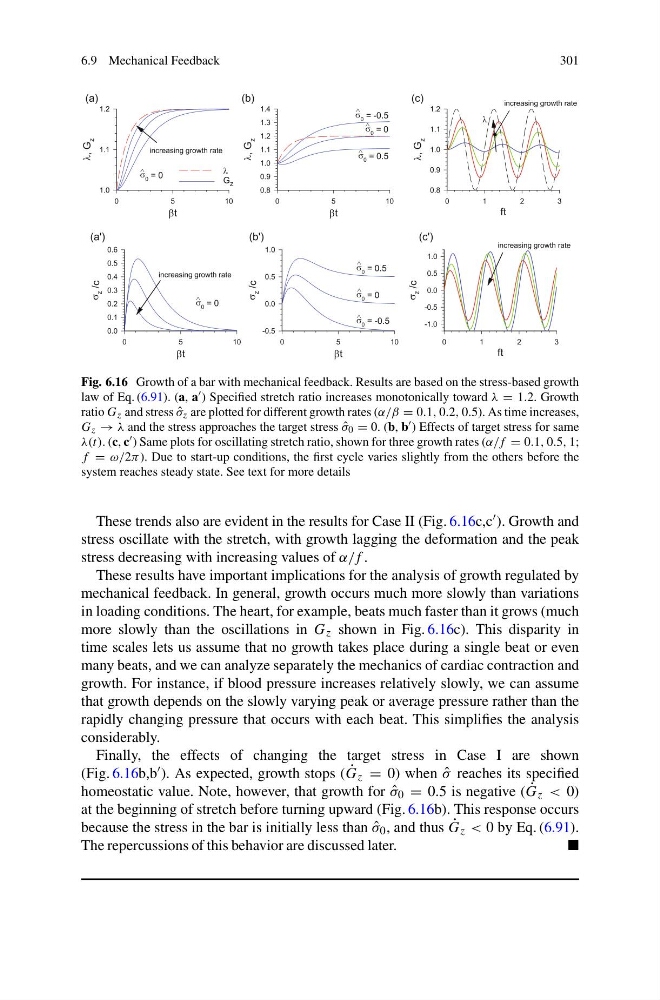
Fig. 6.16 Growth of a bar with mechanical feedback. Results are based on the stress-based growth
law of Eq. (6.91). (a, a ) Specified stretch ratio increases monotonically toward λ = 1.2. Growth
ratio G z and stress ˆ
σ z are plotted for different growth rates (α/β = 0.1, 0.2, 0.5). As time increases,
G z → λ and the stress approaches the target stress ˆ
σ 0 = 0. (b, b ) Effects of target stress for same
λ(t). (c, c ) Same plots for oscillating stretch ratio, shown for three growth rates (α/f = 0.1, 0.5, 1;
f = ω/2π ). Due to start-up conditions, the first cycle varies slightly from the others before the
system reaches steady state. See text for more details
These trends also are evident in the results for Case II (Fig. 6.16c,c ). Growth and
stress oscillate with the stretch, with growth lagging the deformation and the peak
stress decreasing with increasing values of α/f .
These results have important implications for the analysis of growth regulated by
mechanical feedback. In general, growth occurs much more slowly than variations
in loading conditions. The heart, for example, beats much faster than it grows (much
more slowly than the oscillations in G z shown in Fig. 6.16c). This disparity in
time scales lets us assume that no growth takes place during a single beat or even
many beats, and we can analyze separately the mechanics of cardiac contraction and
growth. For instance, if blood pressure increases relatively slowly, we can assume
that growth depends on the slowly varying peak or average pressure rather than the
rapidly changing pressure that occurs with each beat. This simplifies the analysis
considerably.
Finally, the effects of changing the target stress in Case I are shown
(Fig. 6.16b,b ). As expected, growth stops ( ˙
G z = 0) when ˆ
σ reaches its specified
homeostatic value. Note, however, that growth for ˆ
σ 0 = 0.5 is negative ( ˙
G z < 0)
at the beginning of stretch before turning upward (Fig. 6.16b). This response occurs
because the stress in the bar is initially less than ˆ
σ 0 , and thus ˙
G z < 0 by Eq. (6.91).
The repercussions of this behavior are discussed later.
301
Fig. 6.16 Growth of a bar with mechanical feedback. Results are based on the stress-based growth
law of Eq. (6.91). (a, a ) Specified stretch ratio increases monotonically toward λ = 1.2. Growth
ratio G z and stress ˆ
σ z are plotted for different growth rates (α/β = 0.1, 0.2, 0.5). As time increases,
G z → λ and the stress approaches the target stress ˆ
σ 0 = 0. (b, b ) Effects of target stress for same
λ(t). (c, c ) Same plots for oscillating stretch ratio, shown for three growth rates (α/f = 0.1, 0.5, 1;
f = ω/2π ). Due to start-up conditions, the first cycle varies slightly from the others before the
system reaches steady state. See text for more details
These trends also are evident in the results for Case II (Fig. 6.16c,c ). Growth and
stress oscillate with the stretch, with growth lagging the deformation and the peak
stress decreasing with increasing values of α/f .
These results have important implications for the analysis of growth regulated by
mechanical feedback. In general, growth occurs much more slowly than variations
in loading conditions. The heart, for example, beats much faster than it grows (much
more slowly than the oscillations in G z shown in Fig. 6.16c). This disparity in
time scales lets us assume that no growth takes place during a single beat or even
many beats, and we can analyze separately the mechanics of cardiac contraction and
growth. For instance, if blood pressure increases relatively slowly, we can assume
that growth depends on the slowly varying peak or average pressure rather than the
rapidly changing pressure that occurs with each beat. This simplifies the analysis
considerably.
Finally, the effects of changing the target stress in Case I are shown
(Fig. 6.16b,b ). As expected, growth stops ( ˙
G z = 0) when ˆ
σ reaches its specified
homeostatic value. Note, however, that growth for ˆ
σ 0 = 0.5 is negative ( ˙
G z < 0)
at the beginning of stretch before turning upward (Fig. 6.16b). This response occurs
because the stress in the bar is initially less than ˆ
σ 0 , and thus ˙
G z < 0 by Eq. (6.91).
The repercussions of this behavior are discussed later.