

6.6 General Theory for Growth in 3D
285
6.6.3 Equations for Residual Stress
To compute residual stress, we set all external loads to zero, including body forces
and surface tractions, and remove any constraints on surface motion. In terms of
Cauchy stress, the equilibrium equation (6.52) 1 and boundary condition (6.56) 1
become
In R :
∇ · σ = 0
On S R :
n · σ = 0,
(6.57)
where R and S R are the volume and surface area, respectively, of state B R (see
Fig. 6.10). The other equations remain the same.
6.6.4 Growth Equations in Principal Cylindrical Coordinates
Numerous problems involving biological growth involve cylindrical or spherical
structures. Thus, it is useful to list the basic equations in cylindrical and spherical
coordinates. The expressions given below for the Lagrange multiplier p are obtained
by substituting the constitutive relations for the Cauchy stresses σ i into the (radial)
equilibrium equation. Auxiliary equations (e.g., growth laws), as well as boundary
and initial conditions, are given later for specific problems.
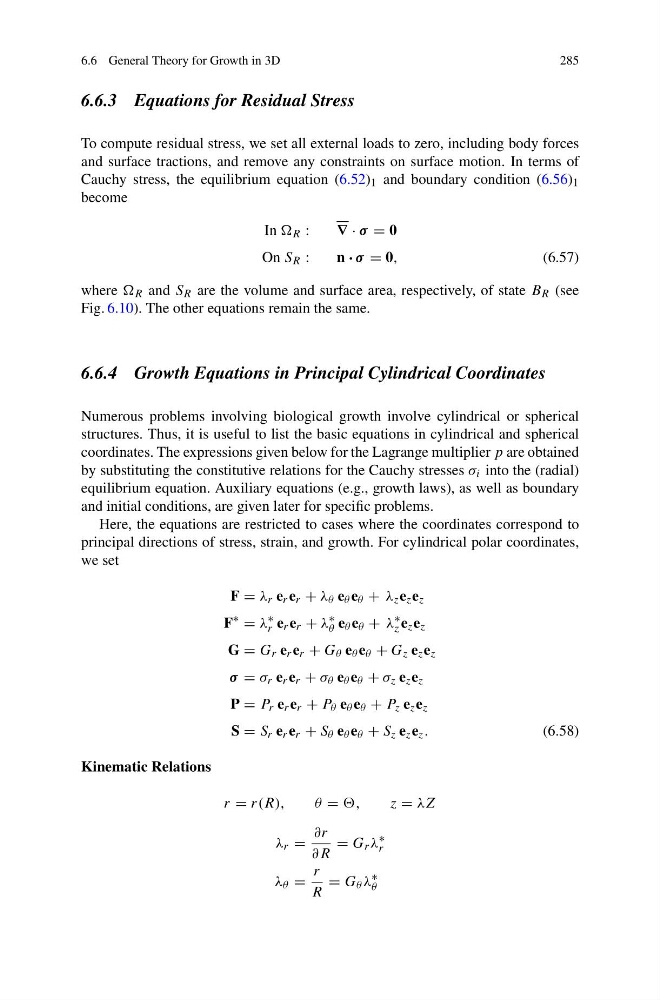
Here, the equations are restricted to cases where the coordinates correspond to
principal directions of stress, strain, and growth. For cylindrical polar coordinates,
we set
F = λ r e r e r + λ θ e θ e θ + λ z e z e z
F
∗
= λ
∗
r e r e r + λ
∗
θ e θ e θ + λ
∗
z e z e z
G = G r e r e r + G θ e θ e θ + G z e z e z
σ = σ r e r e r + σ θ e θ e θ + σ z e z e z
P = P r e r e r + P θ e θ e θ + P z e z e z
S = S r e r e r + S θ e θ e θ + S z e z e z .
(6.58)
Kinematic Relations
r = r(R),
θ = ,
z = λZ
λ r =
∂r
∂R
= G r λ
∗
r
λ θ =
r
R
= G θ λ
∗
θ
285
6.6.3 Equations for Residual Stress
To compute residual stress, we set all external loads to zero, including body forces
and surface tractions, and remove any constraints on surface motion. In terms of
Cauchy stress, the equilibrium equation (6.52) 1 and boundary condition (6.56) 1
become
In R :
∇ · σ = 0
On S R :
n · σ = 0,
(6.57)
where R and S R are the volume and surface area, respectively, of state B R (see
Fig. 6.10). The other equations remain the same.
6.6.4 Growth Equations in Principal Cylindrical Coordinates
Numerous problems involving biological growth involve cylindrical or spherical
structures. Thus, it is useful to list the basic equations in cylindrical and spherical
coordinates. The expressions given below for the Lagrange multiplier p are obtained
by substituting the constitutive relations for the Cauchy stresses σ i into the (radial)
equilibrium equation. Auxiliary equations (e.g., growth laws), as well as boundary
and initial conditions, are given later for specific problems.
Here, the equations are restricted to cases where the coordinates correspond to
principal directions of stress, strain, and growth. For cylindrical polar coordinates,
we set
F = λ r e r e r + λ θ e θ e θ + λ z e z e z
F
∗
= λ
∗
r e r e r + λ
∗
θ e θ e θ + λ
∗
z e z e z
G = G r e r e r + G θ e θ e θ + G z e z e z
σ = σ r e r e r + σ θ e θ e θ + σ z e z e z
P = P r e r e r + P θ e θ e θ + P z e z e z
S = S r e r e r + S θ e θ e θ + S z e z e z .
(6.58)
Kinematic Relations
r = r(R),
θ = ,
z = λZ
λ r =
∂r
∂R
= G r λ
∗
r
λ θ =
r
R
= G θ λ
∗
θ