

284
6 Growth
E =
1
2 (F
T
· F − I)
=
1
2
∇u + (∇u)
T
+ (∇u) · (∇u)
T
E
∗
=
1
2 (F
∗T
· F
∗
− I)
(6.51)
Incompressibility
J
∗
= 1
Equilibrium
∇ · σ + f = 0
∇ · P + f 0 = 0
∇ · (S · F
T )+f 0 = 0
(6.52)
Constitutive Relations
σ =
1
J ∗ F
∗
·
∂W ∗
∂E ∗ · F
∗T
− p I =
1
J ∗ F
∗
·
∂W ∗
∂F ∗T − p I
P = J F
−1
· σ
S = J F
−1
· σ · F
−T
(6.53)
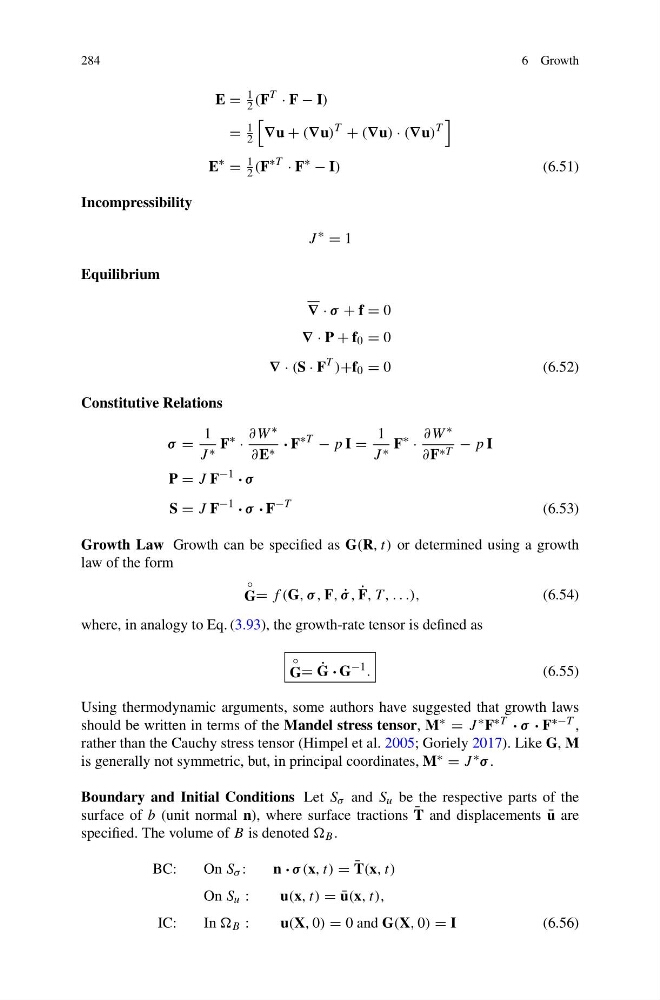
Growth Law Growth can be specified as G(R, t) or determined using a growth
law of the form
◦
G= f (G, σ , F, ˙
σ , ˙
F, T , . . .),
(6.54)
where, in analogy to Eq. (3.93), the growth-rate tensor is defined as
◦
G= ˙
G · G −1 .
(6.55)
Using thermodynamic arguments, some authors have suggested that growth laws
should be written in terms of the Mandel stress tensor, M ∗ = J ∗ F ∗T · σ · F ∗−T ,
rather than the Cauchy stress tensor (Himpel et al. 2005; Goriely 2017). Like G, M
is generally not symmetric, but, in principal coordinates, M ∗ = J ∗ σ .
Boundary and Initial Conditions Let S σ and S u be the respective parts of the
surface of b (unit normal n), where surface tractions ¯
T and displacements ¯
u are
specified. The volume of B is denoted B .
BC:
On S σ :
n · σ (x, t) = ¯
T(x, t)
On S u :
u(x, t) = ¯
u(x, t),
IC:
In B :
u(X, 0) = 0 and G(X, 0) = I
(6.56)
6 Growth
E =
1
2 (F
T
· F − I)
=
1
2
∇u + (∇u)
T
+ (∇u) · (∇u)
T
E
∗
=
1
2 (F
∗T
· F
∗
− I)
(6.51)
Incompressibility
J
∗
= 1
Equilibrium
∇ · σ + f = 0
∇ · P + f 0 = 0
∇ · (S · F
T )+f 0 = 0
(6.52)
Constitutive Relations
σ =
1
J ∗ F
∗
·
∂W ∗
∂E ∗ · F
∗T
− p I =
1
J ∗ F
∗
·
∂W ∗
∂F ∗T − p I
P = J F
−1
· σ
S = J F
−1
· σ · F
−T
(6.53)
Growth Law Growth can be specified as G(R, t) or determined using a growth
law of the form
◦
G= f (G, σ , F, ˙
σ , ˙
F, T , . . .),
(6.54)
where, in analogy to Eq. (3.93), the growth-rate tensor is defined as
◦
G= ˙
G · G −1 .
(6.55)
Using thermodynamic arguments, some authors have suggested that growth laws
should be written in terms of the Mandel stress tensor, M ∗ = J ∗ F ∗T · σ · F ∗−T ,
rather than the Cauchy stress tensor (Himpel et al. 2005; Goriely 2017). Like G, M
is generally not symmetric, but, in principal coordinates, M ∗ = J ∗ σ .
Boundary and Initial Conditions Let S σ and S u be the respective parts of the
surface of b (unit normal n), where surface tractions ¯
T and displacements ¯
u are
specified. The volume of B is denoted B .
BC:
On S σ :
n · σ (x, t) = ¯
T(x, t)
On S u :
u(x, t) = ¯
u(x, t),
IC:
In B :
u(X, 0) = 0 and G(X, 0) = I
(6.56)