

282
6 Growth
(Skalak 1981; Skalak et al. 1982; Tozeren and Skalak 1988). The RHM theory
for volumetric growth, which is presented below, extends the linear formulation
of Skalak and coworkers to the nonlinear regime (Rodriguez et al. 1994).
6.6.1 Configurations for a Growing Body
Suppose an elastic body undergoes growth and deformation in transforming from
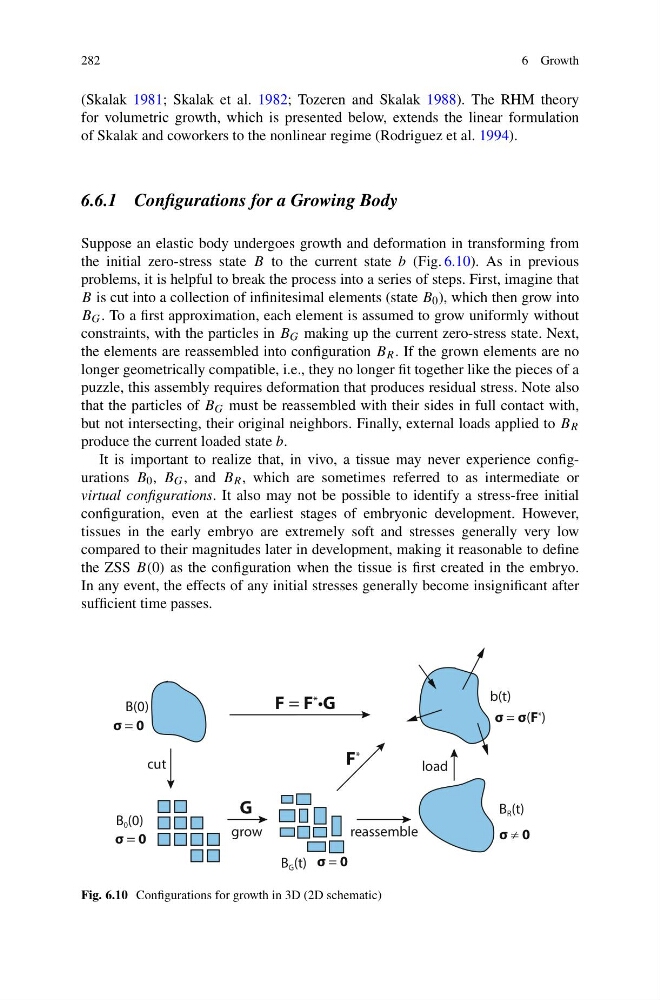
the initial zero-stress state B to the current state b (Fig. 6.10). As in previous
problems, it is helpful to break the process into a series of steps. First, imagine that
B is cut into a collection of infinitesimal elements (state B 0 ), which then grow into
B G . To a first approximation, each element is assumed to grow uniformly without
constraints, with the particles in B G making up the current zero-stress state. Next,
the elements are reassembled into configuration B R . If the grown elements are no
longer geometrically compatible, i.e., they no longer fit together like the pieces of a
puzzle, this assembly requires deformation that produces residual stress. Note also
that the particles of B G must be reassembled with their sides in full contact with,
but not intersecting, their original neighbors. Finally, external loads applied to B R
produce the current loaded state b.
It is important to realize that, in vivo, a tissue may never experience configurations B 0 , B G , and B R , which are sometimes referred to as intermediate or
virtual configurations. It also may not be possible to identify a stress-free initial
configuration, even at the earliest stages of embryonic development. However,
tissues in the early embryo are extremely soft and stresses generally very low
compared to their magnitudes later in development, making it reasonable to define
the ZSS B(0) as the configuration when the tissue is first created in the embryo.
In any event, the effects of any initial stresses generally become insignificant after
sufficient time passes.
B(0)
B G (t)
B R (t)
b(t)
B 0 (0)
F = F * •G
G
F *
σ = 0
σ = 0
σ = 0
σ = σ(F * )
σ ≠ 0
cut
grow
reassemble
load
Fig. 6.10 Configurations for growth in 3D (2D schematic)
6 Growth
(Skalak 1981; Skalak et al. 1982; Tozeren and Skalak 1988). The RHM theory
for volumetric growth, which is presented below, extends the linear formulation
of Skalak and coworkers to the nonlinear regime (Rodriguez et al. 1994).
6.6.1 Configurations for a Growing Body
Suppose an elastic body undergoes growth and deformation in transforming from
the initial zero-stress state B to the current state b (Fig. 6.10). As in previous
problems, it is helpful to break the process into a series of steps. First, imagine that
B is cut into a collection of infinitesimal elements (state B 0 ), which then grow into
B G . To a first approximation, each element is assumed to grow uniformly without
constraints, with the particles in B G making up the current zero-stress state. Next,
the elements are reassembled into configuration B R . If the grown elements are no
longer geometrically compatible, i.e., they no longer fit together like the pieces of a
puzzle, this assembly requires deformation that produces residual stress. Note also
that the particles of B G must be reassembled with their sides in full contact with,
but not intersecting, their original neighbors. Finally, external loads applied to B R
produce the current loaded state b.
It is important to realize that, in vivo, a tissue may never experience configurations B 0 , B G , and B R , which are sometimes referred to as intermediate or
virtual configurations. It also may not be possible to identify a stress-free initial
configuration, even at the earliest stages of embryonic development. However,
tissues in the early embryo are extremely soft and stresses generally very low
compared to their magnitudes later in development, making it reasonable to define
the ZSS B(0) as the configuration when the tissue is first created in the embryo.
In any event, the effects of any initial stresses generally become insignificant after
sufficient time passes.
B(0)
B G (t)
B R (t)
b(t)
B 0 (0)
F = F * •G
G
F *
σ = 0
σ = 0
σ = 0
σ = σ(F * )
σ ≠ 0
cut
grow
reassemble
load
Fig. 6.10 Configurations for growth in 3D (2D schematic)