

6.6 General Theory for Growth in 3D
281
P
P
M
M
+
r
E T
r
E T
r
E T
Residual strain
Pressure strain
Total strain
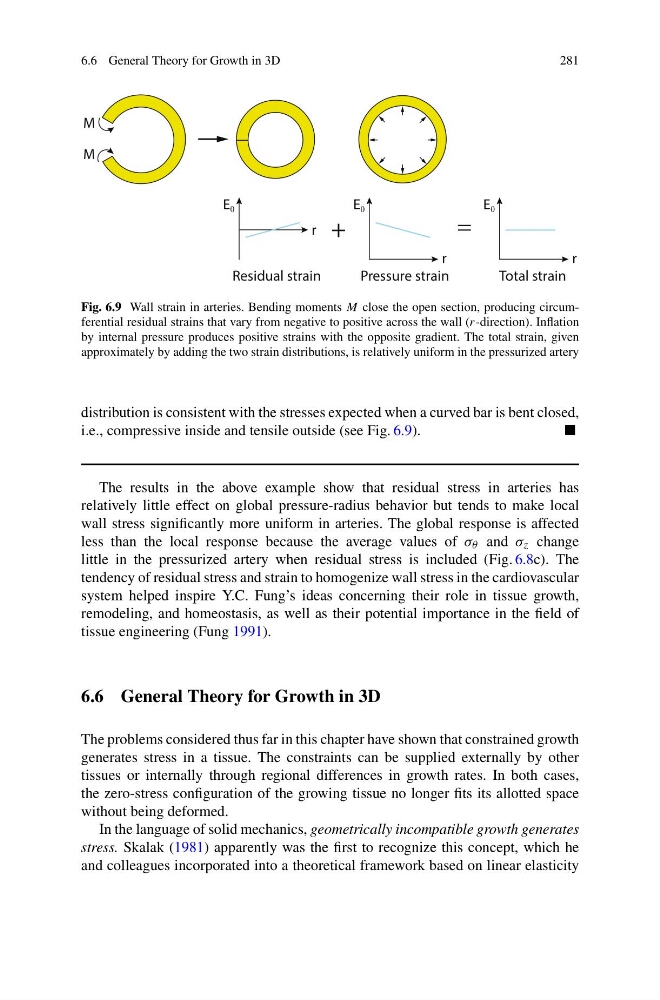
Fig. 6.9 Wall strain in arteries. Bending moments M close the open section, producing circumferential residual strains that vary from negative to positive across the wall (r-direction). Inflation
by internal pressure produces positive strains with the opposite gradient. The total strain, given
approximately by adding the two strain distributions, is relatively uniform in the pressurized artery
distribution is consistent with the stresses expected when a curved bar is bent closed,
i.e., compressive inside and tensile outside (see Fig. 6.9).
The results in the above example show that residual stress in arteries has
relatively little effect on global pressure-radius behavior but tends to make local
wall stress significantly more uniform in arteries. The global response is affected
less than the local response because the average values of σ θ and σ z change
little in the pressurized artery when residual stress is included (Fig. 6.8c). The
tendency of residual stress and strain to homogenize wall stress in the cardiovascular
system helped inspire Y.C. Fung’s ideas concerning their role in tissue growth,
remodeling, and homeostasis, as well as their potential importance in the field of
tissue engineering (Fung 1991).
6.6 General Theory for Growth in 3D
The problems considered thus far in this chapter have shown that constrained growth
generates stress in a tissue. The constraints can be supplied externally by other
tissues or internally through regional differences in growth rates. In both cases,
the zero-stress configuration of the growing tissue no longer fits its allotted space
without being deformed.
In the language of solid mechanics, geometrically incompatible growth generates
stress. Skalak (1981) apparently was the first to recognize this concept, which he
and colleagues incorporated into a theoretical framework based on linear elasticity
281
P
P
M
M
+
r
E T
r
E T
r
E T
Residual strain
Pressure strain
Total strain
Fig. 6.9 Wall strain in arteries. Bending moments M close the open section, producing circumferential residual strains that vary from negative to positive across the wall (r-direction). Inflation
by internal pressure produces positive strains with the opposite gradient. The total strain, given
approximately by adding the two strain distributions, is relatively uniform in the pressurized artery
distribution is consistent with the stresses expected when a curved bar is bent closed,
i.e., compressive inside and tensile outside (see Fig. 6.9).
The results in the above example show that residual stress in arteries has
relatively little effect on global pressure-radius behavior but tends to make local
wall stress significantly more uniform in arteries. The global response is affected
less than the local response because the average values of σ θ and σ z change
little in the pressurized artery when residual stress is included (Fig. 6.8c). The
tendency of residual stress and strain to homogenize wall stress in the cardiovascular
system helped inspire Y.C. Fung’s ideas concerning their role in tissue growth,
remodeling, and homeostasis, as well as their potential importance in the field of
tissue engineering (Fung 1991).
6.6 General Theory for Growth in 3D
The problems considered thus far in this chapter have shown that constrained growth
generates stress in a tissue. The constraints can be supplied externally by other
tissues or internally through regional differences in growth rates. In both cases,
the zero-stress configuration of the growing tissue no longer fits its allotted space
without being deformed.
In the language of solid mechanics, geometrically incompatible growth generates
stress. Skalak (1981) apparently was the first to recognize this concept, which he
and colleagues incorporated into a theoretical framework based on linear elasticity