

258
6 Growth
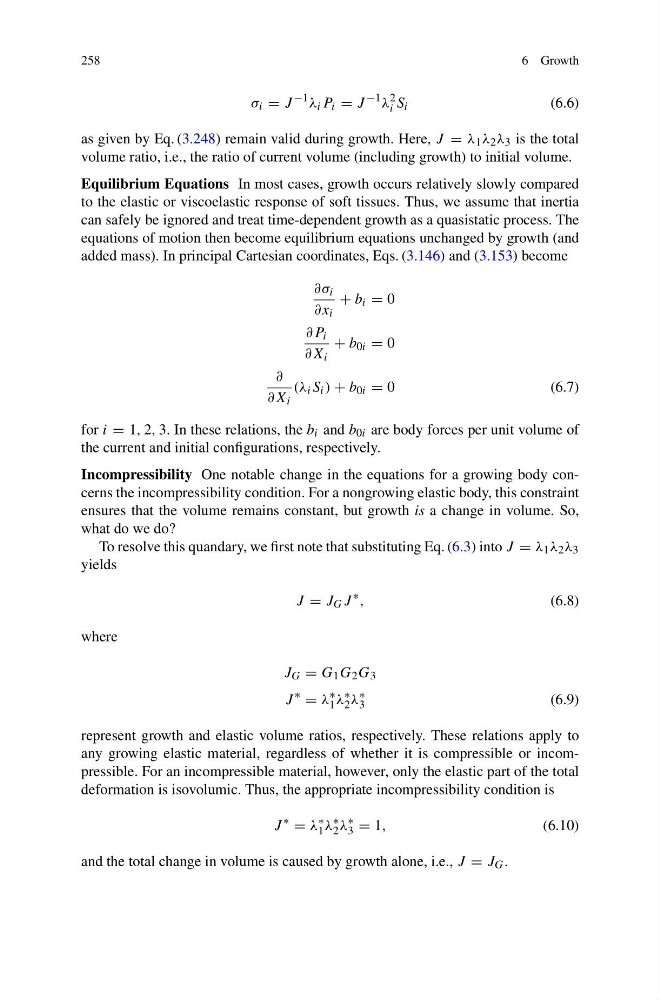
σ i = J
−1 λ i P i = J
−1 λ
2
i S i
(6.6)
as given by Eq. (3.248) remain valid during growth. Here, J = λ 1 λ 2 λ 3 is the total
volume ratio, i.e., the ratio of current volume (including growth) to initial volume.
Equilibrium Equations In most cases, growth occurs relatively slowly compared
to the elastic or viscoelastic response of soft tissues. Thus, we assume that inertia
can safely be ignored and treat time-dependent growth as a quasistatic process. The
equations of motion then become equilibrium equations unchanged by growth (and
added mass). In principal Cartesian coordinates, Eqs. (3.146) and (3.153) become
∂σ i
∂x i
+ b i = 0
∂P i
∂X i
+ b 0i = 0
∂
∂X i
(λ i S i ) + b 0i = 0
(6.7)
for i = 1, 2, 3. In these relations, the b i and b 0i are body forces per unit volume of
the current and initial configurations, respectively.
Incompressibility One notable change in the equations for a growing body concerns the incompressibility condition. For a nongrowing elastic body, this constraint
ensures that the volume remains constant, but growth is a change in volume. So,
what do we do?
To resolve this quandary, we first note that substituting Eq. (6.3) into J = λ 1 λ 2 λ 3
yields
J = J G J
∗ ,
(6.8)
where
J G = G 1 G 2 G 3
J
∗
= λ
∗
1 λ
∗
2 λ
∗
3
(6.9)
represent growth and elastic volume ratios, respectively. These relations apply to
any growing elastic material, regardless of whether it is compressible or incompressible. For an incompressible material, however, only the elastic part of the total
deformation is isovolumic. Thus, the appropriate incompressibility condition is
J
∗
= λ
∗
1 λ
∗
2 λ
∗
3 = 1,
(6.10)
and the total change in volume is caused by growth alone, i.e., J = J G .
6 Growth
σ i = J
−1 λ i P i = J
−1 λ
2
i S i
(6.6)
as given by Eq. (3.248) remain valid during growth. Here, J = λ 1 λ 2 λ 3 is the total
volume ratio, i.e., the ratio of current volume (including growth) to initial volume.
Equilibrium Equations In most cases, growth occurs relatively slowly compared
to the elastic or viscoelastic response of soft tissues. Thus, we assume that inertia
can safely be ignored and treat time-dependent growth as a quasistatic process. The
equations of motion then become equilibrium equations unchanged by growth (and
added mass). In principal Cartesian coordinates, Eqs. (3.146) and (3.153) become
∂σ i
∂x i
+ b i = 0
∂P i
∂X i
+ b 0i = 0
∂
∂X i
(λ i S i ) + b 0i = 0
(6.7)
for i = 1, 2, 3. In these relations, the b i and b 0i are body forces per unit volume of
the current and initial configurations, respectively.
Incompressibility One notable change in the equations for a growing body concerns the incompressibility condition. For a nongrowing elastic body, this constraint
ensures that the volume remains constant, but growth is a change in volume. So,
what do we do?
To resolve this quandary, we first note that substituting Eq. (6.3) into J = λ 1 λ 2 λ 3
yields
J = J G J
∗ ,
(6.8)
where
J G = G 1 G 2 G 3
J
∗
= λ
∗
1 λ
∗
2 λ
∗
3
(6.9)
represent growth and elastic volume ratios, respectively. These relations apply to
any growing elastic material, regardless of whether it is compressible or incompressible. For an incompressible material, however, only the elastic part of the total
deformation is isovolumic. Thus, the appropriate incompressibility condition is
J
∗
= λ
∗
1 λ
∗
2 λ
∗
3 = 1,
(6.10)
and the total change in volume is caused by growth alone, i.e., J = J G .