

6.3 Equations for a Growing Bar
257
growth equilibrium or a homeostatic state, and G > 1 corresponding to positive
growth. It is important to realize that a homeostatic state implies the absence of
net growth; during homeostasis, the element may continue to grow, but the rate of
negative growth equals the rate of positive growth. In the present theory, only the
net growth influences mechanical behavior.
Equation (6.2) illustrates the link between RHM theory and elastoplasticity,
whereby growth is treated like plastic (permanent) deformation. However, positive
growth in biological tissues can effectively be reversed through atrophy. Thus,
thermoelasticity may be a better analogy, with positive and negative growth corresponding to thermal expansion (on heating) and shrinkage (on cooling), respectively.
6.3.2 Growth Equations in Principal Cartesian Coordinates
Consider a rectangular bar that grows orthotropically so that it remains straight and
rectangular. Let X i and x i (i = 1, 2, 3) be respective material and spatial Cartesian
coordinates aligned with the bar geometry. Since the bar remains rectangular (no
shear), these also are principal coordinates of stress and strain, and, with some
modification to accommodate growth, the equations in Sect. 3.7.3 apply here as well.
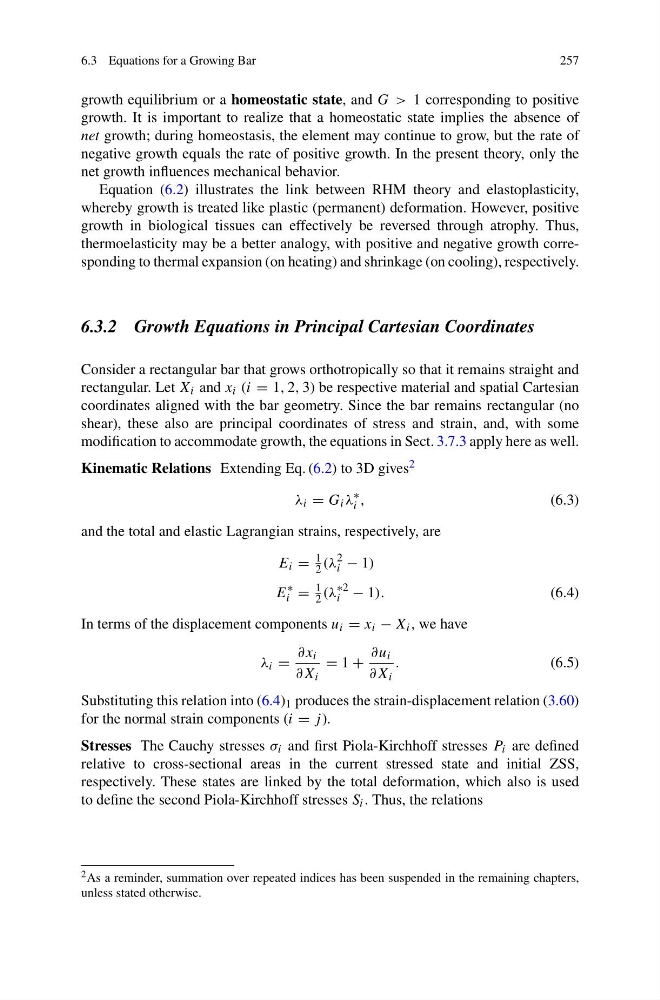
Kinematic Relations Extending Eq. (6.2) to 3D gives 2
λ i = G i λ
∗
i ,
(6.3)
and the total and elastic Lagrangian strains, respectively, are
E i =
1
2 (λ
2
i − 1)
E
∗
i =
1
2 (λ
∗2
i − 1).
(6.4)
In terms of the displacement components u i = x i − X i , we have
λ i =
∂x i
∂X i
= 1 +
∂u i
∂X i
.
(6.5)
Substituting this relation into (6.4) 1 produces the strain-displacement relation (3.60)
for the normal strain components (i = j ).
Stresses The Cauchy stresses σ i and first Piola-Kirchhoff stresses P i are defined
relative to cross-sectional areas in the current stressed state and initial ZSS,
respectively. These states are linked by the total deformation, which also is used
to define the second Piola-Kirchhoff stresses S i . Thus, the relations
2 As a reminder, summation over repeated indices has been suspended in the remaining chapters,
unless stated otherwise.
257
growth equilibrium or a homeostatic state, and G > 1 corresponding to positive
growth. It is important to realize that a homeostatic state implies the absence of
net growth; during homeostasis, the element may continue to grow, but the rate of
negative growth equals the rate of positive growth. In the present theory, only the
net growth influences mechanical behavior.
Equation (6.2) illustrates the link between RHM theory and elastoplasticity,
whereby growth is treated like plastic (permanent) deformation. However, positive
growth in biological tissues can effectively be reversed through atrophy. Thus,
thermoelasticity may be a better analogy, with positive and negative growth corresponding to thermal expansion (on heating) and shrinkage (on cooling), respectively.
6.3.2 Growth Equations in Principal Cartesian Coordinates
Consider a rectangular bar that grows orthotropically so that it remains straight and
rectangular. Let X i and x i (i = 1, 2, 3) be respective material and spatial Cartesian
coordinates aligned with the bar geometry. Since the bar remains rectangular (no
shear), these also are principal coordinates of stress and strain, and, with some
modification to accommodate growth, the equations in Sect. 3.7.3 apply here as well.
Kinematic Relations Extending Eq. (6.2) to 3D gives 2
λ i = G i λ
∗
i ,
(6.3)
and the total and elastic Lagrangian strains, respectively, are
E i =
1
2 (λ
2
i − 1)
E
∗
i =
1
2 (λ
∗2
i − 1).
(6.4)
In terms of the displacement components u i = x i − X i , we have
λ i =
∂x i
∂X i
= 1 +
∂u i
∂X i
.
(6.5)
Substituting this relation into (6.4) 1 produces the strain-displacement relation (3.60)
for the normal strain components (i = j ).
Stresses The Cauchy stresses σ i and first Piola-Kirchhoff stresses P i are defined
relative to cross-sectional areas in the current stressed state and initial ZSS,
respectively. These states are linked by the total deformation, which also is used
to define the second Piola-Kirchhoff stresses S i . Thus, the relations
2 As a reminder, summation over repeated indices has been suspended in the remaining chapters,
unless stated otherwise.