

5.5 Case Study: Cardiac Mechanics
247
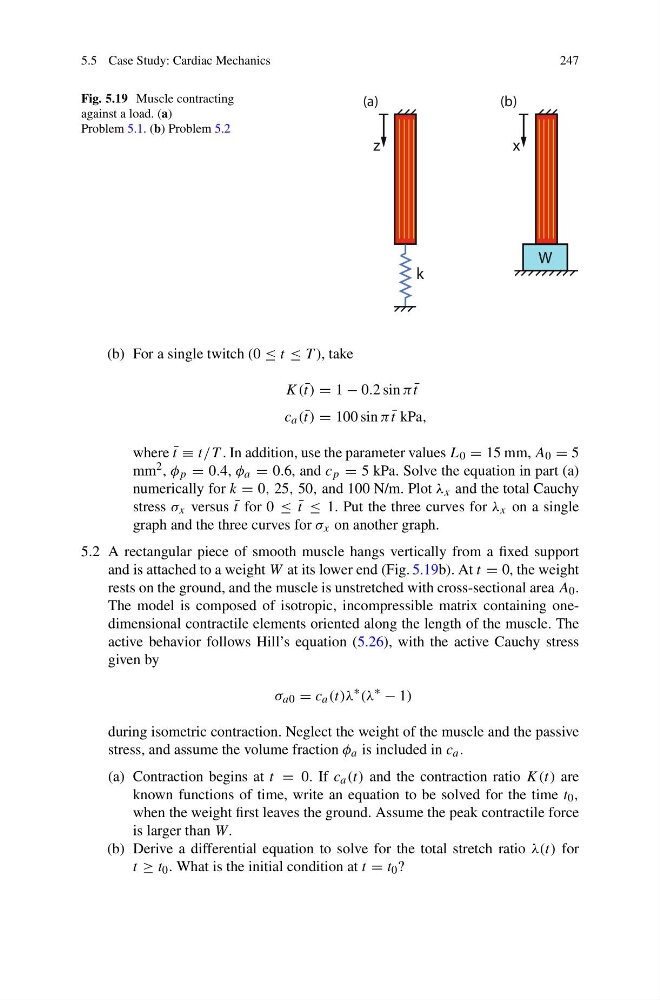
Fig. 5.19 Muscle contracting
against a load. (a)
Problem 5.1. (b) Problem 5.2
k
(b)
z
x
W
(a)
(b) For a single twitch (0 ≤ t ≤ T ), take
K(¯ t) = 1 − 0.2 sin π ¯
t
c a (¯ t) = 100 sin π ¯
t kPa,
where ¯
t ≡ t/T . In addition, use the parameter values L 0 = 15 mm, A 0 = 5
mm 2 , φ p = 0.4, φ a = 0.6, and c p = 5 kPa. Solve the equation in part (a)
numerically for k = 0, 25, 50, and 100 N/m. Plot λ x and the total Cauchy
stress σ x versus ¯
t for 0 ≤ ¯
t ≤ 1. Put the three curves for λ x on a single
graph and the three curves for σ x on another graph.
5.2 A rectangular piece of smooth muscle hangs vertically from a fixed support
and is attached to a weight W at its lower end (Fig. 5.19b). At t = 0, the weight
rests on the ground, and the muscle is unstretched with cross-sectional area A 0 .
The model is composed of isotropic, incompressible matrix containing onedimensional contractile elements oriented along the length of the muscle. The
active behavior follows Hill’s equation (5.26), with the active Cauchy stress
given by
σ a0 = c a (t)λ
∗ (λ
∗
− 1)
during isometric contraction. Neglect the weight of the muscle and the passive
stress, and assume the volume fraction φ a is included in c a .
(a) Contraction begins at t = 0. If c a (t) and the contraction ratio K(t) are
known functions of time, write an equation to be solved for the time t 0 ,
when the weight first leaves the ground. Assume the peak contractile force
is larger than W.
(b) Derive a differential equation to solve for the total stretch ratio λ(t) for
t ≥ t 0 . What is the initial condition at t = t 0 ?
247
Fig. 5.19 Muscle contracting
against a load. (a)
Problem 5.1. (b) Problem 5.2
k
(b)
z
x
W
(a)
(b) For a single twitch (0 ≤ t ≤ T ), take
K(¯ t) = 1 − 0.2 sin π ¯
t
c a (¯ t) = 100 sin π ¯
t kPa,
where ¯
t ≡ t/T . In addition, use the parameter values L 0 = 15 mm, A 0 = 5
mm 2 , φ p = 0.4, φ a = 0.6, and c p = 5 kPa. Solve the equation in part (a)
numerically for k = 0, 25, 50, and 100 N/m. Plot λ x and the total Cauchy
stress σ x versus ¯
t for 0 ≤ ¯
t ≤ 1. Put the three curves for λ x on a single
graph and the three curves for σ x on another graph.
5.2 A rectangular piece of smooth muscle hangs vertically from a fixed support
and is attached to a weight W at its lower end (Fig. 5.19b). At t = 0, the weight
rests on the ground, and the muscle is unstretched with cross-sectional area A 0 .
The model is composed of isotropic, incompressible matrix containing onedimensional contractile elements oriented along the length of the muscle. The
active behavior follows Hill’s equation (5.26), with the active Cauchy stress
given by
σ a0 = c a (t)λ
∗ (λ
∗
− 1)
during isometric contraction. Neglect the weight of the muscle and the passive
stress, and assume the volume fraction φ a is included in c a .
(a) Contraction begins at t = 0. If c a (t) and the contraction ratio K(t) are
known functions of time, write an equation to be solved for the time t 0 ,
when the weight first leaves the ground. Assume the peak contractile force
is larger than W.
(b) Derive a differential equation to solve for the total stretch ratio λ(t) for
t ≥ t 0 . What is the initial condition at t = t 0 ?