

246
5 Contraction
Note the increase in wall thickness indicated by the curves during systole, as well
as the result that the maximum stress occurs at the beginning of ejection (point C).
Comparing these results with those for inflation of a tube with circumferential fibers
(Fig. 4.10b, page 180) shows that the variation in fiber angle across the wall leads to
more complex stress distributions.
Results are also shown for β 0 = 80 ◦ (dashed curves in Fig. 5.18). Whereas the
global pressure-volume behavior is affected only marginally, the stress distributions
change markedly. Notably, the peak fiber stress moves from near the lumen toward
the interior of the wall.
Finally, for β 0 = 60 ◦ , the angle of twist per unit length has values ψ =
−0.002, −0.01, 0.01 and 0.06 rad/cm at points A, B, C, and D, respectively.
Thus, ψ changes relatively little during diastolic filling (A–B) and isovolumic
contraction (B–C). Then, it increases and decreases rapidly during ejection (C–D)
and isovolumic relaxation (D–A), respectively. The predicted increase in ψ from
end diastole (B) to end systole (D) is about 0.07 rad/cm. These results agree well
with experimental measurements for the dog LV (Beyar et al. 1989). The rapid
untwisting during isovolumic relaxation is primarily caused by elastic recoil, as
the strain energy stored in the myocardium during contraction is released when the
ventricle relaxes (Taber et al. 1996).
Problems
5.1 A papillary muscle is modeled as a pseudoelastic cylindrical bar containing
axially aligned contractile elements embedded in a passive isotropic matrix,
with volume fractions φ a and φ p , respectively. In cylindrical coordinates, the
passive and active strain-energy density functions are given by
W p = c p (I 1 − 3)
2
W a = c a (t)
λ
∗
z − 1
2 ,
where I 1 = λ 2
r + λ 2
θ + λ 2
z , and c p and c a are material coefficients. The muscle is
attached to a rigid support at one end and to a linear spring of stiffness k at the
other end (Fig. 5.19a). When the muscle is passive, the spring is not stretched,
and the bar has a length L 0 and uniform cross-sectional area A 0 .
(a) Neglecting velocity effects, derive the following equation to solve for the
axial stretch ratio λ z during a twitch defined by the contraction ratio K(t):
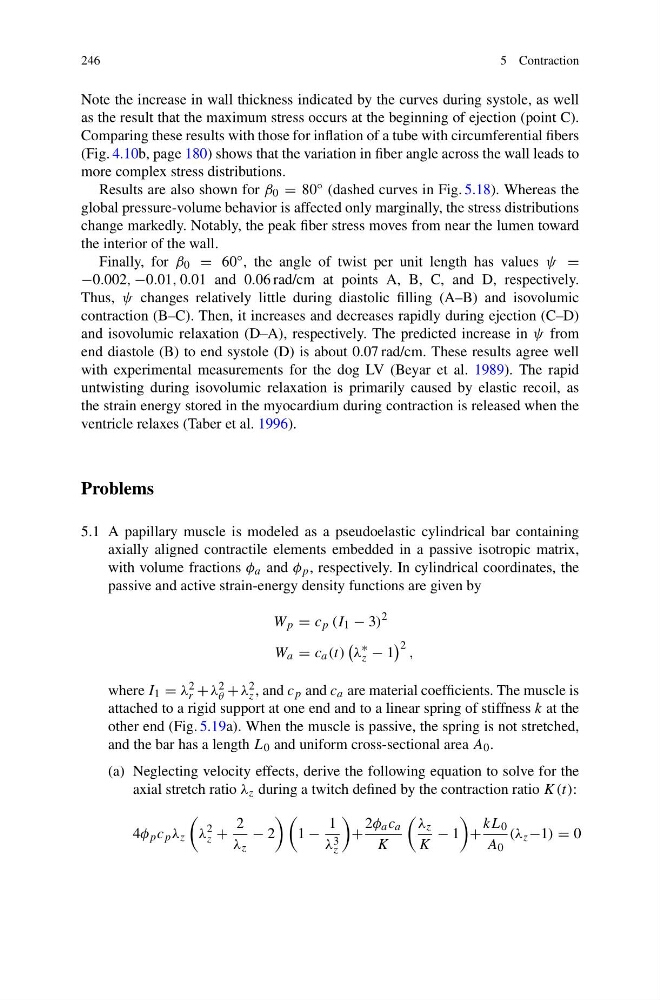
4φ p c p λ z
λ
2
z +
2
λ z
− 2
1 −
1
λ 3
z
+
2φ a c a
K
λ z
K
− 1
+
kL 0
A 0
(λ z −1) = 0
5 Contraction
Note the increase in wall thickness indicated by the curves during systole, as well
as the result that the maximum stress occurs at the beginning of ejection (point C).
Comparing these results with those for inflation of a tube with circumferential fibers
(Fig. 4.10b, page 180) shows that the variation in fiber angle across the wall leads to
more complex stress distributions.
Results are also shown for β 0 = 80 ◦ (dashed curves in Fig. 5.18). Whereas the
global pressure-volume behavior is affected only marginally, the stress distributions
change markedly. Notably, the peak fiber stress moves from near the lumen toward
the interior of the wall.
Finally, for β 0 = 60 ◦ , the angle of twist per unit length has values ψ =
−0.002, −0.01, 0.01 and 0.06 rad/cm at points A, B, C, and D, respectively.
Thus, ψ changes relatively little during diastolic filling (A–B) and isovolumic
contraction (B–C). Then, it increases and decreases rapidly during ejection (C–D)
and isovolumic relaxation (D–A), respectively. The predicted increase in ψ from
end diastole (B) to end systole (D) is about 0.07 rad/cm. These results agree well
with experimental measurements for the dog LV (Beyar et al. 1989). The rapid
untwisting during isovolumic relaxation is primarily caused by elastic recoil, as
the strain energy stored in the myocardium during contraction is released when the
ventricle relaxes (Taber et al. 1996).
Problems
5.1 A papillary muscle is modeled as a pseudoelastic cylindrical bar containing
axially aligned contractile elements embedded in a passive isotropic matrix,
with volume fractions φ a and φ p , respectively. In cylindrical coordinates, the
passive and active strain-energy density functions are given by
W p = c p (I 1 − 3)
2
W a = c a (t)
λ
∗
z − 1
2 ,
where I 1 = λ 2
r + λ 2
θ + λ 2
z , and c p and c a are material coefficients. The muscle is
attached to a rigid support at one end and to a linear spring of stiffness k at the
other end (Fig. 5.19a). When the muscle is passive, the spring is not stretched,
and the bar has a length L 0 and uniform cross-sectional area A 0 .
(a) Neglecting velocity effects, derive the following equation to solve for the
axial stretch ratio λ z during a twitch defined by the contraction ratio K(t):
4φ p c p λ z
λ
2
z +
2
λ z
− 2
1 −
1
λ 3
z
+
2φ a c a
K
λ z
K
− 1
+
kL 0
A 0
(λ z −1) = 0