

5.4 Mechanical Properties of Contractile Fibers
227
(σ z ) a = λ
∗
z
∂W a
∂λ ∗
z
= c a λ
∗
z sin π
λ ∗
z − 1
ˆ
λ ∗
z − 1
(σ r ) a = (σ θ ) a = 0.
(5.33)
With these results, Eqs. (5.10) provide the total stress components
σ r = φ p ( ¯
σ r ) p − p
σ θ = φ p ( ¯
σ θ ) p − p
σ z = φ p ( ¯
σ z ) p + φ a (σ z ) a − p.
(5.34)
Since there is no transverse loading, setting σ r = 0 gives p = φ p ( ¯
σ r ) p . Then,
substituting Eqs. (5.33) into (5.34) 3 and using (5.30) yields
σ z = 2φ p c p
λ
2
z −
1
λ z
e
β(λ 2
z +2/λ z −3)
+ φ a c a (K)
λ z
K
sin π
λ z /K − 1
ˆ
λ z /K − 1
,
(5.35)
where the second term is nonzero only when 1 < λ z /K < ˆ
λ/K.
Results
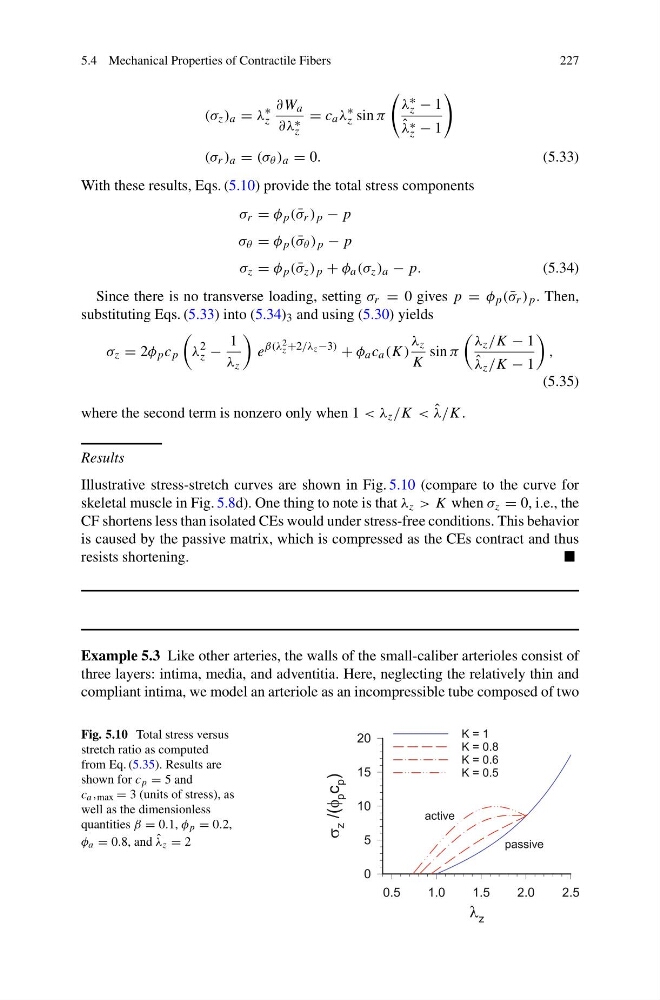
Illustrative stress-stretch curves are shown in Fig. 5.10 (compare to the curve for
skeletal muscle in Fig. 5.8d). One thing to note is that λ z > K when σ z = 0, i.e., the
CF shortens less than isolated CEs would under stress-free conditions. This behavior
is caused by the passive matrix, which is compressed as the CEs contract and thus
resists shortening.
Example 5.3 Like other arteries, the walls of the small-caliber arterioles consist of
three layers: intima, media, and adventitia. Here, neglecting the relatively thin and
compliant intima, we model an arteriole as an incompressible tube composed of two
Fig. 5.10 Total stress versus
stretch ratio as computed
from Eq. (5.35). Results are
shown for c p = 5 and
c a , max = 3 (units of stress), as
well as the dimensionless
quantities β = 0.1, φ p = 0.2,
φ a = 0.8, and ˆ
λ z = 2
227
(σ z ) a = λ
∗
z
∂W a
∂λ ∗
z
= c a λ
∗
z sin π
λ ∗
z − 1
ˆ
λ ∗
z − 1
(σ r ) a = (σ θ ) a = 0.
(5.33)
With these results, Eqs. (5.10) provide the total stress components
σ r = φ p ( ¯
σ r ) p − p
σ θ = φ p ( ¯
σ θ ) p − p
σ z = φ p ( ¯
σ z ) p + φ a (σ z ) a − p.
(5.34)
Since there is no transverse loading, setting σ r = 0 gives p = φ p ( ¯
σ r ) p . Then,
substituting Eqs. (5.33) into (5.34) 3 and using (5.30) yields
σ z = 2φ p c p
λ
2
z −
1
λ z
e
β(λ 2
z +2/λ z −3)
+ φ a c a (K)
λ z
K
sin π
λ z /K − 1
ˆ
λ z /K − 1
,
(5.35)
where the second term is nonzero only when 1 < λ z /K < ˆ
λ/K.
Results
Illustrative stress-stretch curves are shown in Fig. 5.10 (compare to the curve for
skeletal muscle in Fig. 5.8d). One thing to note is that λ z > K when σ z = 0, i.e., the
CF shortens less than isolated CEs would under stress-free conditions. This behavior
is caused by the passive matrix, which is compressed as the CEs contract and thus
resists shortening.
Example 5.3 Like other arteries, the walls of the small-caliber arterioles consist of
three layers: intima, media, and adventitia. Here, neglecting the relatively thin and
compliant intima, we model an arteriole as an incompressible tube composed of two
Fig. 5.10 Total stress versus
stretch ratio as computed
from Eq. (5.35). Results are
shown for c p = 5 and
c a , max = 3 (units of stress), as
well as the dimensionless
quantities β = 0.1, φ p = 0.2,
φ a = 0.8, and ˆ
λ z = 2