

4.6 Inflation of a Spherical Shell
193
which is Laplace’s Law for a pressurized spherical membrane. For future reference,
Laplace’s law for a pressurized cylindrical membrane with closed ends is
σ θ =
p i a
h
,
σ z =
p i a
2h
(4.108)
for the circumferential and longitudinal stresses, respectively.
Typically, the membrane solution is considered accurate for shells with a/ h ≥
20. Many biological structures satisfy this criterion. Even for those that do not, such
as the heart and arteries, membrane theory can provide a useful first approximation
for average wall stresses.
4.6.3 Illustrative Results
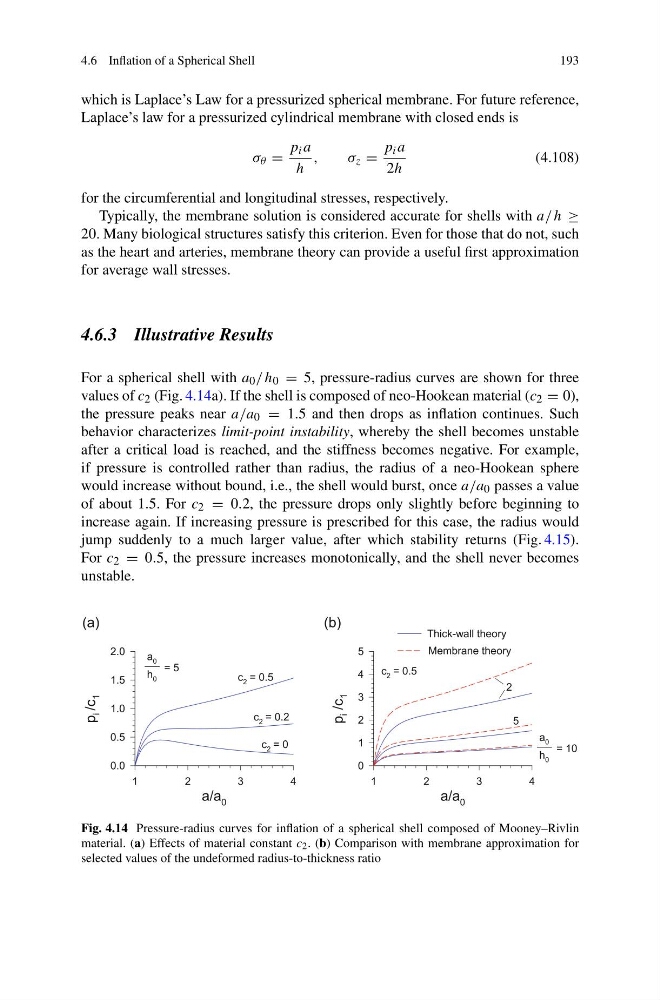
For a spherical shell with a 0 /h 0 = 5, pressure-radius curves are shown for three
values of c 2 (Fig. 4.14a). If the shell is composed of neo-Hookean material (c 2 = 0),
the pressure peaks near a/a 0 = 1.5 and then drops as inflation continues. Such
behavior characterizes limit-point instability, whereby the shell becomes unstable
after a critical load is reached, and the stiffness becomes negative. For example,
if pressure is controlled rather than radius, the radius of a neo-Hookean sphere
would increase without bound, i.e., the shell would burst, once a/a 0 passes a value
of about 1.5. For c 2 = 0.2, the pressure drops only slightly before beginning to
increase again. If increasing pressure is prescribed for this case, the radius would
jump suddenly to a much larger value, after which stability returns (Fig. 4.15).
For c 2 = 0.5, the pressure increases monotonically, and the shell never becomes
unstable.
Fig. 4.14 Pressure-radius curves for inflation of a spherical shell composed of Mooney–Rivlin
material. (a) Effects of material constant c 2 . (b) Comparison with membrane approximation for
selected values of the undeformed radius-to-thickness ratio
193
which is Laplace’s Law for a pressurized spherical membrane. For future reference,
Laplace’s law for a pressurized cylindrical membrane with closed ends is
σ θ =
p i a
h
,
σ z =
p i a
2h
(4.108)
for the circumferential and longitudinal stresses, respectively.
Typically, the membrane solution is considered accurate for shells with a/ h ≥
20. Many biological structures satisfy this criterion. Even for those that do not, such
as the heart and arteries, membrane theory can provide a useful first approximation
for average wall stresses.
4.6.3 Illustrative Results
For a spherical shell with a 0 /h 0 = 5, pressure-radius curves are shown for three
values of c 2 (Fig. 4.14a). If the shell is composed of neo-Hookean material (c 2 = 0),
the pressure peaks near a/a 0 = 1.5 and then drops as inflation continues. Such
behavior characterizes limit-point instability, whereby the shell becomes unstable
after a critical load is reached, and the stiffness becomes negative. For example,
if pressure is controlled rather than radius, the radius of a neo-Hookean sphere
would increase without bound, i.e., the shell would burst, once a/a 0 passes a value
of about 1.5. For c 2 = 0.2, the pressure drops only slightly before beginning to
increase again. If increasing pressure is prescribed for this case, the radius would
jump suddenly to a much larger value, after which stability returns (Fig. 4.15).
For c 2 = 0.5, the pressure increases monotonically, and the shell never becomes
unstable.
Fig. 4.14 Pressure-radius curves for inflation of a spherical shell composed of Mooney–Rivlin
material. (a) Effects of material constant c 2 . (b) Comparison with membrane approximation for
selected values of the undeformed radius-to-thickness ratio