

4.6 Inflation of a Spherical Shell
191
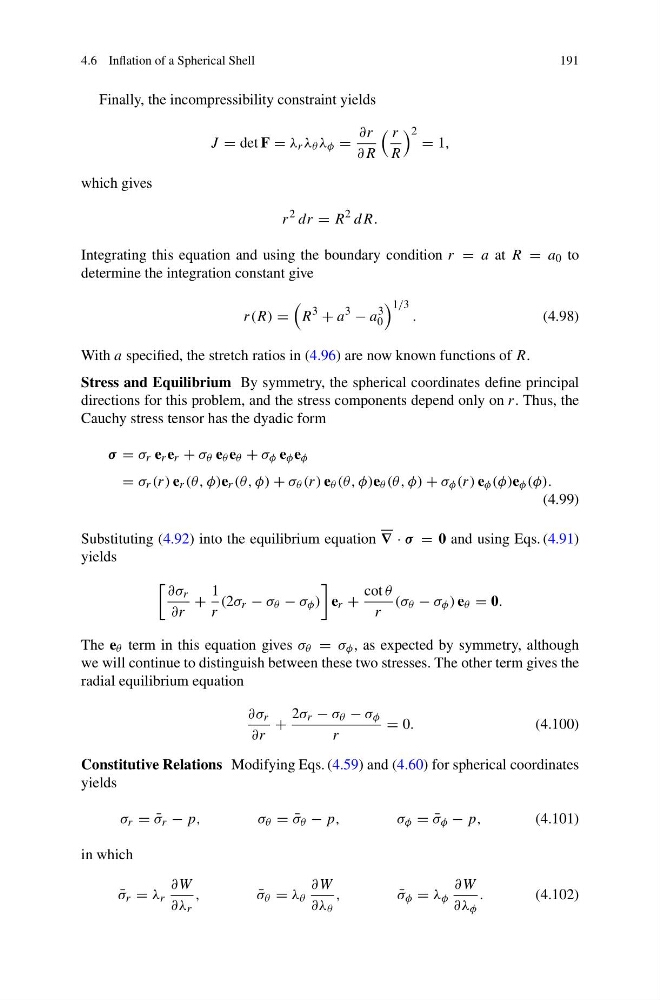
Finally, the incompressibility constraint yields
J = det F = λ r λ θ λ φ =
∂r
∂R
r
R
2 = 1,
which gives
r
2 dr = R
2 dR.
Integrating this equation and using the boundary condition r = a at R = a 0 to
determine the integration constant give
r(R) =
R
3
+ a
3
− a
3
0
1/3
.
(4.98)
With a specified, the stretch ratios in (4.96) are now known functions of R.
Stress and Equilibrium By symmetry, the spherical coordinates define principal
directions for this problem, and the stress components depend only on r. Thus, the
Cauchy stress tensor has the dyadic form
σ = σ r e r e r + σ θ e θ e θ + σ φ e φ e φ
= σ r (r) e r (θ, φ)e r (θ, φ) + σ θ (r) e θ (θ, φ)e θ (θ, φ) + σ φ (r) e φ (φ)e φ (φ).
(4.99)
Substituting (4.92) into the equilibrium equation ∇ · σ = 0 and using Eqs. (4.91)
yields
∂σ r
∂r
+
1
r
(2σ r − σ θ − σ φ )
e r +
cot θ
r
(σ θ − σ φ ) e θ = 0.
The e θ term in this equation gives σ θ = σ φ , as expected by symmetry, although
we will continue to distinguish between these two stresses. The other term gives the
radial equilibrium equation
∂σ r
∂r
+
2σ r − σ θ − σ φ
r
= 0.
(4.100)
Constitutive Relations Modifying Eqs. (4.59) and (4.60) for spherical coordinates
yields
σ r = ¯
σ r − p,
σ θ = ¯
σ θ − p,
σ φ = ¯
σ φ − p,
(4.101)
in which
¯
σ r = λ r
∂W
∂λ r
,
¯
σ θ = λ θ
∂W
∂λ θ
,
¯
σ φ = λ φ
∂W
∂λ φ
.
(4.102)
191
Finally, the incompressibility constraint yields
J = det F = λ r λ θ λ φ =
∂r
∂R
r
R
2 = 1,
which gives
r
2 dr = R
2 dR.
Integrating this equation and using the boundary condition r = a at R = a 0 to
determine the integration constant give
r(R) =
R
3
+ a
3
− a
3
0
1/3
.
(4.98)
With a specified, the stretch ratios in (4.96) are now known functions of R.
Stress and Equilibrium By symmetry, the spherical coordinates define principal
directions for this problem, and the stress components depend only on r. Thus, the
Cauchy stress tensor has the dyadic form
σ = σ r e r e r + σ θ e θ e θ + σ φ e φ e φ
= σ r (r) e r (θ, φ)e r (θ, φ) + σ θ (r) e θ (θ, φ)e θ (θ, φ) + σ φ (r) e φ (φ)e φ (φ).
(4.99)
Substituting (4.92) into the equilibrium equation ∇ · σ = 0 and using Eqs. (4.91)
yields
∂σ r
∂r
+
1
r
(2σ r − σ θ − σ φ )
e r +
cot θ
r
(σ θ − σ φ ) e θ = 0.
The e θ term in this equation gives σ θ = σ φ , as expected by symmetry, although
we will continue to distinguish between these two stresses. The other term gives the
radial equilibrium equation
∂σ r
∂r
+
2σ r − σ θ − σ φ
r
= 0.
(4.100)
Constitutive Relations Modifying Eqs. (4.59) and (4.60) for spherical coordinates
yields
σ r = ¯
σ r − p,
σ θ = ¯
σ θ − p,
σ φ = ¯
σ φ − p,
(4.101)
in which
¯
σ r = λ r
∂W
∂λ r
,
¯
σ θ = λ θ
∂W
∂λ θ
,
¯
σ φ = λ φ
∂W
∂λ φ
.
(4.102)