

4.5 Extension and Torsion of a Cylindrical Bar
183
r(R, ,, Z) = r(R)e r ((, Z) + z(Z)e z .
(4.71)
Computing the deformation gradient tensor using F T = ∇r gives Eq. (4.50), but
with the extra term
re Z
∂e r
∂Z
= re Z
∂e r
∂θ
∂θ
∂Z
= ψre Z e θ ,
since ∂e r /∂θ = e θ . This calculation yields 3
F = F rr e r e R + F θθ e θ e + F zz e z e Z + F θz e θ e Z ,
(4.72)
where
F rr =
∂r
∂R
,
F θθ =
r
R
,
F zz = λ,
F θz = ψr.
(4.73)
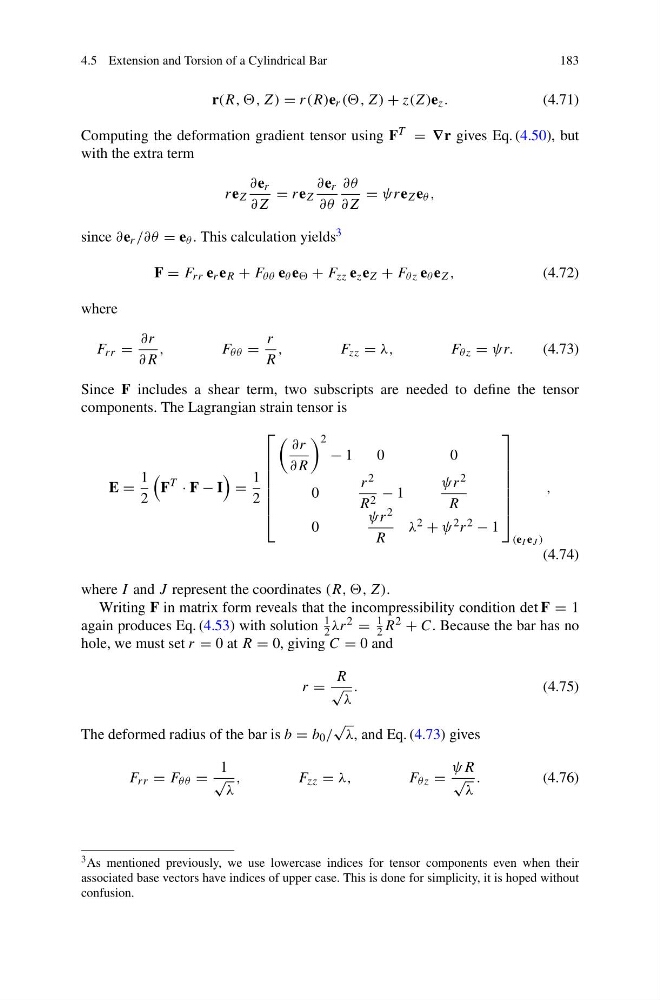
Since F includes a shear term, two subscripts are needed to define the tensor
components. The Lagrangian strain tensor is
E =
1
2
F
T
· F − I
=
1
2
⎡
⎢
⎢
⎢
⎢
⎢
⎢
⎣
∂r
∂R
2
− 1
0
0
0
r 2
R 2 − 1
ψr 2
R
0
ψr 2
R
λ 2 + ψ 2 r 2 − 1
⎤
⎥
⎥
⎥
⎥
⎥
⎥
⎦
(e I e J )
,
(4.74)
where I and J represent the coordinates (R, ,, Z).
Writing F in matrix form reveals that the incompressibility condition det F = 1
again produces Eq. (4.53) with solution
1
2 λr 2 =
1
2 R 2 + C. Because the bar has no
hole, we must set r = 0 at R = 0, giving C = 0 and
r =
R
√
λ
.
(4.75)
The deformed radius of the bar is b = b 0 /
√
λ, and Eq. (4.73) gives
F rr = F θθ =
1
√
λ
,
F zz = λ,
F θz =
ψR
√
λ
.
(4.76)
3 As mentioned previously, we use lowercase indices for tensor components even when their
associated base vectors have indices of upper case. This is done for simplicity, it is hoped without
confusion.
183
r(R, ,, Z) = r(R)e r ((, Z) + z(Z)e z .
(4.71)
Computing the deformation gradient tensor using F T = ∇r gives Eq. (4.50), but
with the extra term
re Z
∂e r
∂Z
= re Z
∂e r
∂θ
∂θ
∂Z
= ψre Z e θ ,
since ∂e r /∂θ = e θ . This calculation yields 3
F = F rr e r e R + F θθ e θ e + F zz e z e Z + F θz e θ e Z ,
(4.72)
where
F rr =
∂r
∂R
,
F θθ =
r
R
,
F zz = λ,
F θz = ψr.
(4.73)
Since F includes a shear term, two subscripts are needed to define the tensor
components. The Lagrangian strain tensor is
E =
1
2
F
T
· F − I
=
1
2
⎡
⎢
⎢
⎢
⎢
⎢
⎢
⎣
∂r
∂R
2
− 1
0
0
0
r 2
R 2 − 1
ψr 2
R
0
ψr 2
R
λ 2 + ψ 2 r 2 − 1
⎤
⎥
⎥
⎥
⎥
⎥
⎥
⎦
(e I e J )
,
(4.74)
where I and J represent the coordinates (R, ,, Z).
Writing F in matrix form reveals that the incompressibility condition det F = 1
again produces Eq. (4.53) with solution
1
2 λr 2 =
1
2 R 2 + C. Because the bar has no
hole, we must set r = 0 at R = 0, giving C = 0 and
r =
R
√
λ
.
(4.75)
The deformed radius of the bar is b = b 0 /
√
λ, and Eq. (4.73) gives
F rr = F θθ =
1
√
λ
,
F zz = λ,
F θz =
ψR
√
λ
.
(4.76)
3 As mentioned previously, we use lowercase indices for tensor components even when their
associated base vectors have indices of upper case. This is done for simplicity, it is hoped without
confusion.