

182
4 Problems in Soft Tissue Biomechanics
d
e
m
r
o
f
e
D
d
e
m
r
o
f
e
d
n
U
Fibers
z
4
Z
R
b 0
M
N
L 0
L
T
.
P
R 4
.
p
r
TT 4+\Z
T
e r
e T
e R
e 4
b 0
R
b
r
)
b
(
)
a
(
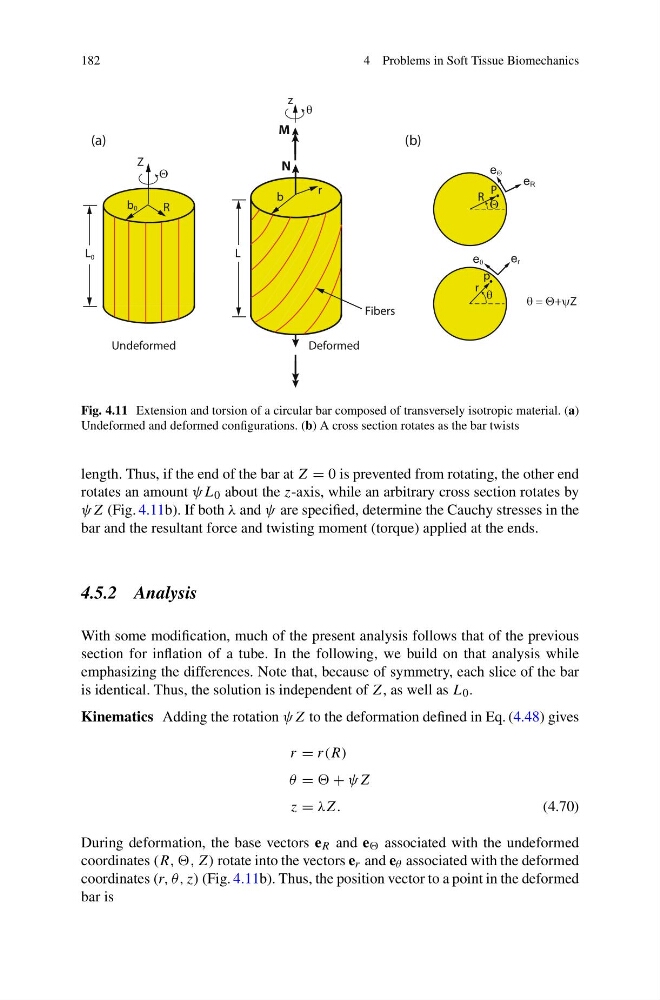
Fig. 4.11 Extension and torsion of a circular bar composed of transversely isotropic material. (a)
Undeformed and deformed configurations. (b) A cross section rotates as the bar twists
length. Thus, if the end of the bar at Z = 0 is prevented from rotating, the other end
rotates an amount ψL 0 about the z-axis, while an arbitrary cross section rotates by
ψZ (Fig. 4.11b). If both λ and ψ are specified, determine the Cauchy stresses in the
bar and the resultant force and twisting moment (torque) applied at the ends.
4.5.2 Analysis
With some modification, much of the present analysis follows that of the previous
section for inflation of a tube. In the following, we build on that analysis while
emphasizing the differences. Note that, because of symmetry, each slice of the bar
is identical. Thus, the solution is independent of Z, as well as L 0 .
Kinematics Adding the rotation ψZ to the deformation defined in Eq. (4.48) gives
r = r(R)
θ = + ψZ
z = λZ.
(4.70)
During deformation, the base vectors e R and e associated with the undeformed
coordinates (R, ,, Z) rotate into the vectors e r and e θ associated with the deformed
coordinates (r, θ, z) (Fig. 4.11b). Thus, the position vector to a point in the deformed
bar is
4 Problems in Soft Tissue Biomechanics
d
e
m
r
o
f
e
D
d
e
m
r
o
f
e
d
n
U
Fibers
z
4
Z
R
b 0
M
N
L 0
L
T
.
P
R 4
.
p
r
TT 4+\Z
T
e r
e T
e R
e 4
b 0
R
b
r
)
b
(
)
a
(
Fig. 4.11 Extension and torsion of a circular bar composed of transversely isotropic material. (a)
Undeformed and deformed configurations. (b) A cross section rotates as the bar twists
length. Thus, if the end of the bar at Z = 0 is prevented from rotating, the other end
rotates an amount ψL 0 about the z-axis, while an arbitrary cross section rotates by
ψZ (Fig. 4.11b). If both λ and ψ are specified, determine the Cauchy stresses in the
bar and the resultant force and twisting moment (torque) applied at the ends.
4.5.2 Analysis
With some modification, much of the present analysis follows that of the previous
section for inflation of a tube. In the following, we build on that analysis while
emphasizing the differences. Note that, because of symmetry, each slice of the bar
is identical. Thus, the solution is independent of Z, as well as L 0 .
Kinematics Adding the rotation ψZ to the deformation defined in Eq. (4.48) gives
r = r(R)
θ = + ψZ
z = λZ.
(4.70)
During deformation, the base vectors e R and e associated with the undeformed
coordinates (R, ,, Z) rotate into the vectors e r and e θ associated with the deformed
coordinates (r, θ, z) (Fig. 4.11b). Thus, the position vector to a point in the deformed
bar is