

130
3 Continuum Mechanics and Nonlinear Elasticity
This book deals with elastic solids. When applied loads are removed, an ideal
elastic solid returns to its original configuration without loss of energy. The work
done during deformation is stored as potential energy, or strain energy, which is
recovered during the unloading phase. Hence, this process is reversible.
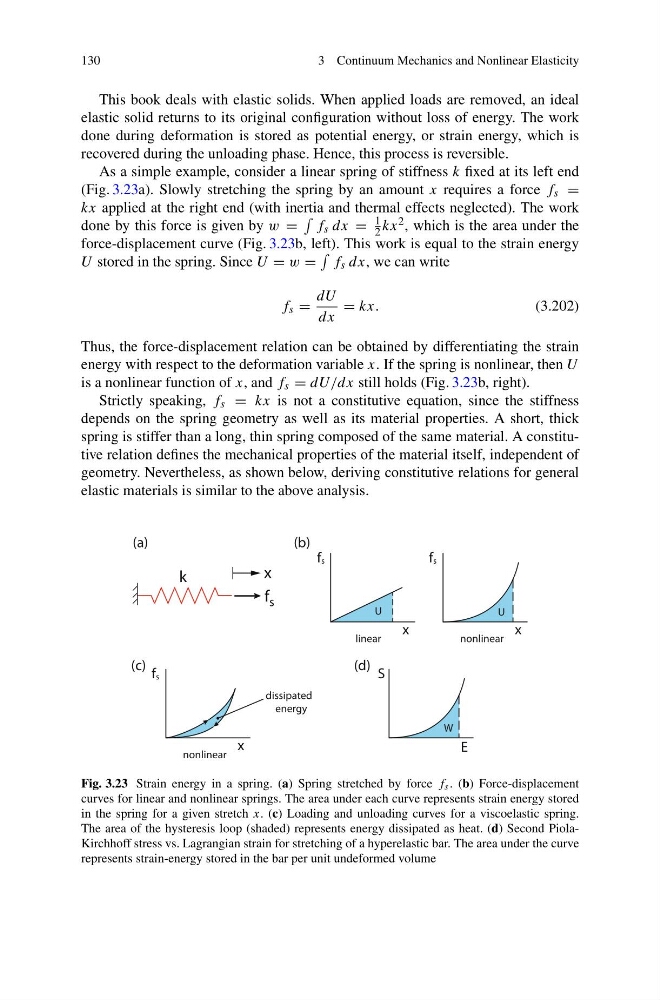
As a simple example, consider a linear spring of stiffness k fixed at its left end
(Fig. 3.23a). Slowly stretching the spring by an amount x requires a force f s =
kx applied at the right end (with inertia and thermal effects neglected). The work
done by this force is given by w =
f s dx =
1
2 kx 2 , which is the area under the
force-displacement curve (Fig. 3.23b, left). This work is equal to the strain energy
U stored in the spring. Since U = w =
f s dx, we can write
f s =
dU
dx
= kx.
(3.202)
Thus, the force-displacement relation can be obtained by differentiating the strain
energy with respect to the deformation variable x. If the spring is nonlinear, then U
is a nonlinear function of x, and f s = dU/dx still holds (Fig. 3.23b, right).
Strictly speaking, f s = kx is not a constitutive equation, since the stiffness
depends on the spring geometry as well as its material properties. A short, thick
spring is stiffer than a long, thin spring composed of the same material. A constitutive relation defines the mechanical properties of the material itself, independent of
geometry. Nevertheless, as shown below, deriving constitutive relations for general
elastic materials is similar to the above analysis.
k
f s
x
(a)
(b)
fs
x
fs
x
linear
nonlinear
U
U
S
E
W
(c)
(d)
fs
x
nonlinear
dissipated
energy
Fig. 3.23 Strain energy in a spring. (a) Spring stretched by force f s . (b) Force-displacement
curves for linear and nonlinear springs. The area under each curve represents strain energy stored
in the spring for a given stretch x. (c) Loading and unloading curves for a viscoelastic spring.
The area of the hysteresis loop (shaded) represents energy dissipated as heat. (d) Second PiolaKirchhoff stress vs. Lagrangian strain for stretching of a hyperelastic bar. The area under the curve
represents strain-energy stored in the bar per unit undeformed volume
3 Continuum Mechanics and Nonlinear Elasticity
This book deals with elastic solids. When applied loads are removed, an ideal
elastic solid returns to its original configuration without loss of energy. The work
done during deformation is stored as potential energy, or strain energy, which is
recovered during the unloading phase. Hence, this process is reversible.
As a simple example, consider a linear spring of stiffness k fixed at its left end
(Fig. 3.23a). Slowly stretching the spring by an amount x requires a force f s =
kx applied at the right end (with inertia and thermal effects neglected). The work
done by this force is given by w =
f s dx =
1
2 kx 2 , which is the area under the
force-displacement curve (Fig. 3.23b, left). This work is equal to the strain energy
U stored in the spring. Since U = w =
f s dx, we can write
f s =
dU
dx
= kx.
(3.202)
Thus, the force-displacement relation can be obtained by differentiating the strain
energy with respect to the deformation variable x. If the spring is nonlinear, then U
is a nonlinear function of x, and f s = dU/dx still holds (Fig. 3.23b, right).
Strictly speaking, f s = kx is not a constitutive equation, since the stiffness
depends on the spring geometry as well as its material properties. A short, thick
spring is stiffer than a long, thin spring composed of the same material. A constitutive relation defines the mechanical properties of the material itself, independent of
geometry. Nevertheless, as shown below, deriving constitutive relations for general
elastic materials is similar to the above analysis.
k
f s
x
(a)
(b)
fs
x
fs
x
linear
nonlinear
U
U
S
E
W
(c)
(d)
fs
x
nonlinear
dissipated
energy
Fig. 3.23 Strain energy in a spring. (a) Spring stretched by force f s . (b) Force-displacement
curves for linear and nonlinear springs. The area under each curve represents strain energy stored
in the spring for a given stretch x. (c) Loading and unloading curves for a viscoelastic spring.
The area of the hysteresis loop (shaded) represents energy dissipated as heat. (d) Second PiolaKirchhoff stress vs. Lagrangian strain for stretching of a hyperelastic bar. The area under the curve
represents strain-energy stored in the bar per unit undeformed volume