

3.6 Constitutive Relations
129
and temporarily introducing Cartesian coordinates yields
∇
1
T
= e i
∂
∂x i
1
T
= e i
−
1
T 2
∂T
∂x i
= −
1
T 2 ∇T .
With these relations, Eq. (3.198) takes the form
ρ
dη
dt
−
r
T
+
1
T
∇ · q −
1
T 2 q · ∇T ≥ 0.
(3.199)
A similar analysis yields the material form of this equation as
ρ 0
dη
dt
−
r
T
+
1
T
∇ · q 0 −
1
T 2 q 0 · ∇T ≥ 0.
(3.200)
Finally, since heat flows naturally down a temperature gradient, i.e., from warm
to cold, the vectors q and ∇T , as well as q 0 and ∇T , point in opposite directions.
Thus, it is always true that
q · ∇T ≤ 0
and
q 0 · ∇T ≤ 0,
which also are consistent with the case of no heat flow, i.e., q = q 0 = 0 when
∇T = ∇T = 0. Thus, the above relations can be written in the alternate (stronger)
forms
ρ
dη
dt
−
r
T
+
1
T
∇ · q ≥ 0
ρ 0
dη
dt
−
r 0
T
+
1
T
∇ · q 0 ≥ 0,
(3.201)
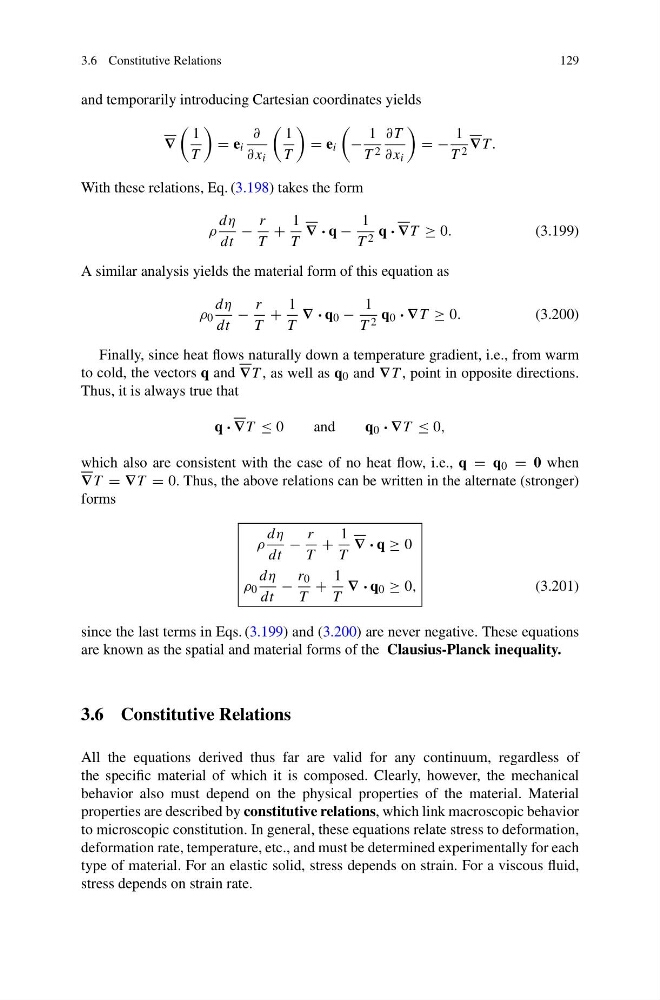
since the last terms in Eqs. (3.199) and (3.200) are never negative. These equations
are known as the spatial and material forms of the Clausius-Planck inequality.
3.6 Constitutive Relations
All the equations derived thus far are valid for any continuum, regardless of
the specific material of which it is composed. Clearly, however, the mechanical
behavior also must depend on the physical properties of the material. Material
properties are described by constitutive relations, which link macroscopic behavior
to microscopic constitution. In general, these equations relate stress to deformation,
deformation rate, temperature, etc., and must be determined experimentally for each
type of material. For an elastic solid, stress depends on strain. For a viscous fluid,
stress depends on strain rate.
129
and temporarily introducing Cartesian coordinates yields
∇
1
T
= e i
∂
∂x i
1
T
= e i
−
1
T 2
∂T
∂x i
= −
1
T 2 ∇T .
With these relations, Eq. (3.198) takes the form
ρ
dη
dt
−
r
T
+
1
T
∇ · q −
1
T 2 q · ∇T ≥ 0.
(3.199)
A similar analysis yields the material form of this equation as
ρ 0
dη
dt
−
r
T
+
1
T
∇ · q 0 −
1
T 2 q 0 · ∇T ≥ 0.
(3.200)
Finally, since heat flows naturally down a temperature gradient, i.e., from warm
to cold, the vectors q and ∇T , as well as q 0 and ∇T , point in opposite directions.
Thus, it is always true that
q · ∇T ≤ 0
and
q 0 · ∇T ≤ 0,
which also are consistent with the case of no heat flow, i.e., q = q 0 = 0 when
∇T = ∇T = 0. Thus, the above relations can be written in the alternate (stronger)
forms
ρ
dη
dt
−
r
T
+
1
T
∇ · q ≥ 0
ρ 0
dη
dt
−
r 0
T
+
1
T
∇ · q 0 ≥ 0,
(3.201)
since the last terms in Eqs. (3.199) and (3.200) are never negative. These equations
are known as the spatial and material forms of the Clausius-Planck inequality.
3.6 Constitutive Relations
All the equations derived thus far are valid for any continuum, regardless of
the specific material of which it is composed. Clearly, however, the mechanical
behavior also must depend on the physical properties of the material. Material
properties are described by constitutive relations, which link macroscopic behavior
to microscopic constitution. In general, these equations relate stress to deformation,
deformation rate, temperature, etc., and must be determined experimentally for each
type of material. For an elastic solid, stress depends on strain. For a viscous fluid,
stress depends on strain rate.