

108
3 Continuum Mechanics and Nonlinear Elasticity
location to another within a tissue. In contrast, the differential equation ensures that
the mass (e.g., solid + fluid) remains constant for each particle.
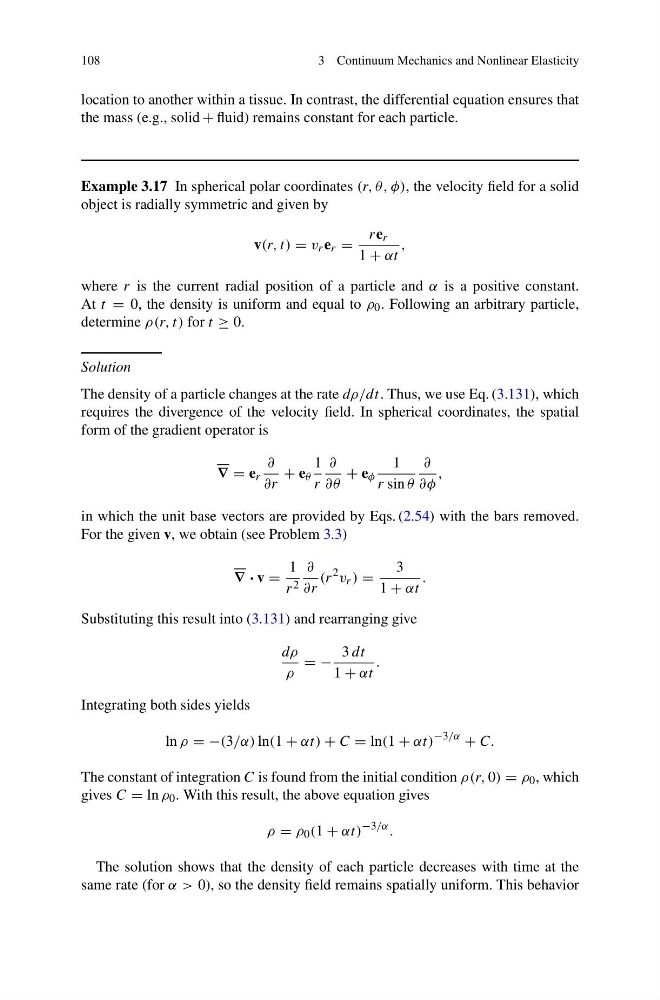
Example 3.17 In spherical polar coordinates (r, θ, φ), the velocity field for a solid
object is radially symmetric and given by
v(r, t) = v r e r =
re r
1 + αt
,
where r is the current radial position of a particle and α is a positive constant.
At t = 0, the density is uniform and equal to ρ 0 . Following an arbitrary particle,
determine ρ(r, t) for t ≥ 0.
Solution
The density of a particle changes at the rate dρ/dt. Thus, we use Eq. (3.131), which
requires the divergence of the velocity field. In spherical coordinates, the spatial
form of the gradient operator is
∇ = e r
∂
∂r
+ e θ
1
r
∂
∂θ
+ e φ
1
r sin θ
∂
∂φ
,
in which the unit base vectors are provided by Eqs. (2.54) with the bars removed.
For the given v, we obtain (see Problem 3.3)
∇ · v =
1
r 2
∂
∂r
(r
2 v r ) =
3
1 + αt
.
Substituting this result into (3.131) and rearranging give
dρ
ρ
= −
3 dt
1 + αt
.
Integrating both sides yields
ln ρ = −(3/α) ln(1 + αt) + C = ln(1 + αt)
−3/α
+ C.
The constant of integration C is found from the initial condition ρ(r, 0) = ρ 0 , which
gives C = ln ρ 0 . With this result, the above equation gives
ρ = ρ 0 (1 + αt)
−3/α .
The solution shows that the density of each particle decreases with time at the
same rate (for α > 0), so the density field remains spatially uniform. This behavior
3 Continuum Mechanics and Nonlinear Elasticity
location to another within a tissue. In contrast, the differential equation ensures that
the mass (e.g., solid + fluid) remains constant for each particle.
Example 3.17 In spherical polar coordinates (r, θ, φ), the velocity field for a solid
object is radially symmetric and given by
v(r, t) = v r e r =
re r
1 + αt
,
where r is the current radial position of a particle and α is a positive constant.
At t = 0, the density is uniform and equal to ρ 0 . Following an arbitrary particle,
determine ρ(r, t) for t ≥ 0.
Solution
The density of a particle changes at the rate dρ/dt. Thus, we use Eq. (3.131), which
requires the divergence of the velocity field. In spherical coordinates, the spatial
form of the gradient operator is
∇ = e r
∂
∂r
+ e θ
1
r
∂
∂θ
+ e φ
1
r sin θ
∂
∂φ
,
in which the unit base vectors are provided by Eqs. (2.54) with the bars removed.
For the given v, we obtain (see Problem 3.3)
∇ · v =
1
r 2
∂
∂r
(r
2 v r ) =
3
1 + αt
.
Substituting this result into (3.131) and rearranging give
dρ
ρ
= −
3 dt
1 + αt
.
Integrating both sides yields
ln ρ = −(3/α) ln(1 + αt) + C = ln(1 + αt)
−3/α
+ C.
The constant of integration C is found from the initial condition ρ(r, 0) = ρ 0 , which
gives C = ln ρ 0 . With this result, the above equation gives
ρ = ρ 0 (1 + αt)
−3/α .
The solution shows that the density of each particle decreases with time at the
same rate (for α > 0), so the density field remains spatially uniform. This behavior