

3.5 Balance Laws
107
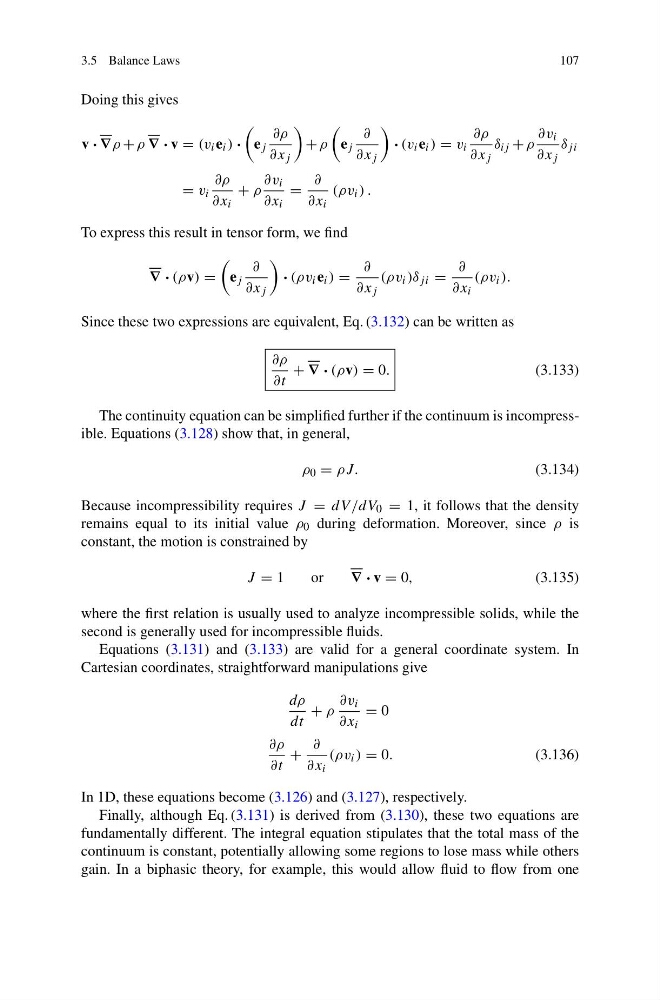
Doing this gives
v · ∇ρ + ρ ∇ · v = (v i e i ) ·
e j
∂ρ
∂x j
+ ρ
e j
∂
∂x j
· (v i e i ) = v i
∂ρ
∂x j
δ ij + ρ
∂v i
∂x j
δ ji
= v i
∂ρ
∂x i
+ ρ
∂v i
∂x i
=
∂
∂x i
(ρv i ) .
To express this result in tensor form, we find
∇ · (ρv) =
e j
∂
∂x j
· (ρv i e i ) =
∂
∂x j
(ρv i )δ ji =
∂
∂x i
(ρv i ).
Since these two expressions are equivalent, Eq. (3.132) can be written as
∂ρ
∂t
+ ∇ · (ρv) = 0.
(3.133)
The continuity equation can be simplified further if the continuum is incompressible. Equations (3.128) show that, in general,
ρ 0 = ρJ.
(3.134)
Because incompressibility requires J = dV /dV 0 = 1, it follows that the density
remains equal to its initial value ρ 0 during deformation. Moreover, since ρ is
constant, the motion is constrained by
J = 1
or
∇ · v = 0,
(3.135)
where the first relation is usually used to analyze incompressible solids, while the
second is generally used for incompressible fluids.
Equations (3.131) and (3.133) are valid for a general coordinate system. In
Cartesian coordinates, straightforward manipulations give
dρ
dt
+ ρ
∂v i
∂x i
= 0
∂ρ
∂t
+
∂
∂x i
(ρv i ) = 0.
(3.136)
In 1D, these equations become (3.126) and (3.127), respectively.
Finally, although Eq. (3.131) is derived from (3.130), these two equations are
fundamentally different. The integral equation stipulates that the total mass of the
continuum is constant, potentially allowing some regions to lose mass while others
gain. In a biphasic theory, for example, this would allow fluid to flow from one
107
Doing this gives
v · ∇ρ + ρ ∇ · v = (v i e i ) ·
e j
∂ρ
∂x j
+ ρ
e j
∂
∂x j
· (v i e i ) = v i
∂ρ
∂x j
δ ij + ρ
∂v i
∂x j
δ ji
= v i
∂ρ
∂x i
+ ρ
∂v i
∂x i
=
∂
∂x i
(ρv i ) .
To express this result in tensor form, we find
∇ · (ρv) =
e j
∂
∂x j
· (ρv i e i ) =
∂
∂x j
(ρv i )δ ji =
∂
∂x i
(ρv i ).
Since these two expressions are equivalent, Eq. (3.132) can be written as
∂ρ
∂t
+ ∇ · (ρv) = 0.
(3.133)
The continuity equation can be simplified further if the continuum is incompressible. Equations (3.128) show that, in general,
ρ 0 = ρJ.
(3.134)
Because incompressibility requires J = dV /dV 0 = 1, it follows that the density
remains equal to its initial value ρ 0 during deformation. Moreover, since ρ is
constant, the motion is constrained by
J = 1
or
∇ · v = 0,
(3.135)
where the first relation is usually used to analyze incompressible solids, while the
second is generally used for incompressible fluids.
Equations (3.131) and (3.133) are valid for a general coordinate system. In
Cartesian coordinates, straightforward manipulations give
dρ
dt
+ ρ
∂v i
∂x i
= 0
∂ρ
∂t
+
∂
∂x i
(ρv i ) = 0.
(3.136)
In 1D, these equations become (3.126) and (3.127), respectively.
Finally, although Eq. (3.131) is derived from (3.130), these two equations are
fundamentally different. The integral equation stipulates that the total mass of the
continuum is constant, potentially allowing some regions to lose mass while others
gain. In a biphasic theory, for example, this would allow fluid to flow from one