

3.1 Oxygen Etching Effect
41
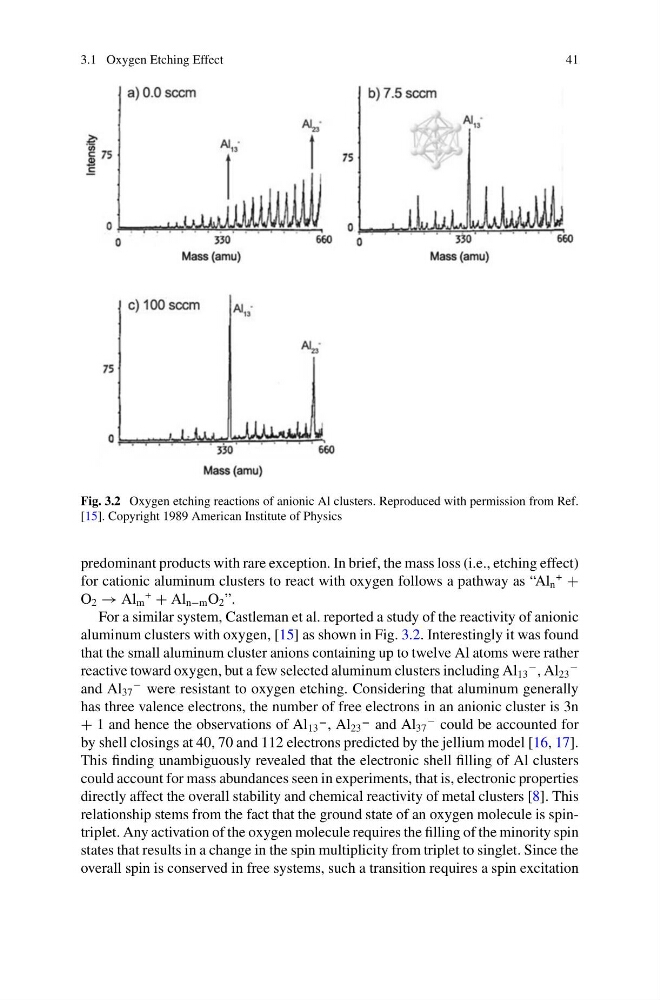
Fig. 3.2 Oxygen etching reactions of anionic Al clusters. Reproduced with permission from Ref.
[15]. Copyright 1989 American Institute of Physics
predominant products with rare exception. In brief, the mass loss (i.e., etching effect)
for cationic aluminum clusters to react with oxygen follows a pathway as “Al n
+
+
O 2 → Al m
+
+ Al n−m O 2 ”.
For a similar system, Castleman et al. reported a study of the reactivity of anionic
aluminum clusters with oxygen, [15] as shown in Fig. 3.2. Interestingly it was found
that the small aluminum cluster anions containing up to twelve Al atoms were rather
reactive toward oxygen, but a few selected aluminum clusters including Al 13
− , Al 23
−
and Al 37
− were resistant to oxygen etching. Considering that aluminum generally
has three valence electrons, the number of free electrons in an anionic cluster is 3n
+ 1 and hence the observations of Al 13
− , Al 23
− and Al 37
− could be accounted for
by shell closings at 40, 70 and 112 electrons predicted by the jellium model [16, 17].
This finding unambiguously revealed that the electronic shell filling of Al clusters
could account for mass abundances seen in experiments, that is, electronic properties
directly affect the overall stability and chemical reactivity of metal clusters [8]. This
relationship stems from the fact that the ground state of an oxygen molecule is spintriplet. Any activation of the oxygen molecule requires the filling of the minority spin
states that results in a change in the spin multiplicity from triplet to singlet. Since the
overall spin is conserved in free systems, such a transition requires a spin excitation
41
Fig. 3.2 Oxygen etching reactions of anionic Al clusters. Reproduced with permission from Ref.
[15]. Copyright 1989 American Institute of Physics
predominant products with rare exception. In brief, the mass loss (i.e., etching effect)
for cationic aluminum clusters to react with oxygen follows a pathway as “Al n
+
+
O 2 → Al m
+
+ Al n−m O 2 ”.
For a similar system, Castleman et al. reported a study of the reactivity of anionic
aluminum clusters with oxygen, [15] as shown in Fig. 3.2. Interestingly it was found
that the small aluminum cluster anions containing up to twelve Al atoms were rather
reactive toward oxygen, but a few selected aluminum clusters including Al 13
− , Al 23
−
and Al 37
− were resistant to oxygen etching. Considering that aluminum generally
has three valence electrons, the number of free electrons in an anionic cluster is 3n
+ 1 and hence the observations of Al 13
− , Al 23
− and Al 37
− could be accounted for
by shell closings at 40, 70 and 112 electrons predicted by the jellium model [16, 17].
This finding unambiguously revealed that the electronic shell filling of Al clusters
could account for mass abundances seen in experiments, that is, electronic properties
directly affect the overall stability and chemical reactivity of metal clusters [8]. This
relationship stems from the fact that the ground state of an oxygen molecule is spintriplet. Any activation of the oxygen molecule requires the filling of the minority spin
states that results in a change in the spin multiplicity from triplet to singlet. Since the
overall spin is conserved in free systems, such a transition requires a spin excitation