

26
2 Instrumentation for Cluster Science
2.4.2 Ionization of Cluster Neutrals
Detection of neutral clusters is associated with an additional ionization process.
According to different ionization methods, mass spectrometry techniques are generally classified into hard ionization (i.e., EI method) [187] and soft ionization
which includes photoionization (PI) [188–194], chemical ionization (CI) [195, 196],
electrospray ionization (ESI) [197], and matrix-assisted laser desorption/ionization
(MALDI) [198]. Among them, the EI technique usually employs high-energy electron impacts (c.a., ~70 eV) to attain maximal ionization efficiency but inevitably
brings rigorous fragmentation. This is not only questionable for organic compounds,
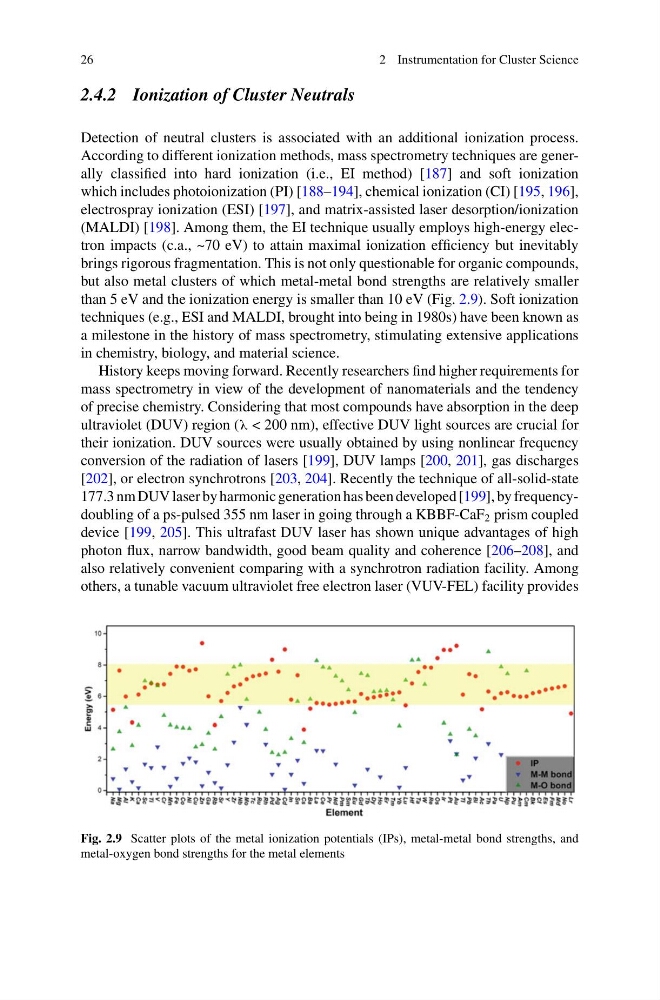
but also metal clusters of which metal-metal bond strengths are relatively smaller
than 5 eV and the ionization energy is smaller than 10 eV (Fig. 2.9). Soft ionization
techniques (e.g., ESI and MALDI, brought into being in 1980s) have been known as
a milestone in the history of mass spectrometry, stimulating extensive applications
in chemistry, biology, and material science.
History keeps moving forward. Recently researchers find higher requirements for
mass spectrometry in view of the development of nanomaterials and the tendency
of precise chemistry. Considering that most compounds have absorption in the deep
ultraviolet (DUV) region (λ < 200 nm), effective DUV light sources are crucial for
their ionization. DUV sources were usually obtained by using nonlinear frequency
conversion of the radiation of lasers [199], DUV lamps [200, 201], gas discharges
[202], or electron synchrotrons [203, 204]. Recently the technique of all-solid-state
177.3 nm DUV laser by harmonic generation has been developed [199], by frequencydoubling of a ps-pulsed 355 nm laser in going through a KBBF-CaF 2 prism coupled
device [199, 205]. This ultrafast DUV laser has shown unique advantages of high
photon flux, narrow bandwidth, good beam quality and coherence [206–208], and
also relatively convenient comparing with a synchrotron radiation facility. Among
others, a tunable vacuum ultraviolet free electron laser (VUV-FEL) facility provides
Fig. 2.9 Scatter plots of the metal ionization potentials (IPs), metal-metal bond strengths, and
metal-oxygen bond strengths for the metal elements
2 Instrumentation for Cluster Science
2.4.2 Ionization of Cluster Neutrals
Detection of neutral clusters is associated with an additional ionization process.
According to different ionization methods, mass spectrometry techniques are generally classified into hard ionization (i.e., EI method) [187] and soft ionization
which includes photoionization (PI) [188–194], chemical ionization (CI) [195, 196],
electrospray ionization (ESI) [197], and matrix-assisted laser desorption/ionization
(MALDI) [198]. Among them, the EI technique usually employs high-energy electron impacts (c.a., ~70 eV) to attain maximal ionization efficiency but inevitably
brings rigorous fragmentation. This is not only questionable for organic compounds,
but also metal clusters of which metal-metal bond strengths are relatively smaller
than 5 eV and the ionization energy is smaller than 10 eV (Fig. 2.9). Soft ionization
techniques (e.g., ESI and MALDI, brought into being in 1980s) have been known as
a milestone in the history of mass spectrometry, stimulating extensive applications
in chemistry, biology, and material science.
History keeps moving forward. Recently researchers find higher requirements for
mass spectrometry in view of the development of nanomaterials and the tendency
of precise chemistry. Considering that most compounds have absorption in the deep
ultraviolet (DUV) region (λ < 200 nm), effective DUV light sources are crucial for
their ionization. DUV sources were usually obtained by using nonlinear frequency
conversion of the radiation of lasers [199], DUV lamps [200, 201], gas discharges
[202], or electron synchrotrons [203, 204]. Recently the technique of all-solid-state
177.3 nm DUV laser by harmonic generation has been developed [199], by frequencydoubling of a ps-pulsed 355 nm laser in going through a KBBF-CaF 2 prism coupled
device [199, 205]. This ultrafast DUV laser has shown unique advantages of high
photon flux, narrow bandwidth, good beam quality and coherence [206–208], and
also relatively convenient comparing with a synchrotron radiation facility. Among
others, a tunable vacuum ultraviolet free electron laser (VUV-FEL) facility provides
Fig. 2.9 Scatter plots of the metal ionization potentials (IPs), metal-metal bond strengths, and
metal-oxygen bond strengths for the metal elements