

14.2 Building Blocks Identified from Gas Phase
243
experimentally by Knight et al. in 1984 [6]. Sizes and electron counts of superatoms
interpreted by the jellium model are quite stable compared with others of similar sizes;
also their properties are dominated as expectation to reach a certain valence state.
Typical superatom species having a spherical-like structure are Al 13 and Al 13
− which
share an icosahedral structure of 13 aluminum atoms. The stability of a cluster with
13 atoms is not limited to aluminum and allowing for modifications of the theory to
account for non-spherical symmetries. For example, some other metal clusters such as
Ag
−
13 [15], Au 13 [16], Pt 13 and Pd 13 [17], also exhibit enhanced stability although their
lowest energy structures are not icosahedral. Among them, for instance, the stability
of Ag
−
13 is assigned to the large spin excitation energy and a big HOMO-LUMO gap
associated with its bi-layer triangular cluster structure.
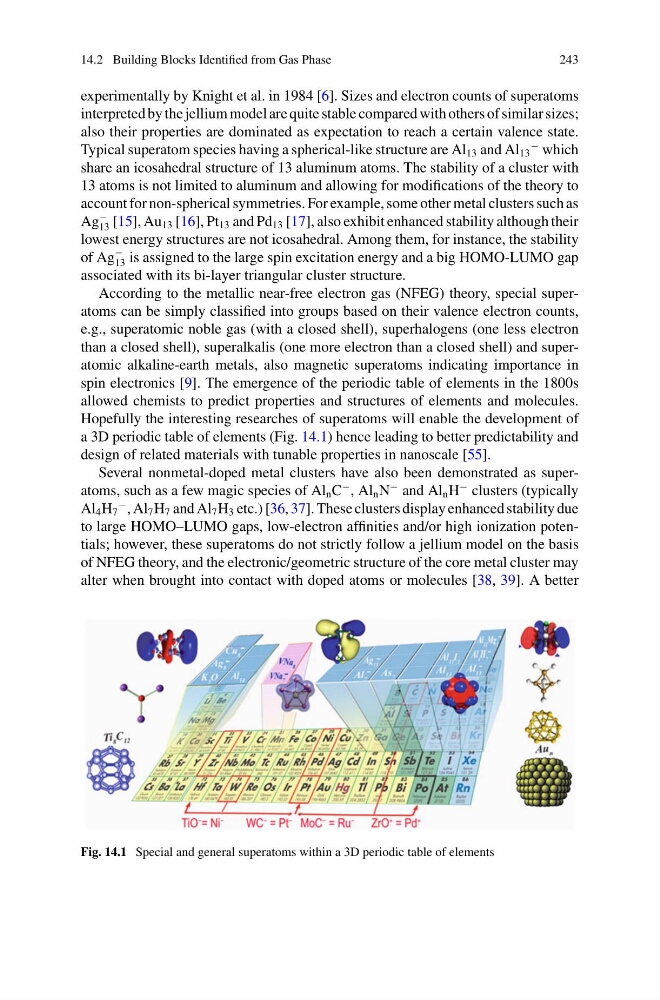
According to the metallic near-free electron gas (NFEG) theory, special superatoms can be simply classified into groups based on their valence electron counts,
e.g., superatomic noble gas (with a closed shell), superhalogens (one less electron
than a closed shell), superalkalis (one more electron than a closed shell) and superatomic alkaline-earth metals, also magnetic superatoms indicating importance in
spin electronics [9]. The emergence of the periodic table of elements in the 1800s
allowed chemists to predict properties and structures of elements and molecules.
Hopefully the interesting researches of superatoms will enable the development of
a 3D periodic table of elements (Fig. 14.1) hence leading to better predictability and
design of related materials with tunable properties in nanoscale [55].
Several nonmetal-doped metal clusters have also been demonstrated as superatoms, such as a few magic species of Al n C
− , Al n N
− and Al n H
− clusters (typically
Al 4 H 7
− , Al 7 H 7 and Al 7 H 3 etc.) [36, 37]. These clusters display enhanced stability due
to large HOMO–LUMO gaps, low-electron affinities and/or high ionization potentials; however, these superatoms do not strictly follow a jellium model on the basis
of NFEG theory, and the electronic/geometric structure of the core metal cluster may
alter when brought into contact with doped atoms or molecules [38, 39]. A better
Fig. 14.1 Special and general superatoms within a 3D periodic table of elements
243
experimentally by Knight et al. in 1984 [6]. Sizes and electron counts of superatoms
interpreted by the jellium model are quite stable compared with others of similar sizes;
also their properties are dominated as expectation to reach a certain valence state.
Typical superatom species having a spherical-like structure are Al 13 and Al 13
− which
share an icosahedral structure of 13 aluminum atoms. The stability of a cluster with
13 atoms is not limited to aluminum and allowing for modifications of the theory to
account for non-spherical symmetries. For example, some other metal clusters such as
Ag
−
13 [15], Au 13 [16], Pt 13 and Pd 13 [17], also exhibit enhanced stability although their
lowest energy structures are not icosahedral. Among them, for instance, the stability
of Ag
−
13 is assigned to the large spin excitation energy and a big HOMO-LUMO gap
associated with its bi-layer triangular cluster structure.
According to the metallic near-free electron gas (NFEG) theory, special superatoms can be simply classified into groups based on their valence electron counts,
e.g., superatomic noble gas (with a closed shell), superhalogens (one less electron
than a closed shell), superalkalis (one more electron than a closed shell) and superatomic alkaline-earth metals, also magnetic superatoms indicating importance in
spin electronics [9]. The emergence of the periodic table of elements in the 1800s
allowed chemists to predict properties and structures of elements and molecules.
Hopefully the interesting researches of superatoms will enable the development of
a 3D periodic table of elements (Fig. 14.1) hence leading to better predictability and
design of related materials with tunable properties in nanoscale [55].
Several nonmetal-doped metal clusters have also been demonstrated as superatoms, such as a few magic species of Al n C
− , Al n N
− and Al n H
− clusters (typically
Al 4 H 7
− , Al 7 H 7 and Al 7 H 3 etc.) [36, 37]. These clusters display enhanced stability due
to large HOMO–LUMO gaps, low-electron affinities and/or high ionization potentials; however, these superatoms do not strictly follow a jellium model on the basis
of NFEG theory, and the electronic/geometric structure of the core metal cluster may
alter when brought into contact with doped atoms or molecules [38, 39]. A better
Fig. 14.1 Special and general superatoms within a 3D periodic table of elements