

13.2 Gold Cluster Catalysis
221
details of reactions catalyzed by oxide-supported gold, which have been under debate
for many years [23, 44, 45, 106]. By taking into account that niobium oxides have
extraordinary catalytic properties in selective oxidation reactions, Wu et al. [110]
reported such an investigation on Au x Nb y O
+
z reacting with methane, ethane, and
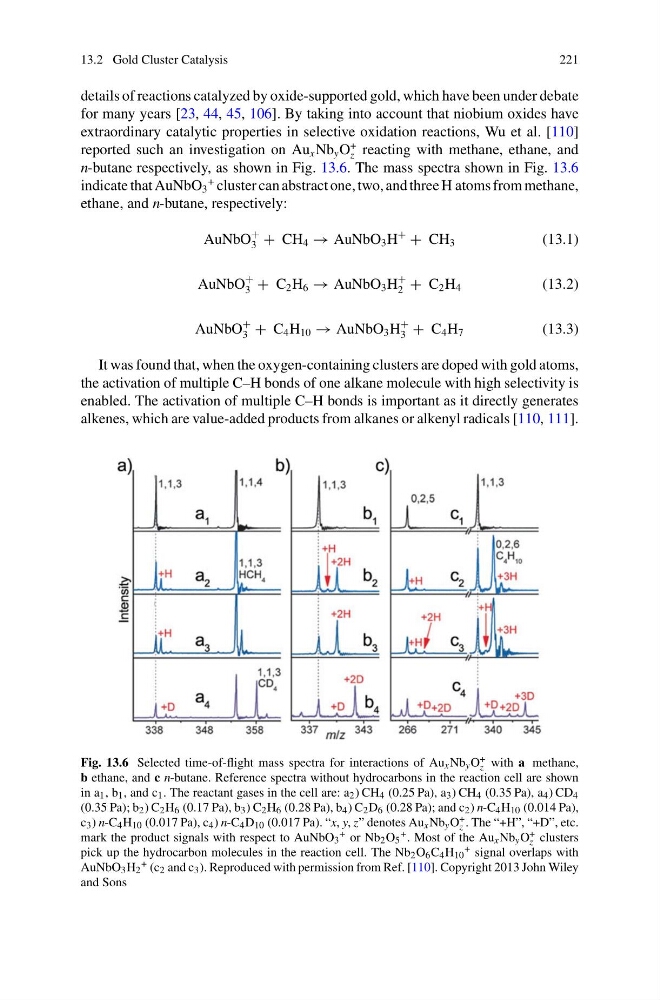
n-butane respectively, as shown in Fig. 13.6. The mass spectra shown in Fig. 13.6
indicate that AuNbO 3
+ cluster can abstract one, two, and three H atoms from methane,
ethane, and n-butane, respectively:
AuNbO
+
3 + CH 4 → AuNbO 3 H
+
+ CH 3
(13.1)
AuNbO
+
3 + C 2 H 6 → AuNbO 3 H
+
2 + C 2 H 4
(13.2)
AuNbO
+
3 + C 4 H 10 → AuNbO 3 H
+
3 + C 4 H 7
(13.3)
It was found that, when the oxygen-containing clusters are doped with gold atoms,
the activation of multiple C–H bonds of one alkane molecule with high selectivity is
enabled. The activation of multiple C–H bonds is important as it directly generates
alkenes, which are value-added products from alkanes or alkenyl radicals [110, 111].
Fig. 13.6 Selected time-of-flight mass spectra for interactions of Au x Nb y O +
z with a methane,
b ethane, and c n-butane. Reference spectra without hydrocarbons in the reaction cell are shown
in a 1 , b 1 , and c 1 . The reactant gases in the cell are: a 2 ) CH 4 (0.25 Pa), a 3 ) CH 4 (0.35 Pa), a 4 ) CD 4
(0.35 Pa); b 2 ) C 2 H 6 (0.17 Pa), b 3 ) C 2 H 6 (0.28 Pa), b 4 ) C 2 D 6 (0.28 Pa); and c 2 ) n-C 4 H 10 (0.014 Pa),
c 3 ) n-C 4 H 10 (0.017 Pa), c 4 ) n-C 4 D 10 (0.017 Pa). “x, y, z” denotes Au x Nb y O +
z . The “+H”, “+D”, etc.
mark the product signals with respect to AuNbO 3
+ or Nb 2 O 5
+ . Most of the Au x Nb y O +
z clusters
pick up the hydrocarbon molecules in the reaction cell. The Nb 2 O 6 C 4 H 10
+ signal overlaps with
AuNbO 3 H 2
+ (c 2 and c 3 ). Reproduced with permission from Ref. [110]. Copyright 2013 John Wiley
and Sons
221
details of reactions catalyzed by oxide-supported gold, which have been under debate
for many years [23, 44, 45, 106]. By taking into account that niobium oxides have
extraordinary catalytic properties in selective oxidation reactions, Wu et al. [110]
reported such an investigation on Au x Nb y O
+
z reacting with methane, ethane, and
n-butane respectively, as shown in Fig. 13.6. The mass spectra shown in Fig. 13.6
indicate that AuNbO 3
+ cluster can abstract one, two, and three H atoms from methane,
ethane, and n-butane, respectively:
AuNbO
+
3 + CH 4 → AuNbO 3 H
+
+ CH 3
(13.1)
AuNbO
+
3 + C 2 H 6 → AuNbO 3 H
+
2 + C 2 H 4
(13.2)
AuNbO
+
3 + C 4 H 10 → AuNbO 3 H
+
3 + C 4 H 7
(13.3)
It was found that, when the oxygen-containing clusters are doped with gold atoms,
the activation of multiple C–H bonds of one alkane molecule with high selectivity is
enabled. The activation of multiple C–H bonds is important as it directly generates
alkenes, which are value-added products from alkanes or alkenyl radicals [110, 111].
Fig. 13.6 Selected time-of-flight mass spectra for interactions of Au x Nb y O +
z with a methane,
b ethane, and c n-butane. Reference spectra without hydrocarbons in the reaction cell are shown
in a 1 , b 1 , and c 1 . The reactant gases in the cell are: a 2 ) CH 4 (0.25 Pa), a 3 ) CH 4 (0.35 Pa), a 4 ) CD 4
(0.35 Pa); b 2 ) C 2 H 6 (0.17 Pa), b 3 ) C 2 H 6 (0.28 Pa), b 4 ) C 2 D 6 (0.28 Pa); and c 2 ) n-C 4 H 10 (0.014 Pa),
c 3 ) n-C 4 H 10 (0.017 Pa), c 4 ) n-C 4 D 10 (0.017 Pa). “x, y, z” denotes Au x Nb y O +
z . The “+H”, “+D”, etc.
mark the product signals with respect to AuNbO 3
+ or Nb 2 O 5
+ . Most of the Au x Nb y O +
z clusters
pick up the hydrocarbon molecules in the reaction cell. The Nb 2 O 6 C 4 H 10
+ signal overlaps with
AuNbO 3 H 2
+ (c 2 and c 3 ). Reproduced with permission from Ref. [110]. Copyright 2013 John Wiley
and Sons