

11.1 Cluster Dissociation
177
It was found that Nb
+
n readily dissociate to all possible ionic fragments, with the
lowest energy dissociation pathway as “Nb
+
n → Nb
+
n-1 + Nb”, and the largest neutral
fragments at collision energies of less than 10 eV. Evidence was also presented for
the loss of multiple Nb atoms from the Nb
+
n cluster at collision energies >10 eV. The
varied CID product channels provided information of thermodynamics, qualitative
cross section energy dependences and the relative energy thresholds, enabling to fully
understand the mechanisms of formation and dissociation for such metal clusters.
Anderson [21] studied mass-selected aluminum cluster cations Al
+
n (n = 2–7)
by xenon over an energy range of 0–10 eV. In order to circumvent this problem that
clusters could be formed with broad distributions of internal and translational energy,
they developed a technique to partially thermalize the cluster ions by forcing them
to pass through a radio-frequency trap filled with a buffer gas [21, 36]. The use of
a cooling trap helps improved the clusters to reach complete thermalization. The
cooling trap was constructed from a stack of six 1.95 mm thick stainless-steel plates
spaced 1.5 mm apart; and each plate had a maze-like slot 6.8 mm wide milled through
it. The stack of slotted plates was capped on top and bottom by additional solid plates,
which enables the assembly to form a labyrinthine channel of rectangular cross
section (c.a., 6.8 mm wide, 22 mm high). Alternate slotted plates were connected to
opposite phases of an RF tank circuit (3.5 MHz, 210V rms ), and the capping plates were
connected to positive biased voltage with respect to the DC potential of the slotted
plates [21]. The RF voltage created an effective potential preventing low energy ions
from escaping through the sides of the channel, while the DC voltages preventing an
escape from the top and bottom. In operation, this trap was filled through gas inlets
in the top plate with ~3 mTorr of helium. Cluster ions entered the cooling trap with
a broad distribution of translational energy, and lose energy in ~10 collisions with
the helium when going through the entrance channel. A small DC potential prevents
the ions from escaping back to the source, allowing them only exiting by diffusing
through the gas-filled maze hence becoming thermalized in the process [21]. The
effectiveness of the cooling process was also applied to measure the residence time
distributions for different sized clusters simply by pulsing the cluster ions into the
cooling trap [21].
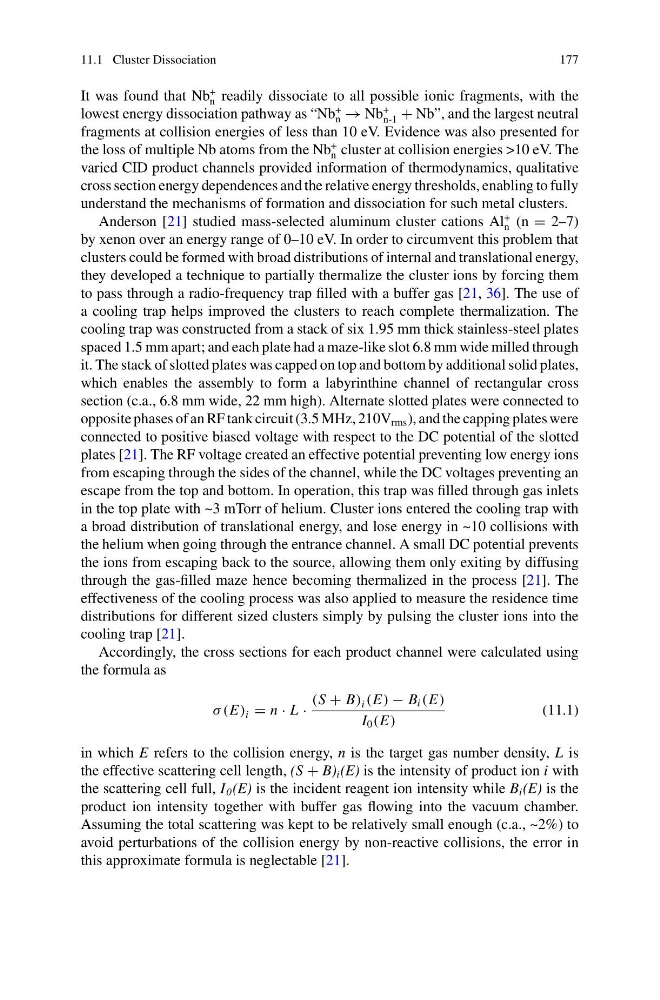
Accordingly, the cross sections for each product channel were calculated using
the formula as
σ (E) i = n · L ·
(S + B) i (E) − B i (E)
I 0 (E)
(11.1)
in which E refers to the collision energy, n is the target gas number density, L is
the effective scattering cell length, (S + B) i (E) is the intensity of product ion i with
the scattering cell full, I 0 (E) is the incident reagent ion intensity while B i (E) is the
product ion intensity together with buffer gas flowing into the vacuum chamber.
Assuming the total scattering was kept to be relatively small enough (c.a., ~2%) to
avoid perturbations of the collision energy by non-reactive collisions, the error in
this approximate formula is neglectable [21].
177
It was found that Nb
+
n readily dissociate to all possible ionic fragments, with the
lowest energy dissociation pathway as “Nb
+
n → Nb
+
n-1 + Nb”, and the largest neutral
fragments at collision energies of less than 10 eV. Evidence was also presented for
the loss of multiple Nb atoms from the Nb
+
n cluster at collision energies >10 eV. The
varied CID product channels provided information of thermodynamics, qualitative
cross section energy dependences and the relative energy thresholds, enabling to fully
understand the mechanisms of formation and dissociation for such metal clusters.
Anderson [21] studied mass-selected aluminum cluster cations Al
+
n (n = 2–7)
by xenon over an energy range of 0–10 eV. In order to circumvent this problem that
clusters could be formed with broad distributions of internal and translational energy,
they developed a technique to partially thermalize the cluster ions by forcing them
to pass through a radio-frequency trap filled with a buffer gas [21, 36]. The use of
a cooling trap helps improved the clusters to reach complete thermalization. The
cooling trap was constructed from a stack of six 1.95 mm thick stainless-steel plates
spaced 1.5 mm apart; and each plate had a maze-like slot 6.8 mm wide milled through
it. The stack of slotted plates was capped on top and bottom by additional solid plates,
which enables the assembly to form a labyrinthine channel of rectangular cross
section (c.a., 6.8 mm wide, 22 mm high). Alternate slotted plates were connected to
opposite phases of an RF tank circuit (3.5 MHz, 210V rms ), and the capping plates were
connected to positive biased voltage with respect to the DC potential of the slotted
plates [21]. The RF voltage created an effective potential preventing low energy ions
from escaping through the sides of the channel, while the DC voltages preventing an
escape from the top and bottom. In operation, this trap was filled through gas inlets
in the top plate with ~3 mTorr of helium. Cluster ions entered the cooling trap with
a broad distribution of translational energy, and lose energy in ~10 collisions with
the helium when going through the entrance channel. A small DC potential prevents
the ions from escaping back to the source, allowing them only exiting by diffusing
through the gas-filled maze hence becoming thermalized in the process [21]. The
effectiveness of the cooling process was also applied to measure the residence time
distributions for different sized clusters simply by pulsing the cluster ions into the
cooling trap [21].
Accordingly, the cross sections for each product channel were calculated using
the formula as
σ (E) i = n · L ·
(S + B) i (E) − B i (E)
I 0 (E)
(11.1)
in which E refers to the collision energy, n is the target gas number density, L is
the effective scattering cell length, (S + B) i (E) is the intensity of product ion i with
the scattering cell full, I 0 (E) is the incident reagent ion intensity while B i (E) is the
product ion intensity together with buffer gas flowing into the vacuum chamber.
Assuming the total scattering was kept to be relatively small enough (c.a., ~2%) to
avoid perturbations of the collision energy by non-reactive collisions, the error in
this approximate formula is neglectable [21].