

176
11 Cluster Dissociation, Intracluster Reactivity and Effect of the Ligands
11.1 Cluster Dissociation
11.1.1 Collision-Induced Dissociation
Collision-induced dissociation (CID) has been extensively investigated [19–22, 35],
and through CID the cluster dissociation energies can be determined by modelling
the measured cross sections and hence checking out the collision energy threshold for
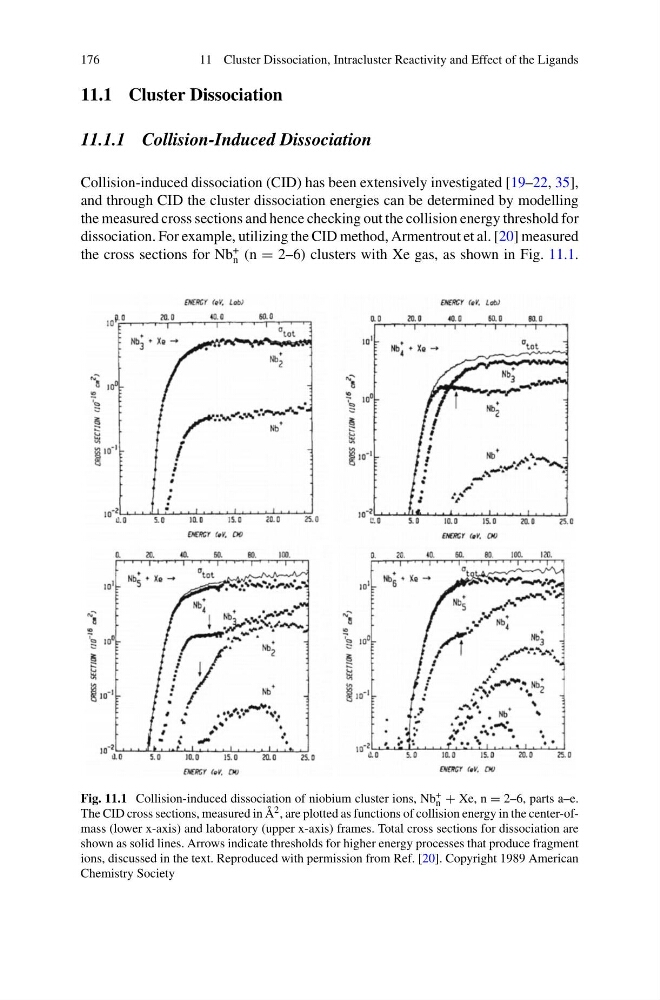
dissociation. For example, utilizing the CID method, Armentrout et al. [20] measured
the cross sections for Nb
+
n (n = 2–6) clusters with Xe gas, as shown in Fig. 11.1.
Fig. 11.1 Collision-induced dissociation of niobium cluster ions, Nb +
n + Xe, n = 2–6, parts a–e.
The CID cross sections, measured in Å 2 , are plotted as functions of collision energy in the center-ofmass (lower x-axis) and laboratory (upper x-axis) frames. Total cross sections for dissociation are
shown as solid lines. Arrows indicate thresholds for higher energy processes that produce fragment
ions, discussed in the text. Reproduced with permission from Ref. [20]. Copyright 1989 American
Chemistry Society
11 Cluster Dissociation, Intracluster Reactivity and Effect of the Ligands
11.1 Cluster Dissociation
11.1.1 Collision-Induced Dissociation
Collision-induced dissociation (CID) has been extensively investigated [19–22, 35],
and through CID the cluster dissociation energies can be determined by modelling
the measured cross sections and hence checking out the collision energy threshold for
dissociation. For example, utilizing the CID method, Armentrout et al. [20] measured
the cross sections for Nb
+
n (n = 2–6) clusters with Xe gas, as shown in Fig. 11.1.
Fig. 11.1 Collision-induced dissociation of niobium cluster ions, Nb +
n + Xe, n = 2–6, parts a–e.
The CID cross sections, measured in Å 2 , are plotted as functions of collision energy in the center-ofmass (lower x-axis) and laboratory (upper x-axis) frames. Total cross sections for dissociation are
shown as solid lines. Arrows indicate thresholds for higher energy processes that produce fragment
ions, discussed in the text. Reproduced with permission from Ref. [20]. Copyright 1989 American
Chemistry Society