

158
9 Carbon-Carbon Cross-Coupling Reactions
For the charge withdrawing transmetallation and reductive elimination steps, the
activation energies of the free Fe 13 , Cu 13, and Ni 13 clusters were found to be significantly higher than that of Pd 13 . This suggests that Suzuki reactions catalyzed by
the first-row transition metals will be hindered in these steps where clusters act
as charge acceptors. After the deposition, the activation energies of supported Fe 13 ,
Cu 13 and Ni 13 clusters were considerably reduced. For the supported Ni 13 cluster, the
activation energy was slightly higher than the free Pd 13 cluster and had the lowest
activation energy of the non-Palladium clusters. A similar trend was seen in the
reductive elimination step that also requires the cluster to act as a charge acceptor.
Among the studied systems, the Pd 13 cluster on graphene has the lowest activation
energy, the free Pd 13 cluster has the second lowest, and the Ni 13 on graphene has the
lowest activation energy for the non-Palladium clusters. While the activation energies of Ni 13 /graphene are higher than those of Pd 13 /graphene, we next considered a
different approach to further reduce the activation energy for Ni clusters.
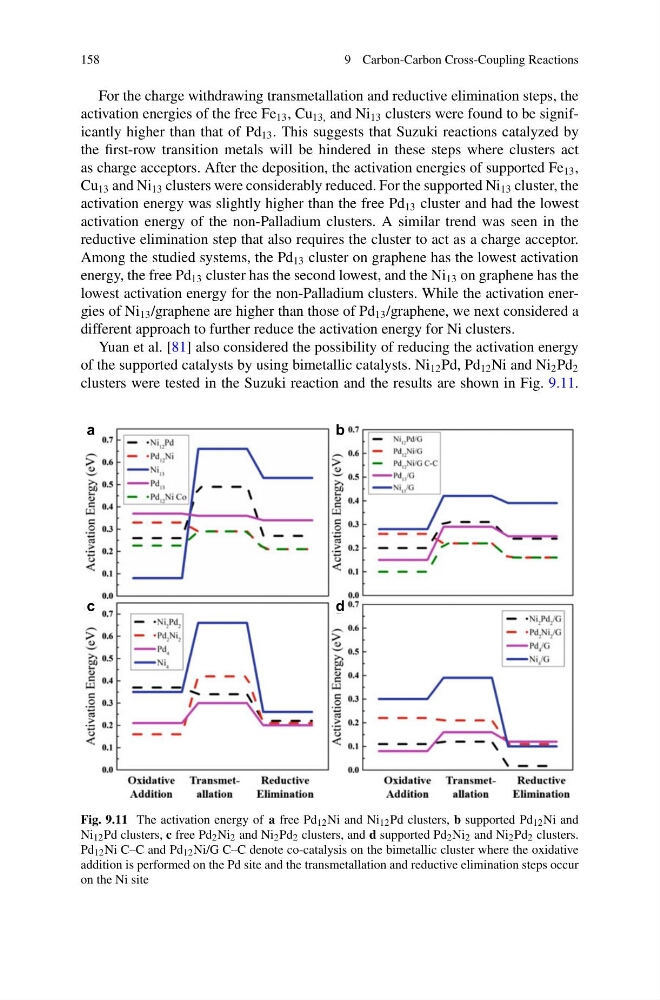
Yuan et al. [81] also considered the possibility of reducing the activation energy
of the supported catalysts by using bimetallic catalysts. Ni 12 Pd, Pd 12 Ni and Ni 2 Pd 2
clusters were tested in the Suzuki reaction and the results are shown in Fig. 9.11.
a
b
c
d
Fig. 9.11 The activation energy of a free Pd 12 Ni and Ni 12 Pd clusters, b supported Pd 12 Ni and
Ni 12 Pd clusters, c free Pd 2 Ni 2 and Ni 2 Pd 2 clusters, and d supported Pd 2 Ni 2 and Ni 2 Pd 2 clusters.
Pd 12 Ni C–C and Pd 12 Ni/G C–C denote co-catalysis on the bimetallic cluster where the oxidative
addition is performed on the Pd site and the transmetallation and reductive elimination steps occur
on the Ni site
9 Carbon-Carbon Cross-Coupling Reactions
For the charge withdrawing transmetallation and reductive elimination steps, the
activation energies of the free Fe 13 , Cu 13, and Ni 13 clusters were found to be significantly higher than that of Pd 13 . This suggests that Suzuki reactions catalyzed by
the first-row transition metals will be hindered in these steps where clusters act
as charge acceptors. After the deposition, the activation energies of supported Fe 13 ,
Cu 13 and Ni 13 clusters were considerably reduced. For the supported Ni 13 cluster, the
activation energy was slightly higher than the free Pd 13 cluster and had the lowest
activation energy of the non-Palladium clusters. A similar trend was seen in the
reductive elimination step that also requires the cluster to act as a charge acceptor.
Among the studied systems, the Pd 13 cluster on graphene has the lowest activation
energy, the free Pd 13 cluster has the second lowest, and the Ni 13 on graphene has the
lowest activation energy for the non-Palladium clusters. While the activation energies of Ni 13 /graphene are higher than those of Pd 13 /graphene, we next considered a
different approach to further reduce the activation energy for Ni clusters.
Yuan et al. [81] also considered the possibility of reducing the activation energy
of the supported catalysts by using bimetallic catalysts. Ni 12 Pd, Pd 12 Ni and Ni 2 Pd 2
clusters were tested in the Suzuki reaction and the results are shown in Fig. 9.11.
a
b
c
d
Fig. 9.11 The activation energy of a free Pd 12 Ni and Ni 12 Pd clusters, b supported Pd 12 Ni and
Ni 12 Pd clusters, c free Pd 2 Ni 2 and Ni 2 Pd 2 clusters, and d supported Pd 2 Ni 2 and Ni 2 Pd 2 clusters.
Pd 12 Ni C–C and Pd 12 Ni/G C–C denote co-catalysis on the bimetallic cluster where the oxidative
addition is performed on the Pd site and the transmetallation and reductive elimination steps occur
on the Ni site