

9.5 Search for Alternate Cheaper Catalysts
157
a
c
d
e
b
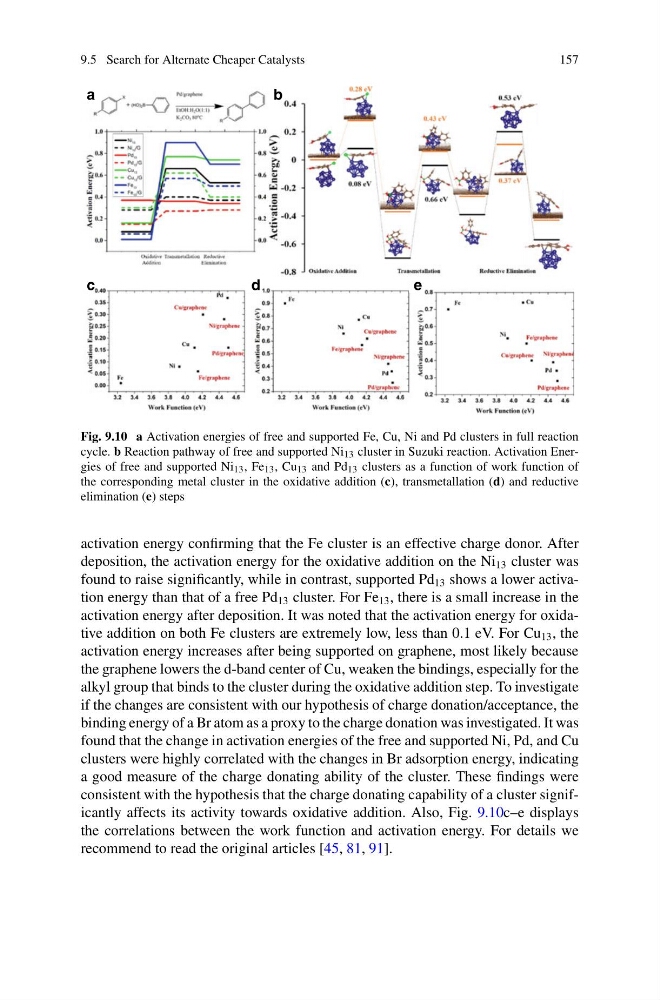
Fig. 9.10 a Activation energies of free and supported Fe, Cu, Ni and Pd clusters in full reaction
cycle. b Reaction pathway of free and supported Ni 13 cluster in Suzuki reaction. Activation Energies of free and supported Ni 13 , Fe 13 , Cu 13 and Pd 13 clusters as a function of work function of
the corresponding metal cluster in the oxidative addition (c), transmetallation (d) and reductive
elimination (e) steps
activation energy confirming that the Fe cluster is an effective charge donor. After
deposition, the activation energy for the oxidative addition on the Ni 13 cluster was
found to raise significantly, while in contrast, supported Pd 13 shows a lower activation energy than that of a free Pd 13 cluster. For Fe 13 , there is a small increase in the
activation energy after deposition. It was noted that the activation energy for oxidative addition on both Fe clusters are extremely low, less than 0.1 eV. For Cu 13 , the
activation energy increases after being supported on graphene, most likely because
the graphene lowers the d-band center of Cu, weaken the bindings, especially for the
alkyl group that binds to the cluster during the oxidative addition step. To investigate
if the changes are consistent with our hypothesis of charge donation/acceptance, the
binding energy of a Br atom as a proxy to the charge donation was investigated. It was
found that the change in activation energies of the free and supported Ni, Pd, and Cu
clusters were highly correlated with the changes in Br adsorption energy, indicating
a good measure of the charge donating ability of the cluster. These findings were
consistent with the hypothesis that the charge donating capability of a cluster significantly affects its activity towards oxidative addition. Also, Fig. 9.10c–e displays
the correlations between the work function and activation energy. For details we
recommend to read the original articles [45, 81, 91].
157
a
c
d
e
b
Fig. 9.10 a Activation energies of free and supported Fe, Cu, Ni and Pd clusters in full reaction
cycle. b Reaction pathway of free and supported Ni 13 cluster in Suzuki reaction. Activation Energies of free and supported Ni 13 , Fe 13 , Cu 13 and Pd 13 clusters as a function of work function of
the corresponding metal cluster in the oxidative addition (c), transmetallation (d) and reductive
elimination (e) steps
activation energy confirming that the Fe cluster is an effective charge donor. After
deposition, the activation energy for the oxidative addition on the Ni 13 cluster was
found to raise significantly, while in contrast, supported Pd 13 shows a lower activation energy than that of a free Pd 13 cluster. For Fe 13 , there is a small increase in the
activation energy after deposition. It was noted that the activation energy for oxidative addition on both Fe clusters are extremely low, less than 0.1 eV. For Cu 13 , the
activation energy increases after being supported on graphene, most likely because
the graphene lowers the d-band center of Cu, weaken the bindings, especially for the
alkyl group that binds to the cluster during the oxidative addition step. To investigate
if the changes are consistent with our hypothesis of charge donation/acceptance, the
binding energy of a Br atom as a proxy to the charge donation was investigated. It was
found that the change in activation energies of the free and supported Ni, Pd, and Cu
clusters were highly correlated with the changes in Br adsorption energy, indicating
a good measure of the charge donating ability of the cluster. These findings were
consistent with the hypothesis that the charge donating capability of a cluster significantly affects its activity towards oxidative addition. Also, Fig. 9.10c–e displays
the correlations between the work function and activation energy. For details we
recommend to read the original articles [45, 81, 91].