

9.4 Microscopic Catalytic Mechanism of Supported Palladium Clusters
153
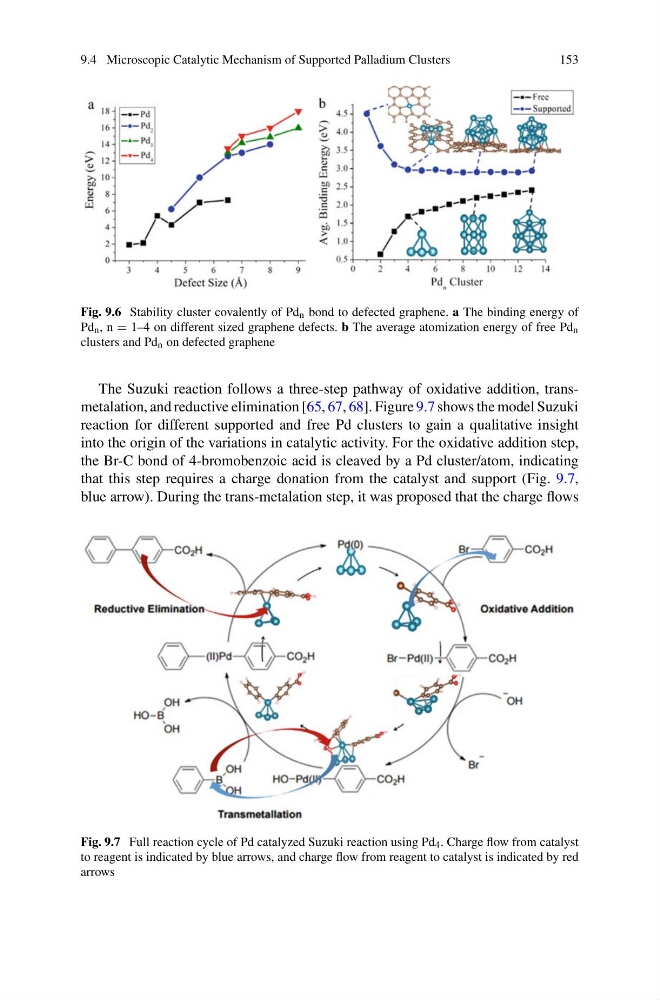
Fig. 9.6 Stability cluster covalently of Pd n bond to defected graphene. a The binding energy of
Pd n , n = 1–4 on different sized graphene defects. b The average atomization energy of free Pd n
clusters and Pd n on defected graphene
The Suzuki reaction follows a three-step pathway of oxidative addition, transmetalation, and reductive elimination [65, 67, 68]. Figure 9.7 shows the model Suzuki
reaction for different supported and free Pd clusters to gain a qualitative insight
into the origin of the variations in catalytic activity. For the oxidative addition step,
the Br-C bond of 4-bromobenzoic acid is cleaved by a Pd cluster/atom, indicating
that this step requires a charge donation from the catalyst and support (Fig. 9.7,
blue arrow). During the trans-metalation step, it was proposed that the charge flows
Fig. 9.7 Full reaction cycle of Pd catalyzed Suzuki reaction using Pd 4 . Charge flow from catalyst
to reagent is indicated by blue arrows, and charge flow from reagent to catalyst is indicated by red
arrows
153
Fig. 9.6 Stability cluster covalently of Pd n bond to defected graphene. a The binding energy of
Pd n , n = 1–4 on different sized graphene defects. b The average atomization energy of free Pd n
clusters and Pd n on defected graphene
The Suzuki reaction follows a three-step pathway of oxidative addition, transmetalation, and reductive elimination [65, 67, 68]. Figure 9.7 shows the model Suzuki
reaction for different supported and free Pd clusters to gain a qualitative insight
into the origin of the variations in catalytic activity. For the oxidative addition step,
the Br-C bond of 4-bromobenzoic acid is cleaved by a Pd cluster/atom, indicating
that this step requires a charge donation from the catalyst and support (Fig. 9.7,
blue arrow). During the trans-metalation step, it was proposed that the charge flows
Fig. 9.7 Full reaction cycle of Pd catalyzed Suzuki reaction using Pd 4 . Charge flow from catalyst
to reagent is indicated by blue arrows, and charge flow from reagent to catalyst is indicated by red
arrows