

152
9 Carbon-Carbon Cross-Coupling Reactions
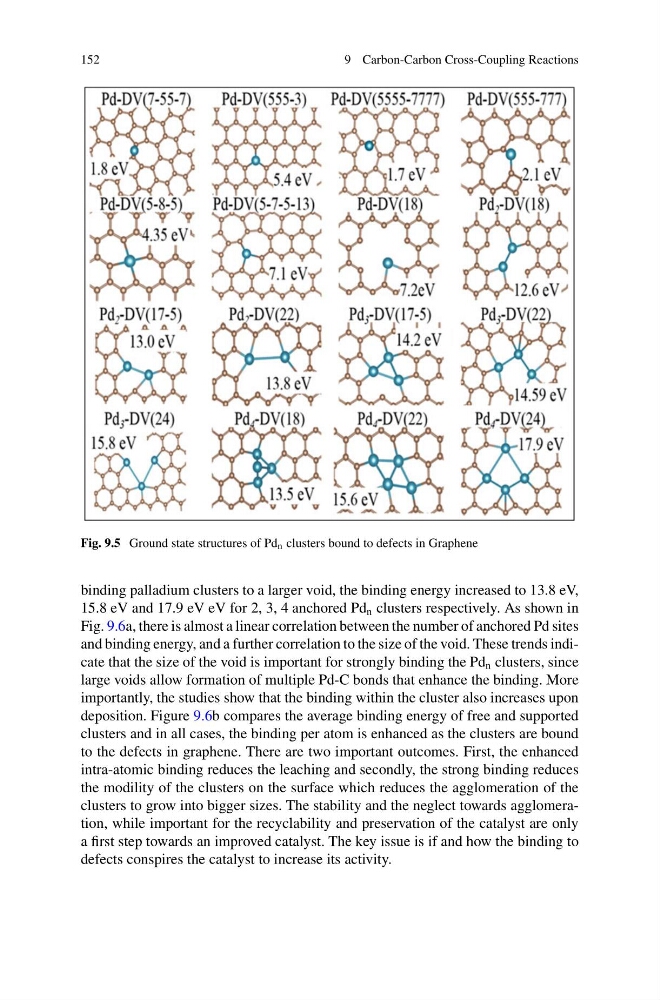
Fig. 9.5 Ground state structures of Pd n clusters bound to defects in Graphene
binding palladium clusters to a larger void, the binding energy increased to 13.8 eV,
15.8 eV and 17.9 eV eV for 2, 3, 4 anchored Pd n clusters respectively. As shown in
Fig. 9.6a, there is almost a linear correlation between the number of anchored Pd sites
and binding energy, and a further correlation to the size of the void. These trends indicate that the size of the void is important for strongly binding the Pd n clusters, since
large voids allow formation of multiple Pd-C bonds that enhance the binding. More
importantly, the studies show that the binding within the cluster also increases upon
deposition. Figure 9.6b compares the average binding energy of free and supported
clusters and in all cases, the binding per atom is enhanced as the clusters are bound
to the defects in graphene. There are two important outcomes. First, the enhanced
intra-atomic binding reduces the leaching and secondly, the strong binding reduces
the modility of the clusters on the surface which reduces the agglomeration of the
clusters to grow into bigger sizes. The stability and the neglect towards agglomeration, while important for the recyclability and preservation of the catalyst are only
a first step towards an improved catalyst. The key issue is if and how the binding to
defects conspires the catalyst to increase its activity.
9 Carbon-Carbon Cross-Coupling Reactions
Fig. 9.5 Ground state structures of Pd n clusters bound to defects in Graphene
binding palladium clusters to a larger void, the binding energy increased to 13.8 eV,
15.8 eV and 17.9 eV eV for 2, 3, 4 anchored Pd n clusters respectively. As shown in
Fig. 9.6a, there is almost a linear correlation between the number of anchored Pd sites
and binding energy, and a further correlation to the size of the void. These trends indicate that the size of the void is important for strongly binding the Pd n clusters, since
large voids allow formation of multiple Pd-C bonds that enhance the binding. More
importantly, the studies show that the binding within the cluster also increases upon
deposition. Figure 9.6b compares the average binding energy of free and supported
clusters and in all cases, the binding per atom is enhanced as the clusters are bound
to the defects in graphene. There are two important outcomes. First, the enhanced
intra-atomic binding reduces the leaching and secondly, the strong binding reduces
the modility of the clusters on the surface which reduces the agglomeration of the
clusters to grow into bigger sizes. The stability and the neglect towards agglomeration, while important for the recyclability and preservation of the catalyst are only
a first step towards an improved catalyst. The key issue is if and how the binding to
defects conspires the catalyst to increase its activity.