

124
8 Energetic Reactions with Hydrocarbons
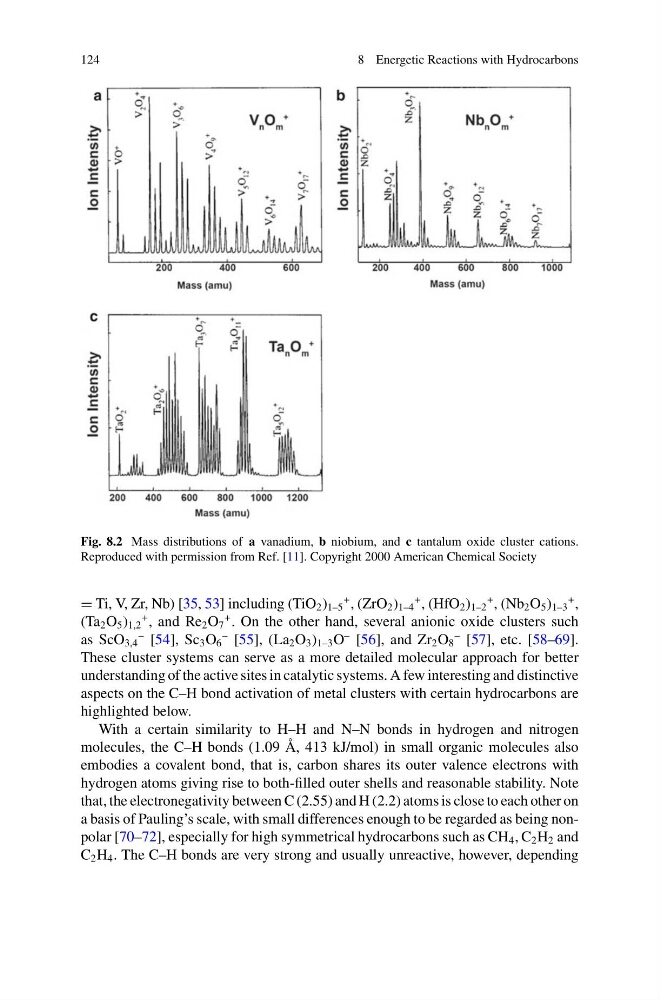
Fig. 8.2 Mass distributions of a vanadium, b niobium, and c tantalum oxide cluster cations.
Reproduced with permission from Ref. [11]. Copyright 2000 American Chemical Society
= Ti, V, Zr, Nb) [35, 53] including (TiO 2 ) 1–5
+ , (ZrO 2 ) 1–4
+ , (HfO 2 ) 1–2
+ , (Nb 2 O 5 ) 1–3
+ ,
(Ta 2 O 5 ) 1,2
+ , and Re 2 O 7
+ . On the other hand, several anionic oxide clusters such
as ScO 3,4
– [54], Sc 3 O 6
– [55], (La 2 O 3 ) 1–3 O
– [56], and Zr 2 O 8
– [57], etc. [58–69].
These cluster systems can serve as a more detailed molecular approach for better
understanding of the active sites in catalytic systems. A few interesting and distinctive
aspects on the C–H bond activation of metal clusters with certain hydrocarbons are
highlighted below.
With a certain similarity to H–H and N–N bonds in hydrogen and nitrogen
molecules, the C–H bonds (1.09 Å, 413 kJ/mol) in small organic molecules also
embodies a covalent bond, that is, carbon shares its outer valence electrons with
hydrogen atoms giving rise to both-filled outer shells and reasonable stability. Note
that, the electronegativity between C (2.55) and H (2.2) atoms is close to each other on
a basis of Pauling’s scale, with small differences enough to be regarded as being nonpolar [70–72], especially for high symmetrical hydrocarbons such as CH 4 , C 2 H 2 and
C 2 H 4 . The C–H bonds are very strong and usually unreactive, however, depending
8 Energetic Reactions with Hydrocarbons
Fig. 8.2 Mass distributions of a vanadium, b niobium, and c tantalum oxide cluster cations.
Reproduced with permission from Ref. [11]. Copyright 2000 American Chemical Society
= Ti, V, Zr, Nb) [35, 53] including (TiO 2 ) 1–5
+ , (ZrO 2 ) 1–4
+ , (HfO 2 ) 1–2
+ , (Nb 2 O 5 ) 1–3
+ ,
(Ta 2 O 5 ) 1,2
+ , and Re 2 O 7
+ . On the other hand, several anionic oxide clusters such
as ScO 3,4
– [54], Sc 3 O 6
– [55], (La 2 O 3 ) 1–3 O
– [56], and Zr 2 O 8
– [57], etc. [58–69].
These cluster systems can serve as a more detailed molecular approach for better
understanding of the active sites in catalytic systems. A few interesting and distinctive
aspects on the C–H bond activation of metal clusters with certain hydrocarbons are
highlighted below.
With a certain similarity to H–H and N–N bonds in hydrogen and nitrogen
molecules, the C–H bonds (1.09 Å, 413 kJ/mol) in small organic molecules also
embodies a covalent bond, that is, carbon shares its outer valence electrons with
hydrogen atoms giving rise to both-filled outer shells and reasonable stability. Note
that, the electronegativity between C (2.55) and H (2.2) atoms is close to each other on
a basis of Pauling’s scale, with small differences enough to be regarded as being nonpolar [70–72], especially for high symmetrical hydrocarbons such as CH 4 , C 2 H 2 and
C 2 H 4 . The C–H bonds are very strong and usually unreactive, however, depending