

8.3 C−H Bond Activation
123
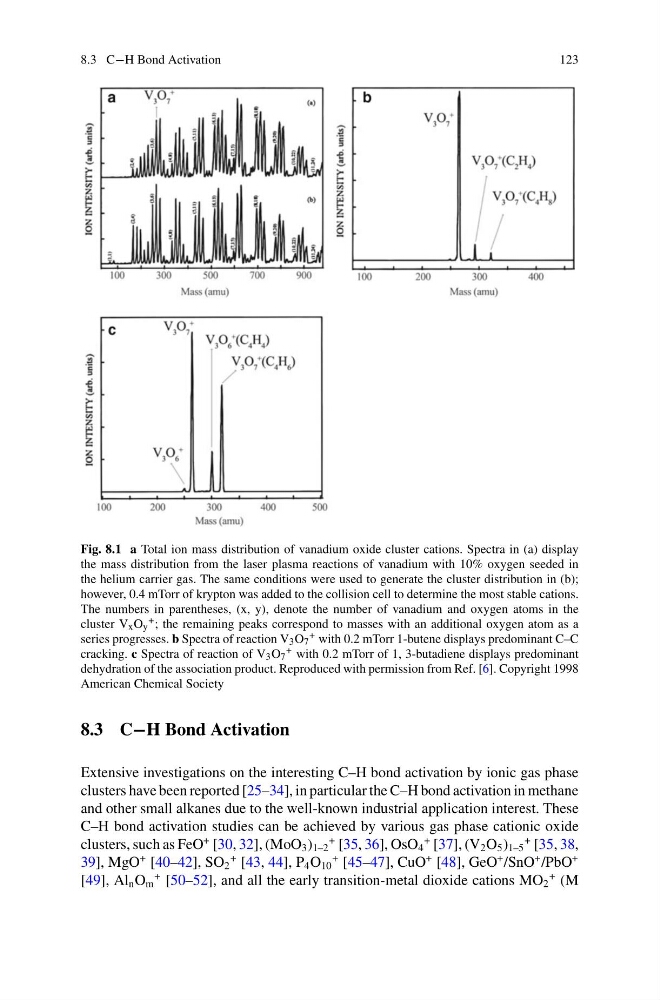
Fig. 8.1 a Total ion mass distribution of vanadium oxide cluster cations. Spectra in (a) display
the mass distribution from the laser plasma reactions of vanadium with 10% oxygen seeded in
the helium carrier gas. The same conditions were used to generate the cluster distribution in (b);
however, 0.4 mTorr of krypton was added to the collision cell to determine the most stable cations.
The numbers in parentheses, (x, y), denote the number of vanadium and oxygen atoms in the
cluster V x O y
+ ; the remaining peaks correspond to masses with an additional oxygen atom as a
series progresses. b Spectra of reaction V 3 O 7
+ with 0.2 mTorr 1-butene displays predominant C–C
cracking. c Spectra of reaction of V 3 O 7
+ with 0.2 mTorr of 1, 3-butadiene displays predominant
dehydration of the association product. Reproduced with permission from Ref. [6]. Copyright 1998
American Chemical Society
8.3 C−H Bond Activation
Extensive investigations on the interesting C–H bond activation by ionic gas phase
clusters have been reported [25–34], in particular the C–H bond activation in methane
and other small alkanes due to the well-known industrial application interest. These
C–H bond activation studies can be achieved by various gas phase cationic oxide
clusters, such as FeO
+ [30, 32], (MoO 3 ) 1–2
+ [35, 36], OsO 4
+ [37], (V 2 O 5 ) 1–5
+ [35, 38,
39], MgO
+ [40–42], SO 2
+ [43, 44], P 4 O 10
+ [45–47], CuO
+ [48], GeO
+ /SnO
+ /PbO
+
[49], Al n O m
+ [50–52], and all the early transition-metal dioxide cations MO 2
+ (M
123
Fig. 8.1 a Total ion mass distribution of vanadium oxide cluster cations. Spectra in (a) display
the mass distribution from the laser plasma reactions of vanadium with 10% oxygen seeded in
the helium carrier gas. The same conditions were used to generate the cluster distribution in (b);
however, 0.4 mTorr of krypton was added to the collision cell to determine the most stable cations.
The numbers in parentheses, (x, y), denote the number of vanadium and oxygen atoms in the
cluster V x O y
+ ; the remaining peaks correspond to masses with an additional oxygen atom as a
series progresses. b Spectra of reaction V 3 O 7
+ with 0.2 mTorr 1-butene displays predominant C–C
cracking. c Spectra of reaction of V 3 O 7
+ with 0.2 mTorr of 1, 3-butadiene displays predominant
dehydration of the association product. Reproduced with permission from Ref. [6]. Copyright 1998
American Chemical Society
8.3 C−H Bond Activation
Extensive investigations on the interesting C–H bond activation by ionic gas phase
clusters have been reported [25–34], in particular the C–H bond activation in methane
and other small alkanes due to the well-known industrial application interest. These
C–H bond activation studies can be achieved by various gas phase cationic oxide
clusters, such as FeO
+ [30, 32], (MoO 3 ) 1–2
+ [35, 36], OsO 4
+ [37], (V 2 O 5 ) 1–5
+ [35, 38,
39], MgO
+ [40–42], SO 2
+ [43, 44], P 4 O 10
+ [45–47], CuO
+ [48], GeO
+ /SnO
+ /PbO
+
[49], Al n O m
+ [50–52], and all the early transition-metal dioxide cations MO 2
+ (M