

7.3 Reactivity of CO with Iron Oxides
105
7.3.2 Cationic Clusters Fe n O m
+ Reacting with CO
As is mentioned above, iron oxide clusters display practical applications in pollution
abatement due to the effective reactivity towards CO, as well as the abundant and
inexpensive iron ore resources [23–35]. Further insights into the reactivity of iron
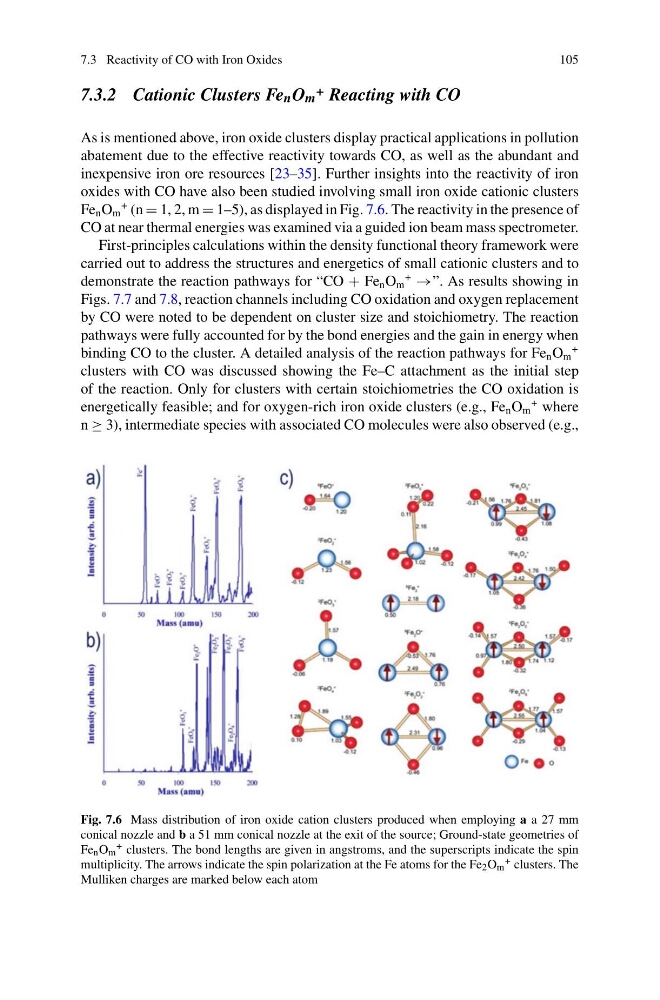
oxides with CO have also been studied involving small iron oxide cationic clusters
Fe n O m
+ (n = 1, 2, m = 1–5), as displayed in Fig. 7.6. The reactivity in the presence of
CO at near thermal energies was examined via a guided ion beam mass spectrometer.
First-principles calculations within the density functional theory framework were
carried out to address the structures and energetics of small cationic clusters and to
demonstrate the reaction pathways for “CO + Fe n O m
+
→”. As results showing in
Figs. 7.7 and 7.8, reaction channels including CO oxidation and oxygen replacement
by CO were noted to be dependent on cluster size and stoichiometry. The reaction
pathways were fully accounted for by the bond energies and the gain in energy when
binding CO to the cluster. A detailed analysis of the reaction pathways for Fe n O m
+
clusters with CO was discussed showing the Fe–C attachment as the initial step
of the reaction. Only for clusters with certain stoichiometries the CO oxidation is
energetically feasible; and for oxygen-rich iron oxide clusters (e.g., Fe n O m
+ where
n ≥ 3), intermediate species with associated CO molecules were also observed (e.g.,
Fig. 7.6 Mass distribution of iron oxide cation clusters produced when employing a a 27 mm
conical nozzle and b a 51 mm conical nozzle at the exit of the source; Ground-state geometries of
Fe n O m
+ clusters. The bond lengths are given in angstroms, and the superscripts indicate the spin
multiplicity. The arrows indicate the spin polarization at the Fe atoms for the Fe 2 O m
+ clusters. The
Mulliken charges are marked below each atom
105
7.3.2 Cationic Clusters Fe n O m
+ Reacting with CO
As is mentioned above, iron oxide clusters display practical applications in pollution
abatement due to the effective reactivity towards CO, as well as the abundant and
inexpensive iron ore resources [23–35]. Further insights into the reactivity of iron
oxides with CO have also been studied involving small iron oxide cationic clusters
Fe n O m
+ (n = 1, 2, m = 1–5), as displayed in Fig. 7.6. The reactivity in the presence of
CO at near thermal energies was examined via a guided ion beam mass spectrometer.
First-principles calculations within the density functional theory framework were
carried out to address the structures and energetics of small cationic clusters and to
demonstrate the reaction pathways for “CO + Fe n O m
+
→”. As results showing in
Figs. 7.7 and 7.8, reaction channels including CO oxidation and oxygen replacement
by CO were noted to be dependent on cluster size and stoichiometry. The reaction
pathways were fully accounted for by the bond energies and the gain in energy when
binding CO to the cluster. A detailed analysis of the reaction pathways for Fe n O m
+
clusters with CO was discussed showing the Fe–C attachment as the initial step
of the reaction. Only for clusters with certain stoichiometries the CO oxidation is
energetically feasible; and for oxygen-rich iron oxide clusters (e.g., Fe n O m
+ where
n ≥ 3), intermediate species with associated CO molecules were also observed (e.g.,
Fig. 7.6 Mass distribution of iron oxide cation clusters produced when employing a a 27 mm
conical nozzle and b a 51 mm conical nozzle at the exit of the source; Ground-state geometries of
Fe n O m
+ clusters. The bond lengths are given in angstroms, and the superscripts indicate the spin
multiplicity. The arrows indicate the spin polarization at the Fe atoms for the Fe 2 O m
+ clusters. The
Mulliken charges are marked below each atom